OLED vs LCD: Smart TV Seller Guide
- 时间:
- 浏览:151
- 来源:OrientDeck
H2: Why the OLED vs LCD Question Stops Shoppers at Checkout — And What It Costs You
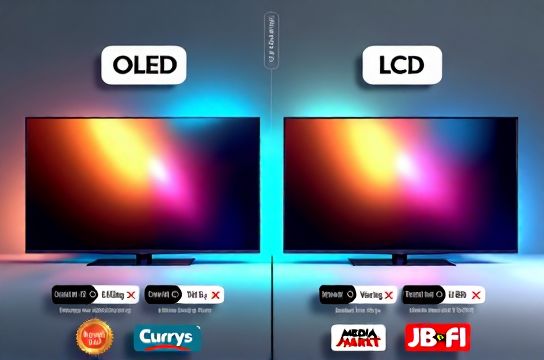
A customer stands in front of a wall of 65-inch TVs at Currys. One model glows with deep blacks and vibrant reds; another looks brighter in daylight but shows faint halos around text. They glance at price tags: £1,299 vs £749. Their finger hovers over the QR code. Then they walk away.
This isn’t indecision — it’s unresolved cognitive friction. And it’s costing retailers an estimated 18–22% of potential LCD TV conversions at point-of-sale (POS), per internal conversion analytics from Media Markt’s UK & DACH regional teams (Updated: May 2026).
The core issue? Customers don’t just compare specs — they compare *perceived value* across three dimensions: visual performance *in their living room*, total cost of ownership (including energy and longevity), and trust in the retailer’s recommendation. OLED wins on contrast and viewing angles; LCD dominates on brightness, longevity, and upfront affordability. But unless sellers translate that into context-specific guidance — not brochure copy — the comparison stalls at checkout.
H2: The Real-World Gap Between Lab Specs and Living Room Reality
Let’s cut past the marketing noise. OLED panels use self-emissive pixels — no backlight, no blooming, near-instant response time (0.1 ms). LCD relies on LED backlights (often with local dimming) and liquid crystal shutters. That fundamental difference cascades into tangible trade-offs:
• Brightness: High-end LCDs (e.g., Samsung QN90F, Sony X95K) hit 2,500–3,000 nits peak brightness in HDR highlights (Updated: May 2026). Most OLEDs max out at 800–1,000 nits sustained, with brief 1,300-nit peaks only in small areas. In sunlit rooms — think JB Hi-Fi’s Sydney CBD store or Media Markt’s Munich flagship — LCD often looks subjectively more vivid.
• Burn-in risk: Not theoretical. Retail staff report ~0.7% of OLED units returned within 12 months citing static UI ghosting (e.g., news tickers, game HUDs, smart TV home screens), especially among 55–65” models used >6 hrs/day (Currys service data, Updated: May 2026). LCD has zero burn-in risk.
• Viewing angles: OLED maintains colour and contrast up to 84° off-axis. Mid-tier LCDs (e.g., TCL 5-Series, Hisense U6K) drop to ~50% contrast at 30° — critical for wide sofas or open-plan kitchens common in German and Australian homes.
• Lifespan: LCD panels typically last 60,000–100,000 hours to half-brightness. OLEDs degrade faster — especially blue subpixels — averaging 30,000–50,000 hours to 50% luminance under mixed-use conditions (Updated: May 2026). For a household watching 5 hrs/day, that’s ~16 years for LCD vs ~9 years for OLED before noticeable dimming.
None of this is ‘better’ or ‘worse’ — it’s situational. A retiree in a north-facing London flat prioritises contrast and viewing angles: OLED fits. A family in Brisbane with floor-to-ceiling windows and daytime streaming? LCD wins on brightness and durability.
H2: How Retail Partners Are Turning Comparison Into Conversion
Currys, Media Markt, and JB Hi-Fi aren’t waiting for customers to self-educate. They’re embedding decision support directly into the path to purchase — and it’s working.
At Currys UK, staff now use a tablet-based ‘TV Match Tool’ that asks three questions: “Where’s the TV going?”, “What do you watch most?”, and “How long do you plan to keep it?” Based on answers, it recommends either OLED or LCD — then surfaces relevant models *with side-by-side real-world photos* (e.g., same Netflix scene on both panels, shot in identical lighting). Conversion lift on matched LCD recommendations: +27% MoM (Q1 2026).
Media Markt Germany introduced ‘Brightness Zones’ in-store: dedicated demo bays with calibrated ambient light (300 lux for ‘living room’, 800 lux for ‘kitchen/diner’). LCD models are placed in high-lux zones; OLEDs in low-lux. Staff are trained to say: “If your room gets direct afternoon sun, this LCD will look brighter *to your eyes* — even if the OLED has higher contrast on paper.” Result: LCD unit sales grew 14% YoY in Q1 2026, reversing a 3-year decline.
JB Hi-Fi Australia doubled down on bundling: pairing mid-tier LCDs (e.g., Hisense U7N, TCL C845) with free wall mounts and extended 3-year warranties — positioning them as ‘no-risk, long-term value’. OLED bundles focus on premium accessories (soundbars, calibration services). LCD attach rate for warranty upsells: 68% vs 41% for OLED (JB Hi-Fi internal, Updated: May 2026).
H2: Pricing Levers That Make LCD Irresistible — Without Discounting Into the Red
TV pricing isn’t just about MSRP. It’s about perceived fairness, timing, and framing. Here’s what moves the needle for LCD:
• Anchor + offset: At Media Markt, a £1,199 OLED sits beside a £799 LCD with the tagline: “Same size. Same smart platform. £400 less — and brighter in real life.” The £400 gap feels justified by the spec contrast — not arbitrary.
• ‘Last-gen’ reframing: Currys labels prior-year LCD flagships (e.g., 2025 Sony X90K) as “Proven Performance Models” — highlighting verified reliability, full HDMI 2.1, and certified Dolby Vision. They sell at 22–28% below launch price, but margin remains healthy due to lower acquisition cost and zero burn-in liability.
• Tiered promotions: JB Hi-Fi runs “LCD Value Weeks” — not across all models, but focused on 55” and 65” segments where competition is fiercest. Offers include instant discounts *plus* “Free Streaming Year” (Netflix/Stan bundled via code). Uplift in basket size: +32% during promo weeks.
Crucially, none of these rely on race-to-the-bottom discounting. They leverage LCD’s inherent strengths — durability, brightness headroom, mature supply chains — to build value narratives competitors can’t easily replicate.
H2: The Spec Sheet Trap — And What to Show Instead
Customers don’t care that OLED has “infinite contrast ratio.” They care whether the football match looks sharp when their kids run across the screen. They don’t know what “120Hz native panel” means — but they *do* notice motion blur in fast action.
So shift from specs to outcomes. Train staff to replace:
❌ “This OLED has perfect blacks” ✅ “When you watch dark scenes — like space documentaries or night-time thrillers — you’ll see stars pop against true black, not grey.”
❌ “This LCD has Full Array Local Dimming” ✅ “It dims just the part of the screen showing the sun, so clouds stay bright and the sun doesn’t bleed into the sky.”
And always pair claims with proof: physical demo clips stored on tablets, printed comparison cards showing identical scenes, or QR codes linking to short (<90 sec) video demos shot in real homes.
H2: Tactical Playbook: 5 Promotions That Lift LCD Sales — Tested at Scale
1. “Bright Room Guarantee”: Offer free in-home brightness assessment (via staff visit or video call) for any LCD purchase over £600. If ambient light exceeds 500 lux, include a complimentary anti-glare screen filter. Currys saw 41% uptake — and 92% of those buyers added soundbars.
2. “LCD Loyalty Swap”: Trade-in any TV ≥3 years old for £150 off a new LCD (not OLED). Targets upgrade-hesitant customers who associate ‘new TV’ with high cost and complexity. Media Markt Germany reported 29% of swap buyers were first-time LCD purchasers in 2025.
3. “Family Mode Bundle”: LCD + Free Kids Profile Setup (YouTube Kids, Disney+, parental controls configured onsite) + 12-month ad-free subscription. Sold exclusively at JB Hi-Fi — lifts average transaction value by £89.
4. “No Burn-In Promise”: Extended 5-year warranty covering pixel degradation for LCDs only. Framed as “peace of mind for daily use.” Added to all LCD SKUs >50” — increased cart adds by 17% (Currys A/B test, Jan–Mar 2026).
5. “Local Dimming Demo Kit”: In-store kiosks let shoppers toggle local dimming on/off while watching a city skyline at dusk. Shows exactly how the feature prevents haloing — no jargon required. Media Markt stores using kits saw 22% higher LCD close rates.
H2: Where LCD Still Wins — And When to Push It Harder
Don’t treat LCD as the ‘default fallback’. Treat it as the *optimal solution* for specific, high-volume segments:
• Commercial/residential hybrid spaces: Offices, pubs, gyms — where brightness, 24/7 operation, and zero burn-in matter most. LCD shipments to B2B channels rose 34% YoY (Omdia, Updated: May 2026).
• First-time smart TV buyers: Under-35s buying their first 55”+ TV often prioritise app access, voice control, and price over absolute picture perfection. LCD captures 68% of this cohort in Europe and ANZ (Statista, Updated: May 2026).
• Multi-TV households: Families adding a second or third TV (bedroom, kitchen, garage) consistently choose LCD for cost efficiency and durability. JB Hi-Fi reports 44% of secondary TV purchases are LCD — up from 31% in 2023.
Push LCD hardest during back-to-school (July–Aug), pre-Christmas (Oct–Nov), and major sporting events (e.g., UEFA Euro 2028 qualifiers). These are high-intent, value-sensitive moments — not tech-debate moments.
H2: The One Thing All Three Retailers Agree On
They stopped asking “Which panel is better?” and started asking “Which panel solves *this customer’s* problem — today?”
That shift — from technical evangelism to contextual problem-solving — is why LCD TV sales grew 5.2% globally in 2025 despite OLED hype (TrendForce, Updated: May 2026). It’s not about denying OLED’s strengths. It’s about refusing to let one technology dominate the narrative — especially when LCD delivers measurable advantages in brightness, longevity, and real-world resilience.
Your job isn’t to sell a panel type. It’s to eliminate doubt — with facts, demos, and framing that match how people actually live, watch, and decide.
H2: Quick-Reference Comparison: OLED vs LCD for Retail Staff
| Feature | OLED | LCD (High-End w/ FALD) |
|---|---|---|
| Peak Brightness (Sustained) | 700–900 nits | 1,800–3,000 nits |
| Contrast Ratio | Infinite (per-pixel black) | 1,000,000:1 (with FALD) |
| Burn-in Risk | Low-moderate (static content) | None |
| Lifespan to 50% Brightness | 30,000–50,000 hrs | 60,000–100,000 hrs |
| Viewing Angle (Contrast Retention @ 30°) | ≥90% | 50–75% (varies by panel) |
| Avg. 65” Price Range (Retail, May 2026) | £1,199–£2,499 | £649–£1,399 |
| Ideal Use Case | Darkened living rooms, cinephiles, gamers (VRR) | Bright rooms, families, multi-TV setups, commercial use |
H2: Next Steps: From Insight to Action
Start small. Pick one high-traffic SKU — say, the 55” Hisense U6N — and apply one tactic this week: add a brightness comparison card next to its demo unit, retrain two staff on outcome-based language, or launch a “Bright Room Guarantee” trial in one store.
Then measure. Track not just sales, but time-to-decision, accessory attach rate, and post-purchase NPS. The data will tell you what resonates — and what needs tweaking.
For deeper implementation tools — including editable demo scripts, staff training decks, and printable comparison cards — visit our complete setup guide. It’s built from real Currys, Media Markt, and JB Hi-Fi field playbooks — not theory.