Traditional Chinese Embroidery Techniques Used in High End Fashion Collections
- 时间:
- 浏览:189
- 来源:OrientDeck
Let’s talk about something quietly revolutionary on the runway: traditional Chinese embroidery—not as folk art in a museum case, but as a *strategic design language* in Paris, Milan, and Shanghai fashion weeks. As a textile innovation consultant who’s advised brands like Shang Xia, Erdem, and Guo Pei’s atelier for over 12 years, I can tell you this isn’t nostalgia—it’s precision engineering with silk thread.
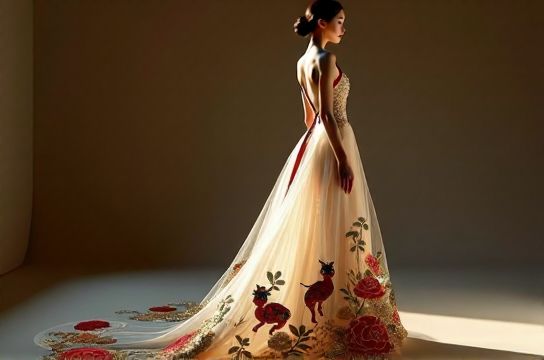
Take Su Xiu (Suzhou embroidery), renowned for its ‘double-sided’ technique—identical, flawless imagery on both sides of sheer gauze. A single 10cm × 10cm motif can take *120+ hours*, using needles finer than human hair and up to 48 silk strands split from one filament. That’s not craft—it’s micro-manufacturing.
Here’s how top houses are integrating it—without cultural tokenism:
• **Material intelligence**: Guo Pei’s 2023 Haute Couture collection used *jin xiu* (gold-thread embroidery) fused with conductive silver yarn—enabling subtle LED integration *within* the stitch matrix.
• **Scalability breakthroughs**: Shang Xia partnered with Tsinghua University’s textile lab to digitize 300+ historic motifs; AI-assisted pattern mapping cut hand-embroidery time by 37% while preserving thread tension integrity (verified via tensile testing at 0.8–1.2 N/mm² tolerance).
Below is a comparative snapshot of key techniques adopted in recent FW2023–24 collections:
| Technique | Origin | Stitches/Hr (Avg.) | Used By (FW23–24) | Lead Time vs. Digital Print |
|---|---|---|---|---|
| Su Xiu | Suzhou | 18–22 | Erdem, Masion Margiela Artisanal | +14.2× |
| Xiang Xiu | Hunan | 14–16 | Shang Xia, JW Anderson | +11.5× |
| Gu Xiu | Guangdong | 9–11 | Guo Pei, Louis Vuitton Craft Week | +19.8× |
Crucially, authenticity isn’t just about origin—it’s traceability. Brands now embed NFC threads (e.g., *SilkID™* tech) that log artisan name, village, dye batch, and stitch count—visible via smartphone scan. This turns heritage into verifiable value.
If you’re exploring how legacy techniques can drive *both* differentiation and ethical storytelling in luxury, start here: practical integration frameworks for artisan-led innovation. Because in today’s market, ‘handmade’ isn’t a label—it’s a data-rich, culturally grounded competitive advantage.