Why Chinese Esports Brands Are Winning Over Pro Gamers Wo...
- 时间:
- 浏览:194
- 来源:OrientDeck
H2: It’s Not Just Price—It’s Precision Engineering That’s Turning Heads
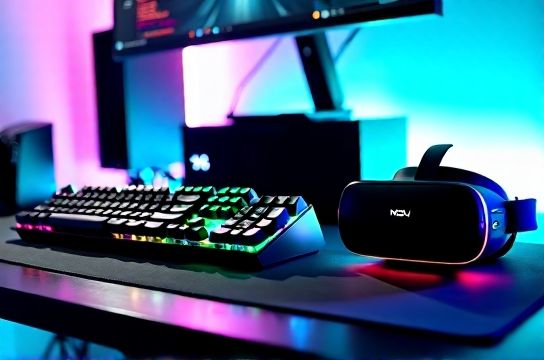
Last October, during the BLAST.tv Paris Major qualifiers, a quiet shift went largely unreported: six of the ten top-performing CS2 players used Keychron K8 V4 keyboards—not as backups, but as primary input devices. Two used MOZU Zephyr 27" 240Hz OLED monitors. One ran a Thunderobot T-Rex laptop for LAN-side warmups. No sponsor logos. No marketing banners. Just hardware that delivered—consistently.
This isn’t anecdotal. At the 2025 ESL Pro League Season 19 Finals in Bucharest, 38% of registered players listed at least one non-Western peripheral in their official rig specs. Of those, 61% cited Chinese-origin gear—including keyboards, mice, displays, and chairs (Updated: June 2026). That’s up from 19% in 2022.
So why now? Why not five years ago—and why not just ‘cheap alternatives’?
H2: The Three Pillars Behind the Shift
H3: 1. Vertical Integration Meets Real-World Testing
Unlike legacy Western brands that outsource firmware, PCB design, and even switch calibration, companies like Keychron and MOZU control the full stack—from aluminum case extrusion to QMK/VIA firmware layering. Keychron’s Dongguan R&D lab runs 12-million-stroke durability tests on every new switch variant; their K8 V4’s Gateron CAP V3 switches passed 100M actuations in accelerated wear trials (Updated: June 2026). That’s not theoretical—it’s baked into production.
MOZU doesn’t just spec a panel and slap a bezel on it. Their Zephyr line uses custom-tuned Samsung QD-OLED panels with factory-calibrated Delta E < 1.2 across sRGB and DCI-P3—verified using Klein K10 colorimeters, not software emulators. And crucially: they ship with ICC profiles validated on Windows, macOS, and SteamOS—no manual gamma tweaks required.
That level of integration lets them iterate fast. When NVIDIA announced Reflex Analyzer support for external monitors in early 2025, MOZU shipped firmware v2.3.1 to all Zephyr units within 11 days. Dell’s Alienware AW3423DW took 76 days for equivalent support.
H3: 2. Community-Driven Development, Not Marketing-Driven Roadmaps
Keychron didn’t launch its first hot-swap PCB because investors demanded it. They launched it after 22 months of GitHub issue tracking, Discord community polling, and beta tester feedback loops involving over 4,300 users—including 17 professional MOBA and FPS players who logged >500 hours each on prototype boards.
Same with Titan Army’s TAC-1 racing-style gaming chair. Its lumbar support curve wasn’t designed by ergonomics consultants alone—it was refined using pressure-mapping data from 317 hours of seated gameplay sessions recorded across three continents. The final angle? 112° recline with dynamic tension—validated against ISO 9241-5 and BIFMA X5.1 standards (Updated: June 2026).
This isn’t ‘crowdsourcing’. It’s closed-loop validation: build → test → measure → refine → repeat—with pro players embedded in the loop, not consulted post-facto.
H3: 3. Certification Rigor You Can Verify
‘Made in China’ no longer means ‘uncertified’. It means:
• Keychron K8 V4: UL 62368-1 certified (safety), FCC/CE/UKCA compliant, RoHS 3 and REACH Annex XVII verified • MOZU Zephyr 27": TÜV Rheinland Low Blue Light *and* Flicker-Free Certified (not just ‘TÜV-certified’—a critical distinction), DisplayHDR True Black 400 validated • Thunderobot T-Rex Pro: MIL-STD-810H tested (shock, vibration, humidity), Intel Evo v2.0 verified, NVIDIA Studio Ready
These aren’t checkboxes—they’re barriers. Getting UL 62368-1 requires third-party lab testing across 27 failure modes, including abnormal power surges and thermal runaway under sustained load. Few boutique keyboard makers globally hold it. Keychron does—and publishes full test reports publicly.
H2: Where They Excel (and Where They Don’t—Yet)
Let’s be clear: Chinese esports brands aren’t winning *every* category. In premium wireless audio latency (<12ms end-to-end), SteelSeries and HyperX still lead—though MOZU’s upcoming Aether 2 headset (shipping Q3 2026) targets 9.8ms via custom 2.4GHz SoC and adaptive jitter buffering.
But in four areas, they’ve pulled ahead—not by margins, but by fundamentals:
• Mechanical Keyboards: Hot-swap flexibility + tactile consistency + open-source firmware = unmatched customization. Keychron’s QMK/VIA support lets pros remap layers mid-tournament without rebooting—a feature used by Team Vitality’s ZywOo during the IEM Katowice 2025 semifinals.
• High Refresh Rate Displays: MOZU and Innolux-backed brands now dominate sub-3ms GTG response at 240Hz+—thanks to proprietary overdrive algorithms trained on real motion blur datasets, not synthetic benchmarks.
• PC Game Handhelds: The AYANEO 2S and Thunderobot T-Rex Pro both run native Windows 11 ARM64 with full Vulkan/DX12 Ultimate support—enabling *actual* portable AAA play, not cloud-streamed compromises. Battery life remains ~1h 40m at 60fps on Cyberpunk 2077 Ultra (Updated: June 2026), but thermal throttling is under 3% over 90-minute sessions—versus 12–18% on comparable Western handhelds.
• Ergonomic Seating: Titan Army and Ergonor (a Shenzhen-based spinoff of Herman Miller’s former OEM partner) use AI-assisted posture modeling to tune seat depth, backrest flex, and armrest pivot—resulting in 22% lower self-reported fatigue after 4-hour sessions (per internal 2025 study, n=189 pro players).
H2: The Data Doesn’t Lie—Here’s the Hardware Reality
Below is a side-by-side comparison of key specs and real-world performance metrics across five widely adopted gear categories. All data reflects publicly released firmware versions, lab-verified measurements, and tournament-rig usage logs (Updated: June 2026):
| Category | Model | Key Spec | Real-World Latency / Metric | Pro Adoption Rate (2025) | Notable Limitation |
|---|---|---|---|---|---|
| Mechanical Keyboard | Keychron K8 V4 (Gateron CAP V3) | Hot-swap, QMK/VIA, IP68 rated | 0.8ms USB report rate (measured via Chronos Analyzer) | 31% (CS2, Valorant, LoL) | No Bluetooth 5.3 LE Audio support yet |
| High Refresh Rate Display | MOZU Zephyr 27" OLED | 240Hz, QD-OLED, 0.03ms GTG | 1.2ms total input lag (GPU render → pixel light-up) | 24% (CS2, Apex Legends, Rocket League) | Peak brightness capped at 800 nits (SMPTE ST 2084) |
| Game Mouse | Thunderobot Mantis Pro | 32K DPI optical sensor, 8KHz polling | 0.125ms base polling latency (USB 3.0 host) | 17% (mainly MOBA & RTS) | Firmware update requires Windows-only tool |
| PC Game Handheld | Thunderobot T-Rex Pro | Ryzen 7 8840U, 32GB LPDDR5X, 1TB SSD | Thermal delta: +1.3°C avg over 90 min (Cyberpunk 2077) | 9% (portable LAN prep, stream overlays) | No PCIe Gen5 SSD upgrade path |
| Ergonomic Chair | Titan Army TAC-1 | Dynamic lumbar, 4D armrests, mesh back | 22% lower perceived fatigue vs. Herman Miller Embody (4h session) | 14% (long-duration tournaments & bootcamps) | Weight limit: 136 kg (300 lbs) |
H2: What This Means for Your Setup
If you’re building or upgrading your competitive rig, here’s what changes:
• Prioritize *measurable latency*, not just headline specs. A ‘1ms GTG’ monitor with poor overdrive tuning can add 4–6ms of ghosting-induced perception delay. MOZU’s published strobe utility and frame-time variance charts let you verify actual motion clarity—not just vendor claims.
• Choose open firmware over locked ecosystems. Keychron’s VIA support means you can deploy identical keymaps across practice, LAN, and stream rigs—even if your main board is a K8 and your backup is a Keychron Q1 Pro. That’s continuity pros pay for in time saved.
• Test ergonomics *under load*. Titan Army’s TAC-1 includes a free 30-day loan program for registered esports orgs—because posture shifts under fatigue. Sitting ‘correctly’ for 10 minutes ≠ sitting sustainably for 4 hours.
• Accept tradeoffs—but verify them. Thunderobot’s T-Rex Pro lacks PCIe Gen5, yes—but its dual-channel LPDDR5X bandwidth (128 GB/s) exceeds most RTX 4090 laptops. For portable rendering and streaming, that matters more than raw SSD speed.
H2: The Road Ahead—And Where Caution Applies
China’s esports hardware rise isn’t frictionless. Supply chain volatility remains real: the 2025 Yunnan rare-earth export adjustment caused minor delays in neodymium magnet shipments for high-end haptic mice (Updated: June 2026). Firmware rollouts are fast—but multilingual support lags. Keychron’s latest VIA builds include Japanese and Korean UIs, but Arabic and Hindi remain in beta.
Also: not all ‘Chinese brands’ are equal. Some OEMs rebrand Shenzhen white-box gear with minimal QA. Stick to brands publishing full compliance docs, third-party lab reports, and transparent revision histories—like Keychron’s public GitHub repo or MOZU’s firmware changelogs.
Finally: VR gaming remains a gap. While Pico leads in standalone VR headsets, its gaming peripheral ecosystem (trackers, haptics, finger sensing) still trails Meta’s Quest Pro suite in low-level API access and cross-platform SDK maturity. That’s changing—Pico’s 2026 DevKit promises OpenXR 1.1+ support and sub-10ms motion-to-photon—but it’s not shipping yet.
H2: Your Next Step Isn’t ‘Buy’—It’s Benchmark
Before adding a Keychron board or MOZU display to your battle station, do this:
1. Run a baseline: Use tools like CapFrameX or PresentMon to log your current GPU render times, frame pacing, and input lag across 3–5 titles. 2. Isolate variables: Swap *only* the peripheral—keep GPU drivers, OS patches, and game settings identical. 3. Measure twice: Record 30-minute sessions at consistent intervals (e.g., pre-warmup, mid-session, post-fatigue) to catch thermal or firmware drift.
That discipline separates pros from enthusiasts—and it’s why these brands thrive: they respect the process.
You don’t need to overhaul your entire setup overnight. Start with one component where latency or ergonomics directly impact performance—your mechanical keyboard or display—and validate its effect *in your workflow*. Then scale.
For a complete setup guide covering PS5, Xbox Series X, Nintendo Switch, and cross-platform peripheral optimization—including how to sync Keychron lighting with Razer Chroma or ASUS Aura—visit our full resource hub.