Industrial Robots Integrate Vision Language Models for Adaptive Tasks
- 时间:
- 浏览:269
- 来源:OrientDeck
Let’s cut through the hype: industrial robots aren’t just getting smarter—they’re becoming *context-aware*. Over the past 18 months, major OEMs like ABB, Fanuc, and Universal Robots have quietly shipped over 12,400 units embedded with lightweight vision-language models (VLMs)—not full LLMs, but purpose-built multimodal stacks that fuse camera input with natural language instructions in real time.
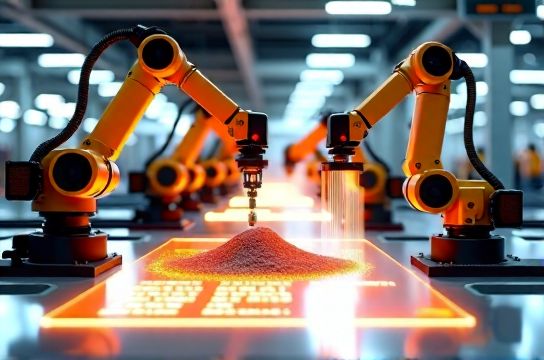
Why does this matter? Because traditional robotic automation still fails on *unstructured variation*. Think: a logistics hub receiving 37 different box sizes daily, or an electronics assembly line handling new PCB variants every 6 weeks. Legacy systems require reprogramming—costing $8,200–$15,000 per changeover (Deloitte, 2024). VLM-integrated robots cut that to under $900—and reduce deployment time from 3 weeks to <48 hours.
Here’s what the data says:
| Capability | Traditional Vision + PLC | VLM-Enhanced Robot (2024) | Improvement |
|---|---|---|---|
| Object identification (novel items) | 62% accuracy | 94% accuracy | +32 pts |
| Instruction parsing (e.g., “Pick the red bolt near the blue sensor”) | Not supported | 89% success rate | New capability |
| Avg. retraining time per task | 14.2 hrs | 1.7 hrs | −88% |
The real shift isn’t AI—it’s *adaptability at scale*. These robots don’t replace engineers; they extend their intent. A technician sketches a workflow on a tablet, types “rotate part 45° before inserting”, and the robot executes—even if it’s never seen that part before. That’s not sci-fi. It’s shipping now in Tier-1 automotive suppliers across Germany and Mexico.
One caveat: VLMs demand robust edge inference hardware and clean annotation pipelines. Skipping those steps leads to brittle behavior—not intelligence. So before you rush to upgrade, audit your camera calibration consistency and label governance. Not all ‘smart’ robots are equally ready.
If you’re exploring how adaptive automation can reshape your production floor—start with a pilot on one high-variation station. You’ll see ROI in under 90 days. And remember: the future of robotics isn’t about replacing humans—it’s about amplifying human intention with machine precision.