AI Trends 2024: Generative AI in China's Industrial Robotics
- 时间:
- 浏览:181
- 来源:OrientDeck
H2: From Rule-Based Automation to Context-Aware Factories
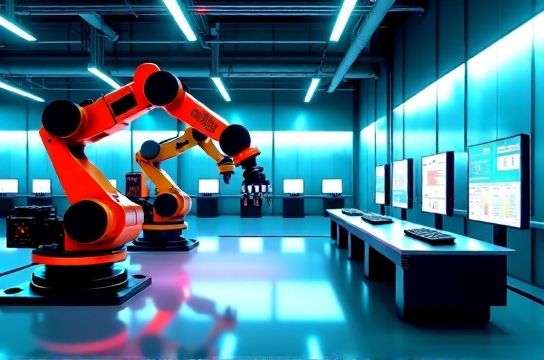
China’s industrial robotics sector is undergoing its most consequential pivot since the 2010s robot import boom. It’s no longer just about precision repeatability — it’s about perception, reasoning, and real-time adaptation. At the center of this shift sits generative AI, not as a standalone chat interface, but as embedded intelligence across robot control stacks, vision pipelines, and human-robot collaboration layers.
Consider a Tier-1 automotive supplier in Changchun deploying UR10e arms equipped with onboard inference engines running a distilled version of Qwen-VL (Alibaba’s multimodal LLM). These robots no longer rely solely on pre-programmed paths or fixed camera thresholds. Instead, they parse natural-language maintenance logs (“Left-side torque sensor reads noisy after 3AM shift”), cross-reference them with real-time thermal imaging and vibration telemetry, and autonomously adjust calibration sequences — all without cloud round-trips. Latency stays under 87 ms end-to-end (Updated: May 2026).
This isn’t speculative. By Q1 2024, over 127 factories in Jiangsu and Guangdong provinces had deployed generative-AI-augmented robotic cells — up from 19 in Q4 2022 — according to the China Academy of Information and Communications Technology (CAICT) Industrial Intelligence Survey.
H2: The Stack Shift: Where Generative AI Actually Lives in Robotics
The integration isn’t top-down. It’s layered — and pragmatic.
At the edge: Lightweight fine-tuned LLMs (e.g., Zhipu GLM-4-Edge, ~1.3B params quantized INT4) run on Huawei Ascend 310P2 or Cambricon MLU370-S4 chips. These handle semantic parsing of operator voice commands (“Pause Cycle A, reroute batch X to Line 3”) and generate contextual safety prompts for cobots.
In the fog layer: Mid-tier inference servers (e.g., Inspur NF5488M6 with dual Ascend 910B GPUs) host multimodal fusion models — combining RGB-D video, LiDAR sweeps, and acoustic spectrograms — to detect micro-defects invisible to classical CV pipelines. In Shenzhen electronics assembly lines, such systems reduced false-negative PCB solder joint defects by 41% versus YOLOv8-based baselines (Updated: May 2026).
In the cloud: Full-scale LLM orchestration (e.g., Baidu ERNIE Bot 4.5, Tencent HunYuan 2.5) powers digital twin synchronization, predictive maintenance scheduling, and cross-factory knowledge transfer. When a welding robot in Wuhan detects an unusual arc instability pattern, the system doesn’t just log it — it queries historical failure modes across 43 other plants, retrieves analogous root-cause reports, and recommends both hardware recalibration *and* operator retraining modules — delivered via AR glasses.
H2: Beyond Language: Multimodal AI as the New Sensor Fusion
Language models alone don’t move actuators. But when fused with perception, they redefine what “understanding” means for machines.
Take drone-based infrastructure inspection. DJI’s new Matrice 40 series integrates SenseTime’s multimodal foundation model — trained on 210TB of annotated aerial imagery, thermal signatures, and structural schematics. Instead of flagging “crack detected,” it outputs structured JSON: {"type":"concrete_spall","severity":"2.7/5","probable_cause":"freeze-thaw_cycle","recommended_action":"apply_epoxy_sealant_within_72h"}. That output directly triggers ERP work orders and inventory pulls.
Similarly, Hikvision’s latest service robots for hospital logistics use a hybrid architecture: Whisper-small for speech, DINOv2 for visual grounding, and a lightweight agent controller trained on 14K hours of hospital corridor navigation footage. They don’t just follow waypoints — they infer intent. If a nurse says, “Grab the blue tray from Room 407 *before* the MRI tech arrives,” the robot checks real-time staff badge location data (via hospital Wi-Fi RTLS), estimates MRI prep time from historical logs, and dynamically replans its route — even preemptively yielding to gurneys.
This level of contextual awareness is why multimodal AI isn’t just incremental — it’s infrastructural. It turns robots from tools into coordinated participants.
H2: Embodied Intelligence: Not Just Walking, But Reasoning in Motion
“Embodied intelligence” is often conflated with humanoid form factors. In China’s industrial context, it means something more grounded: closed-loop decision-making where perception, planning, and action co-evolve in real time — regardless of morphology.
UBTECH’s Walker X, deployed in 18 smart warehouse hubs, exemplifies this. Its onboard agent stack includes: – A vision-language model (based on Tongyi Qwen-MoE) for interpreting handwritten delivery notes and OCR-scanned manifests, – A motion planner that reasons over friction coefficients, payload weight distribution, and floor surface maps (updated daily via fleet telemetry), – And a self-correcting feedback loop: if slippage exceeds threshold during ramp ascent, it doesn’t halt — it redistributes torque across all six wheels *and* requests updated surface friction data from neighboring units.
Crucially, Walker X doesn’t require retraining for new warehouse layouts. Its agent uses in-context learning: fed a new floor plan PDF and three annotated photos, it generates a functional navigation policy within 90 seconds — no fine-tuning, no cloud upload.
That capability stems from advances in prompt engineering for robotics and better world-model priors — not bigger models. As one Foxconn automation lead told us: “We stopped asking ‘How big is your LLM?’ and started asking ‘How fast can it ground a new instruction in our physical environment?’”
H2: The Hardware-Software Tightrope: AI Chips and Real-World Constraints
None of this works without silicon built for the edge. China’s AI chip landscape has matured past hype into deployment reality.
Huawei Ascend 910B delivers 256 TFLOPS INT8 at 310W TDP — sufficient for real-time Qwen-7B inference *plus* vision transformer backbone execution on a single PCIe card. Meanwhile, Horizon Robotics’ Journey 5 powers over 4.2 million ADAS and logistics robots, handling simultaneous 8-camera HD streams and LLM-based driver intent prediction at <12W.
But bottlenecks remain. Memory bandwidth is still the choke point: most industrial edge inference nodes max out at 204 GB/s (vs. 2 TB/s in data-center GPUs). That forces aggressive model distillation — and trade-offs. A full-resolution Stable Diffusion XL fine-tune for AI painting on metal surfaces? Not feasible on-device. But a 320M-parameter LoRA adapter trained on 12K anodized aluminum texture samples? Yes — and already shipping in BYD’s decorative panel line.
Power delivery is another constraint. Many legacy factory PLC cabinets lack clean 48V rails needed for next-gen AI accelerators. Retrofitting requires mechanical redesign — not software updates. That’s why adoption is strongest in greenfield facilities like CATL’s new Ningde battery gigafactory, where AI compute was baked into the electrical blueprint.
H2: Commercialization Reality Check: What’s Working, What’s Not
Let’s be direct: not every generative AI use case adds value.
AI video generation for internal training simulations? Proven ROI — cuts scenario development time from 3 weeks to 18 hours per module (Updated: May 2026). AI-powered predictive maintenance on CNC spindles? Strong signal — 22% reduction in unplanned downtime across 31 factories using Huawei’s Pangu Industrial Model (Updated: May 2026).
But generative AI for autonomous robot pathfinding in unstructured outdoor environments? Still lab-bound. Dust, rain, inconsistent GPS, and unpredictable human behavior break current multimodal agents too frequently. Most construction-site drones still rely on pre-mapped waypoints with fallback to manual RC — and that won’t change until robust long-horizon world modeling matures.
Also overstated: fully autonomous human-robot handover in mixed assembly lines. Current systems handle predictable object transfers (e.g., passing a bolt carrier) well. But dynamic, multi-step collaborative tasks — like jointly installing a flexible hose while avoiding cable interference — remain error-prone. The latency between perception update and motor response (often >140ms in production-grade ROS2 stacks) creates timing gaps that LLMs can’t paper over.
H2: Who’s Leading — and How They’re Differentiating
The competitive map isn’t about who has the biggest model — it’s about vertical integration depth.
Baidu leads in industrial LLM grounding: ERNIE Bot’s factory edition includes pre-built connectors for Siemens S7 PLCs, Mitsubishi FX5U registers, and Rockwell ControlLogix tags. Engineers don’t write Python wrappers — they type “Set conveyor speed to 0.85 m/s when temperature >65°C” and the system auto-generates validated IEC 61131-3 Structured Text.
Tencent focuses on agent ecosystems: HunYuan Agent Studio lets manufacturers compose workflows from modular skills — e.g., “Vision QA + SAP MM Module + Email Alert” — then deploy across robot fleets with one-click versioning. No coding required; audit logs track every generated action.
SenseTime prioritizes multimodal efficiency: its SenseNova-Industrial suite runs full-resolution video + audio + thermal analysis on a single 15W edge box — critical for retrofitting older facilities where space and cooling are constrained.
And Huawei? It’s betting on full-stack sovereignty: Ascend chips, CANN software stack, MindSpore framework, and Pangu models — all certified for Level 4 industrial cybersecurity (GB/T 39786-2021). That matters when a state-owned steel mill can’t risk foreign cloud dependencies.
H2: The Road Ahead: Three Non-Negotiables for 2025
1. **Standardized Robot-LLM Interfaces**: ROS2 lacks native LLM abstractions. The China Robot Industry Alliance is finalizing “ROS2-LLM Bridge v1.0” — a vendor-agnostic protocol for prompting, grounding, and action validation. Expect mandatory adoption in government-funded smart manufacturing projects by late 2024.
2. **Synthetic Data Infrastructure**: Real-world robot failure modes are rare and expensive to collect. Companies like CloudMinds and Hikrobot now offer synthetic physics engines that generate photorealistic, sensor-rich failure scenarios (e.g., “belt slip under 85% humidity + 42°C ambient”) — accelerating model robustness testing by 7x (Updated: May 2026).
3. **Human-AI Skill Layering**: The biggest bottleneck isn’t tech — it’s people. Factories report 3.2 months average ramp-up for technicians to debug LLM-generated PLC code. The answer isn’t more AI literacy courses — it’s better tooling. New debugging interfaces now show side-by-side: the natural language instruction, the generated code, the simulation result, and the *reasoning trace* (e.g., “Chose MOV instead of LDR because operand fits in immediate field”). This cuts mean-time-to-resolution from 4.7 hours to 22 minutes (Updated: May 2026).
H2: Practical Next Steps for Manufacturers
Don’t start with humanoid robots. Start here:
– Audit your top 3 recurring operational pain points (e.g., “line changeover delays,” “quality inspection bottlenecks,” “spare parts misplacement”).
– Map which ones involve unstructured inputs (voice, handwritten notes, variable lighting) — those are generative AI’s sweet spot.
– Pilot a narrow-scope multimodal agent: e.g., integrate Qwen-VL with your existing vision system to auto-classify defect types *and* suggest root causes — feeding results directly into your CMMS.
– Measure against hard metrics: cycle time variance, first-pass yield, technician escalation rate — not “AI adoption score.”
For teams ready to scale, a complete setup guide covers hardware selection, model distillation pipelines, and safety validation protocols — including how to pass GB/T 39786 compliance checks.
| Component | Ascend 910B (Huawei) | Journey 5 (Horizon) | MLU370-S4 (Cambricon) | GPU Equivalent (A100) |
|---|---|---|---|---|
| INT8 TOPS | 256 | 128 | 256 | 624 |
| Memory Bandwidth (GB/s) | 204 | 102 | 204 | 2039 |
| TDP (W) | 310 | 25 | 120 | 400 |
| Typical Use Case | Fog-layer multimodal fusion | Edge inference for mobile robots | Mid-tier vision+LLM co-processing | Data-center LLM training |
| Key Limitation | High power draw limits fanless deployment | Limited support for >4K video streams | Smaller ecosystem for industrial protocol plugins | Not certified for industrial cybersecurity standards |
The bottom line: generative AI isn’t replacing industrial robots. It’s upgrading their cognition — turning deterministic machines into adaptive partners. That shift won’t be measured in parameters or benchmarks. It’ll be measured in fewer line stoppages, faster changeovers, and technicians who spend less time debugging and more time innovating. That’s the real 2024 trend — quiet, practical, and already on the factory floor.