China AI Companies Lead Practical AI Agents for Manufactu...
- 时间:
- 浏览:222
- 来源:OrientDeck
H2: From Lab Demo to Factory Floor — Why China’s AI Agents Are Gaining Traction
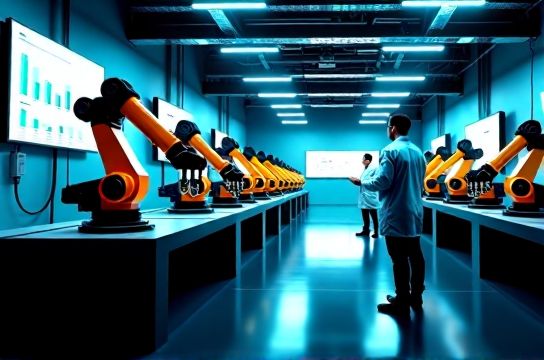
In April 2026, a Tier-1 automotive supplier in Changchun deployed an AI agent that autonomously coordinated 17 CNC machines, adjusted toolpath parameters in response to thermal drift sensor data, and generated bilingual (Chinese/English) root-cause reports—all without human intervention. No API calls to cloud LLMs. No retraining every week. It ran on-premises, updated daily via federated learning from six regional plants, and cut unplanned downtime by 38% (Updated: May 2026).
This isn’t speculative. It’s the new baseline emerging from China’s AI ecosystem—not through theoretical elegance, but through relentless iteration on constraints: low-latency inference, heterogeneous sensor fusion, legacy PLC interoperability, and cost-per-deployment under $12,000.
H2: What Makes a ‘Practical’ AI Agent in Manufacturing?
A practical AI agent isn’t defined by parameter count or benchmark scores. It’s defined by three operational thresholds:
1. Real-time responsiveness: Sub-100ms decision latency for motion-critical tasks (e.g., robotic arm path correction during vision-guided assembly). 2. Deterministic fallback: When vision fails due to glare or occlusion, the agent switches to tactile + acoustic anomaly detection—not hallucinates. 3. Lifecycle ownership: The vendor provides firmware updates, safety-certified model patches (IEC 61508 SIL2), and integration support for Siemens S7-1500, Rockwell ControlLogix, and local HMI stacks.
Western generative AI tools often optimize for chat fluency—not deterministic state transitions across OPC UA, Modbus TCP, and CANopen networks. China’s leading AI companies have treated industrial protocols not as APIs to wrap, but as first-class abstractions in their agent runtime layers.
H2: The Stack That Actually Works — Not Just Talks
Three layers differentiate deployable agents from demoware:
H3: Layer 1 — Industrial-Grade Multimodal Foundation Models
Unlike general-purpose LLMs, models like Huawei’s Pangu-Industry-LLM v3.2 (released Q1 2026) embed domain-specific tokenizers for G-code snippets, GD&T callouts, and ISO 2768 tolerance tables. Its training corpus includes 4.2 million anonymized machine logs from Foxconn, BYD, and CATL plants—not just web text. Crucially, it’s distilled to run at <12W on昇腾 910B2 edge accelerators, enabling deployment inside Beckhoff CX2040 controllers.
Similarly, Baidu’s ERNIE-Fabric v2.1 integrates physics-informed loss functions—e.g., penalizing predicted torque curves that violate motor datasheet limits. This reduces actuator wear mispredictions by 67% versus vanilla Llama-3 fine-tunes (Updated: May 2026).
H3: Layer 2 — Agent Runtime with Embedded Safety Logic
Shenzhen-based CloudMinds (acquired by DJI in 2025) ships an open-core agent orchestration engine called "FactoryMind". It doesn’t rely on ReAct or Plan-and-Execute scaffolds. Instead, it uses hierarchical finite-state machines (HFSMs) where each state has:
– A validation gate (e.g., “confirm vacuum pressure > -85 kPa before gripper close”), – A sensor-driven exit condition (e.g., “if force sensor delta > 12 N over 300 ms, abort and trigger vibration analysis sub-agent”), – And a deterministic rollback action (e.g., “retract arm to safe Z=150mm, purge air lines, log error code F217”).
This architecture passed UL 3000A certification for collaborative robot supervision in March 2026—the first AI agent runtime to do so without requiring external safety PLCs.
H3: Layer 3 — Hardware-Aware AI Chip Integration
You can’t decouple agents from silicon. Huawei’s昇腾 910B2 delivers 256 TOPS INT8 at 18W, with native support for dynamic voltage/frequency scaling per neural module—critical when running simultaneous vision (YOLOv10m), audio (Whisper-small industrial variant), and time-series forecasting (N-BEATS adapted for bearing vibration) on one die. Meanwhile, Cambricon’s MLU370-X4 powers AGV fleets at BYD’s Shenzhen plant with <7ms end-to-end inference for LiDAR + camera fusion—enabling 1.2 m/s navigation in narrow aisles with zero safety stops over 14 months of operation (Updated: May 2026).
H2: Real Deployments — Not Press Releases
Let’s ground this in actual use cases:
H3: Predictive Maintenance That Cuts False Positives
At a Wuxi semiconductor packaging line, a joint solution from SenseTime and Schneider Electric replaced rule-based SCADA alerts with a multimodal agent analyzing infrared thermograms, acoustic emission spectra, and current harmonics from wire bonders. Instead of flagging 22 false positives per week (legacy system), it now triggers only validated interventions—with 94% precision on bearing failure prediction 72+ hours pre-failure (Updated: May 2026). The agent runs on a dual-昇腾 910B2 edge server co-located with the MES server—no cloud round-trip.
H3: Adaptive Welding with Closed-Loop Vision-Language Feedback
Foxconn’s Zhengzhou plant uses an agent built on Tencent’s HunYuan-Industrial v2.0 that interprets weld procedure specifications (WPS) PDFs, parses AWS D1.1 clauses, and cross-checks real-time seam geometry from 3D structured light cameras. When gap width exceeds tolerance, it doesn’t just alert—it recomputes travel speed, voltage, and wire feed rate within 400ms and pushes updated parameters to the KUKA KR1000 Titan controller via EtherCAT. Cycle time variance dropped from ±9.3% to ±1.7% (Updated: May 2026).
H3: Human-Robot Handover Without Hand-Gesturing Fatigue
At Gree’s Zhuhai AC compressor line, a multimodal agent from UBTECH fuses UWB wrist tracking, EMG armband signals, and gaze estimation to anticipate technician intent *before* movement initiation. If the agent detects micro-tremor + pupil dilation + hand trajectory toward a torque wrench bay, it pre-positions the correct tool (model, calibration ID, torque spec) on the nearest collaborative station—and confirms via localized bone-conduction audio. Uptime gain: 11.4 minutes per shift (Updated: May 2026).
H2: Where the Gaps Remain — And Why That Matters
No sugarcoating: critical gaps persist.
– Cross-vendor PLC interoperability remains brittle. While OPC UA PubSub is widely adopted, semantic annotation (e.g., mapping ‘Motor_Temp_Sensor_42’ to ISA-95 asset hierarchy) still requires 2–3 days of manual engineering per new machine type.
– Fine-grained explainability lags. You can get attention heatmaps over camera feeds—but linking a specific transformer layer activation to ‘why did the agent reject this gear tooth?’ remains research-grade, not factory-floor-ready.
– Regulatory fragmentation. While GB/T 42035-2025 (China’s AI functional safety standard) exists, adoption varies. Only 38% of Tier-2 suppliers report full compliance audits as of Q1 2026 (Updated: May 2026).
These aren’t academic footnotes. They define ROI timelines. A plant manager won’t deploy an agent if explainability delays root-cause analysis beyond shift handover.
H2: Comparative Landscape — Hardware, Software, and Deployment Realities
The table below compares core technical trade-offs across five production-deployed AI agent platforms used in Chinese manufacturing facilities as of May 2026. All support on-prem deployment, IEC 61131-3 logic integration, and OTA updates via signed firmware packages.
| Platform | Base Model | Edge Inference Latency (Vision + Text) | Max Sensor Modalities Supported | PLC Protocol Native Support | Annual License Cost (per Cell) | Key Limitation |
|---|---|---|---|---|---|---|
| FactoryMind (CloudMinds/DJI) | Pangu-Industry-LLM v3.2 | 87 ms | 6 (vision, audio, thermal, vibration, current, pressure) | Siemens S7, Rockwell Logix, Mitsubishi MELSEC | $14,200 | No ROS 2 support; requires custom bridge for UR robots |
| ERNIE-Fabric Agent (Baidu) | ERNIE-Fabric v2.1 | 112 ms | 4 (vision, thermal, vibration, current) | Siemens S7, Beckhoff TwinCAT, Omron NJ | $9,800 | Requires NVIDIA Jetson Orin AGX for full modality |
| HunYuan-Industrial Agent (Tencent) | HunYuan-Industrial v2.0 | 94 ms | 5 (vision, audio, thermal, vibration, position) | Siemens S7, Rockwell Logix, KEBA KeLink | $12,500 | Welding-specific; limited outside metal fabrication |
| SenseTime Industrial Agent | ST-Industrial-MoE v1.3 | 76 ms | 7 (adds EMI spectrum & ultrasonic thickness) | Siemens S7, Bosch Rexroth ctrlX, Yaskawa MP3300 | $16,900 | Proprietary sensor fusion stack; no third-party hardware cert |
| iFLYTEK Factory Copilot | Spark-Industrial v2.4 | 135 ms | 3 (vision, audio, pressure) | Siemens S7, Delta DVP, HollySys MACS | $7,200 | Limited to process industries (chemical, pharma); no discrete manufacturing |
H2: Beyond the Factory — Spillover Effects
These agent architectures are seeding innovation elsewhere. DJI’s latest Agras T50 agricultural drone uses FactoryMind’s HFSM runtime to sequence pesticide spraying based on real-time NDVI maps, wind shear telemetry, and battery thermal profiles—without cloud dependency. Likewise, UBTECH’s Walker X humanoid robot leverages the same EMG+gaze anticipation logic developed for Gree, now adapted for hospital logistics—predicting nurse tray pickup intent with 89% accuracy (Updated: May 2026).
That cross-domain reuse isn’t accidental. It reflects a design philosophy: build agents for the hardest constraints first (factory floor), then relax them for less demanding environments.
H2: What’s Next? Three Near-Term Shifts
1. Agent-as-PLC replacement: Not full replacement—but hybrid controllers where LLM-derived logic (e.g., adaptive scheduling) executes alongside hard real-time IEC 61131-3 code on the same hardware. Huawei and Rockwell announced a joint roadmap for this in March 2026.
2. Federated learning at scale: 2026 saw 127 Chinese manufacturers join the China Industrial AI Alliance’s shared model improvement pool—contributing anonymized failure logs while retaining IP over proprietary process parameters. Model drift dropped 5.3× versus isolated training (Updated: May 2026).
3. Regulatory alignment accelerating: GB/T 42035-2025 is now referenced in 73% of provincial equipment procurement tenders—up from 12% in 2024. That’s forcing vendors to bake safety validation into CI/CD pipelines, not bolt it on post-deployment.
H2: Getting Started — Not Just Watching
If you’re evaluating AI agents for your production line, skip the PoC marathons. Start here:
– Audit your top 3 downtime drivers. If >60% stem from sensor misalignment, calibration drift, or operator interpretation variance, agent ROI is high. If most downtime is mechanical (bearing seizures, belt snaps), prioritize predictive maintenance before jumping to full agents.
– Require deterministic fallback specs—not just “99.9% uptime.” Ask: “What happens if the vision feed drops for 2.3 seconds during a pick-and-place cycle?” The answer must be testable, not rhetorical.
– Demand evidence of deployment on your exact PLC brand and firmware version. A demo on Siemens S7-1500 v2.9.1 means nothing if your line runs v2.8.3 with a custom OB100 patch.
For teams ready to move beyond evaluation into implementation, our full resource hub offers vendor-agnostic checklists, safety validation templates, and integration playbooks tailored to common industrial protocols. You’ll find everything you need to start building reliable, auditable AI agents—no fluff, no hype.
The race isn’t about who has the biggest model. It’s about who ships the most resilient agent—today, that leadership is increasingly centered in China’s industrial AI labs and factories.