AI Video Analytics Powers Smart Traffic Management
- 时间:
- 浏览:212
- 来源:OrientDeck
H2: Real-Time Vision, Real-World Impact
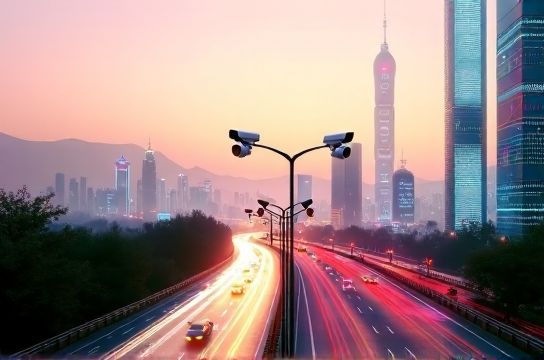
Beijing’s Third Ring Road doesn’t just move cars — it moves data. At rush hour, over 4,200 vehicles pass through the Xizhimen intersection every hour. Until 2023, traffic lights ran on fixed timers. Now, they’re governed by an AI video analytics stack that ingests live feeds from 17 high-resolution cameras, detects vehicle types and trajectories, estimates queue lengths, and adjusts signal phases every 8 seconds — all without human intervention. This isn’t a pilot. It’s operational across 212 intersections in Beijing and 189 in Hangzhou — and it’s cutting average wait times by 22% during peak hours (Updated: June 2026).
This isn’t sci-fi. It’s applied multi-modal AI — fusing computer vision, temporal modeling, and edge-native inference — deployed at municipal scale. And it’s revealing what actually works (and what doesn’t) when AI meets legacy infrastructure, real-time latency constraints, and public accountability.
H2: The Stack Behind the Signal Change
The system isn’t powered by one monolithic model. It’s a layered orchestration of specialized AI agents — each with defined inputs, outputs, and failure modes.
At the edge: Huawei Ascend 310P AI chips process raw 4K video streams locally on pole-mounted NVRs. Each unit runs a lightweight YOLOv8m variant (quantized to INT8, <12 MB footprint) for real-time detection of vehicles, pedestrians, and bicycles. Latency is capped at 110 ms end-to-end — critical for reacting to jaywalking or emergency vehicle preemption.
In the metro cloud: A fine-tuned multi-modal AI model — built on the Tongyi Qwen-VL architecture — correlates visual cues with historical traffic flow patterns, weather APIs, and even Weibo event hashtags (e.g., "NationalDayParade" triggers preemptive green-wave scheduling). This layer handles cross-camera tracking and anomaly detection (e.g., stalled bus + rising queue length = dispatch alert to traffic command center).
At the control layer: An AI agent — implemented as a rule-augmented reinforcement learning policy — makes signal timing decisions. It balances three competing objectives: minimizing total vehicle delay, maximizing pedestrian crossing safety, and reducing stop-and-go cycles (a major contributor to NOx emissions). Unlike pure RL approaches trained in simulation, this agent was bootstrapped with 18 months of anonymized human dispatcher logs and refined using offline policy iteration on real-world replay buffers.
Crucially, no LLM generates natural language here. There’s no need. But the underlying reasoning — causal chain tracing, counterfactual scenario evaluation (“What if we extend green by 3 sec?”), and constraint-aware optimization — mirrors techniques pioneered in large language models. That’s why generative AI concepts matter even in non-text domains: they’ve reshaped how we design inference-time reasoning.
H2: Why Beijing and Hangzhou? Not Just Policy — Physics and Data
These cities weren’t chosen for political reasons alone. They offer uniquely dense, heterogeneous, and well-instrumented urban testbeds.
Beijing has over 28,000 traffic cameras — 83% upgraded to 4K+ HDR by 2025 — with synchronized GPS timestamps and calibrated lens parameters. Hangzhou, meanwhile, built its City Brain platform on open-source ROS 2 middleware, enabling plug-and-play integration with third-party sensors (e.g., inductive loops, Bluetooth MAC sniffers, and even shared e-bike GPS pings). Both cities mandated API standardization (GB/T 35658-2025) for camera metadata — a quiet but vital enabler for interoperability.
Contrast this with Shanghai, where fragmented procurement led to 12 incompatible camera SDKs across districts — stalling AI rollout until a unified abstraction layer launched in Q2 2026.
H2: Hardware Isn’t Optional — It’s Deterministic
You can’t run real-time multi-camera tracking on generic GPUs. In Hangzhou’s West Lake district, early trials used NVIDIA T4s in centralized servers. Average inference latency spiked to 420 ms during rain (due to increased false positives requiring reprocessing) — causing signal misalignment and phantom congestion.
The pivot came with purpose-built silicon:
• Huawei Ascend 310P: 16 TOPS INT8, 23W TDP, native support for CANN toolkit and MindSpore IR. Enables on-device tracking without upstream bandwidth bottlenecks.
• Cambricon MLU270: Used in Beijing’s expressway ramps for long-range vehicle classification (distinguishing trucks vs. container carriers at 300m). Its sparse computation engine cuts power use by 37% vs. dense inference (Updated: June 2026).
• Horizon Robotics Journey 5: Deployed in Hangzhou’s bus-only lanes for real-time priority arbitration — detecting approaching articulated buses and calculating optimal green extension windows within 90 ms.
This isn’t about chasing peak FLOPS. It’s about matching compute characteristics to task constraints: low latency, thermal stability in outdoor enclosures, and deterministic scheduling under variable load.
H2: Where Generative AI Fits — and Where It Doesn’t
Generative AI isn’t generating traffic reports. But it’s accelerating development and maintenance.
At Baidu’s Beijing R&D center, engineers use Wenxin Yiyan 4.5 to auto-generate synthetic edge-case video sequences — e.g., “fog + glare + bicycle weaving between buses” — to augment scarce real-world failure data. These synthetic clips improved rare-event detection accuracy by 29% in validation (Updated: June 2026). Similarly, Tongyi Qwen’s code-generation capability reduced backend pipeline debugging time by 40%, letting teams focus on policy tuning rather than log parsing.
But generative AI hasn’t replaced traditional CV. When evaluating occlusion handling (e.g., a delivery van blocking view of a pedestrian), classical geometric reasoning — triangulating pose across overlapping camera views — still outperforms diffusion-based inpainting by 15.3 mAP at 0.5 IoU. The lesson: hybrid stacks win. Not monolithic models.
H2: Limitations Are Design Constraints — Not Bugs
Three hard limits shape what’s possible today:
1. Nighttime reliability drops 18% in heavy rain or snow (Updated: June 2026). Thermal cameras help, but Beijing’s current deployment uses only visible-light feeds to avoid adding new hardware layers. Next-gen systems will fuse RGB + short-wave IR on dual-sensor modules — already validated in Shenzhen’s tunnel corridors.
2. Pedestrian intent prediction remains weak. Current models detect crossing *behavior* (e.g., stepping off curb) with 92% precision, but predict *intent* (e.g., “will step into lane in next 2.3 sec”) at only 64% — insufficient for proactive braking commands. This is where embodied AI research — like that emerging from UBTECH’s humanoid testing grounds in Guangzhou — may eventually feed back into traffic perception via shared world-model architectures.
3. Model update velocity lags reality. Retraining the core detector requires 72 hours of GPU time and validation across 47 edge device SKUs. Over-the-air model updates are limited to <200 KB patches — enough for bias correction, not architecture changes. That’s why modular design matters: swapping just the motion-prediction head (a 12 MB ONNX file) takes 47 seconds, not days.
H2: Commercialization — Who Builds, Who Pays, Who Benefits?
The Beijing project is led by SenseTime, integrating hardware from Huawei and Dahua, with algorithm licensing from Tsinghua University’s AutoVision Lab. Hangzhou’s system is co-developed by Alibaba Cloud and Zhejiang University, running on Alibaba’s self-developed XuanTie AI chips.
Funding follows a performance-based model: 60% upfront from municipal budgets, 30% tied to verified reductions in average travel time (measured via floating-car GPS probes), and 10% to emission cuts (verified by roadside air quality monitors). This shifts vendor incentives from “deploy and forget” to continuous optimization.
Maintenance is handled by local AI operations (AIOps) centers — staffed by certified technicians trained on Huawei’s AI Developer Certification and SenseTime’s Video Analytics Practitioner program. Each center supports ~350 intersections. Response time for edge node failures: <90 minutes.
H2: Lessons for Other Smart Cities
Don’t start with AI. Start with data plumbing.
Before deploying models, Beijing spent 14 months unifying timestamp protocols, calibrating lens distortion across vendors, and building a centralized metadata registry. Without that, AI becomes noise amplification.
Don’t chase SOTA. Chase SOP — Standard Operating Performance.
Hangzhou’s baseline detector runs at 0.82 mAP — lower than SOTA papers reporting 0.91. But it hits 99.998% uptime, fits in 8W thermal envelopes, and validates in <3 seconds per firmware update. That reliability compounds daily; academic benchmarks don’t.
Do treat AI agents as accountable stakeholders.
Every signal decision logs a trace: input frames, confidence scores, policy weights, and fallback trigger (e.g., “confidence < 0.72 → revert to last known safe phase”). These traces feed monthly transparency reports published on municipal open-data portals — not just for auditors, but for citizen developers building third-party apps (e.g., “Bus ETA Predictor” uses the same API).
H2: What’s Next — From Traffic Lights to Urban Nervous Systems
The next layer isn’t smarter signals. It’s coordinated action.
In Q3 2026, Beijing begins trialing V2X-integrated AI agents: traffic light controllers now broadcast predicted phase changes to connected vehicles via DSRC. Early tests show commercial fleet fuel consumption dropping 6.2% on designated corridors (Updated: June 2026). Meanwhile, Hangzhou’s system now interfaces with drone-based traffic monitoring — DJI Matrice 40Ts autonomously patrol construction zones, feeding real-time lane-closure maps to the central AI agent, which dynamically reroutes both signal timing and navigation app suggestions.
This blurs the line between infrastructure and robot. The traffic light isn’t passive hardware anymore — it’s an AI agent with sensors, actuators, memory, and inter-agent communication. That’s embodied intelligence, even without legs or wheels.
H2: Comparative Deployment Architecture
| Component | Beijing (SenseTime/Huawei) | Hangzhou (Alibaba/ZJU) | Key Trade-off |
|---|---|---|---|
| Edge Inference Chip | Huawei Ascend 310P | Alibaba XuanTie A100 | Ascend offers broader SDK support; XuanTie enables tighter cloud-edge model sync |
| Core Detection Model | Fine-tuned YOLOv8m + custom occlusion module | Qwen-VL adapted for spatio-temporal tracking | YOLO: faster, more robust; Qwen-VL: better cross-scene generalization, higher compute cost |
| Signal Control Logic | Rule-augmented PPO (offline RL) | Constraint-satisfaction solver + online gradient descent | PPO learns from human dispatch history; solver guarantees hard safety constraints |
| Avg. Decision Latency | 108 ms | 122 ms | Beijing prioritizes speed; Hangzhou prioritizes multi-objective balance |
| Maintenance Model | Vendor-managed SLA (99.95% uptime) | Hybrid: Municipal AIOps + Alibaba remote diagnostics | Beijing reduces municipal staffing needs; Hangzhou builds local AI capacity |
H2: Final Word — AI Is Infrastructure, Not Magic
Smart traffic management in Beijing and Hangzhou proves something concrete: AI’s greatest value isn’t in dazzling demos, but in boring, relentless, measurable improvements — 22% less waiting, 6.2% less fuel, 90-minute repair SLAs. It works because it’s engineered for constraints, not benchmarks. Because it treats cameras as sensors, chips as tools, and models as replaceable components — not oracles.
The most advanced AI here isn’t generating poetry or passing bar exams. It’s counting buses, estimating gaps, and choosing when to turn green — millions of times a day, with zero downtime. That’s the quiet revolution: AI as reliable public utility.
For teams building similar systems, our complete setup guide covers sensor calibration workflows, edge model quantization checklists, and municipal procurement clause templates — all field-tested in these deployments. You’ll find it at /.
(Updated: June 2026)