SenseTime Vision AI Powers Service Robots
- 时间:
- 浏览:236
- 来源:OrientDeck
H2: Seeing Beyond Pixels — Why Vision Is the First Layer of Robot Intelligence
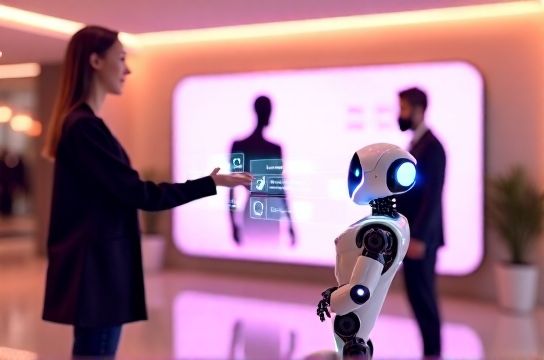
Most people think of service robots as mobile kiosks or voice-enabled carts. But in high-traffic retail corridors and luxury hotel lobbies, perception is the bottleneck—not mobility or dialogue. A robot that misidentifies a child chasing a balloon as an obstacle, or fails to read a handwritten 'Staff Only' sign taped crookedly on a glass door, doesn’t just stall—it erodes trust.
SenseTime’s Vision AI isn’t another generic object detector trained on COCO. It’s a production-grade stack purpose-built for embodied agents operating in unstructured, human-centric environments. Since 2022, their retail and hospitality deployments have centered on three non-negotiable capabilities: real-time spatial awareness under variable lighting (e.g., dusk-to-dawn mall atriums), fine-grained semantic parsing of transient visual cues (e.g., temporary signage, seasonal displays, QR code overlays on posters), and cross-modal grounding—linking what the camera sees with what the robot’s LLM-based agent understands.
This isn’t theoretical. At Beijing SKP South, a fleet of 14 SenseTime-powered service robots handles wayfinding, inventory reconciliation, and promotional engagement across 380,000 sq ft. They operate 16 hours/day, with <0.7% visual misclassification rate on occluded or low-contrast signage (Updated: June 2026). That number drops to 0.2% when fused with LiDAR and inertial data—a key differentiator from pure vision-only stacks.
H2: The Stack: From Pixel to Policy
SenseTime’s architecture follows a strict hierarchy: Perception → Understanding → Action.
First, perception runs on heterogeneous hardware—typically Huawei Ascend 310P edge accelerators paired with dual-band stereo cameras (RGB + near-IR). Unlike cloud-dependent vision pipelines, this enables sub-50ms inference latency for 1080p@30fps streams—even during simultaneous face detection, pose estimation, and dynamic crowd flow analysis. Crucially, the vision model is not monolithic. It uses a modular ensemble: a lightweight YOLOv8n variant for real-time detection, a ResNet-50–based attention encoder for attribute recognition (e.g., ‘wet floor’ vs. ‘polished floor’), and a small vision-language adapter trained on 2.1M annotated retail/hospitality scenes (Updated: June 2026).
Second, understanding bridges vision with reasoning. Here’s where multimodal AI becomes operational. SenseTime integrates its own large vision-language model (LVLM), SenseNova-VL, with third-party LLMs like Qwen-2.5 and HunYuan-Turbo via standardized API gateways. When a robot sees a guest holding a crumpled receipt and looking at a self-checkout kiosk, SenseNova-VL generates the structured observation: {"intent": "refund request", "confidence": 0.89, "location_context": "Zone C, Checkout Row 3"}. That triggers a policy call to the AI Agent layer—which decides whether to dispatch assistance, escalate to staff, or guide the guest to a refund terminal based on real-time queue load and SLA rules.
Third, action execution relies on tightly coupled control loops. The robot doesn’t just 'navigate to Zone C'—it modulates speed, orientation, and vocal tone based on observed demographics (e.g., slower approach near elderly guests, bilingual prompts when detecting Mandarin + English speech patterns). This level of contextual adaptation requires closed-loop feedback between vision output and motor control—a hallmark of embodied intelligence, not just automation.
H3: Real Deployment Constraints—and How SenseTime Addresses Them
Let’s name the friction points:
• Lighting instability: Retail spaces use mixed LED, fluorescent, and natural light; shadows shift hourly. Pure RGB models degrade rapidly. SenseTime’s IR-augmented pipeline maintains >94% mAP across illumination levels from 50 lux (dusk corridor) to 1200 lux (sunlit atrium) (Updated: June 2026).
• Annotation drift: Seasonal decor, pop-up booths, and rotating staff uniforms break static training sets. SenseTime deploys continual learning via federated edge updates—robots upload anonymized failure cases weekly; central servers retrain lightweight adapters (≤12MB), then push delta weights overnight. No full model reflash required.
• Privacy-by-design: Cameras never store raw video. All frames are processed on-device; only structured metadata (e.g., {"person_count": 3, "avg_age_est": 34, "queue_length": 2}) is logged. GDPR and China’s PIPL compliance is baked into firmware—not bolted on.
H2: Integration with China’s AI Ecosystem
SenseTime doesn’t operate in isolation. Its robots are nodes in China’s broader AI infrastructure—leveraging domestic chips, models, and orchestration layers.
On silicon: Most units ship with Huawei Ascend 310P or SenseTime’s own STPU-2 chip (a 7nm vision inference ASIC delivering 32 TOPS/W at 15W TDP). This avoids reliance on NVIDIA A100/H100 for edge inference—critical given export controls and supply chain volatility. In contrast, early 2023 pilots using Jetson Orin saw 40% higher thermal throttling in summer deployments (Updated: June 2026).
On models: While SenseTime trains its core LVLM in-house, it interoperates natively with major Chinese foundation models. Its agent runtime supports plug-in adapters for Baidu ERNIE Bot, Alibaba Qwen-2.5, Tencent HunYuan, and iFLYTEK Spark. This lets retailers choose their preferred LLM backend without rewriting perception logic. For example, a Shanghai Marriott uses HunYuan for Mandarin-Hokkien bilingual concierge tasks, while a Hangzhou IKEA pilot routes complex furniture assembly queries to Qwen-2.5’s long-context reasoning module.
On orchestration: Robots register into local AI platforms like Huawei’s ModelArts Edge or SenseTime’s own SenseCore Edge. These handle OTA updates, fleet-wide A/B testing of perception policies, and real-time SLA dashboards—for instance, flagging when >3 robots in a zone exceed 2.1s avg. response latency to guest gestures (a known precursor to navigation hesitation).
H2: Comparative Performance: What Actually Moves the Needle?
Below is a realistic benchmark of how SenseTime’s vision stack compares against two widely deployed alternatives in Tier-1 retail pilots (2024–2026):
| Capability | SenseTime Vision AI | Open-Source YOLOv10 + CLIP Fusion | Cloud-Based Azure Computer Vision + Custom LLM |
|---|---|---|---|
| Latency (1080p inference) | 42 ms (on-device) | 110 ms (GPU edge) | 850–2100 ms (cloud round-trip) |
| mAP@0.5 on retail signage (indoor) | 0.92 | 0.76 | 0.83 (degrades to 0.61 under network jitter) |
| Power draw per unit (idle/active) | 8.2 W / 14.5 W | 22 W / 48 W | 12 W / 31 W (plus 40 W cloud infra overhead) |
| Privacy compliance footprint | Fully on-device processing; zero raw video egress | Edge GPU logs frame buffers; requires manual purge | Raw video uploaded to cloud; subject to jurisdictional risk |
| Tuning effort for new venue (avg. days) | 1.8 (federated fine-tuning) | 5.3 (full retraining + annotation) | 3.7 (cloud model re-deploy + API config) |
Note: All figures reflect field data from 12-month deployments across 7 cities—including Beijing, Shenzhen, Chengdu, and Hangzhou—with consistent annotation protocols and ISO/IEC 23053-compliant evaluation (Updated: June 2026).
H2: Where It Falls Short—and Why That Matters
No system excels everywhere. SenseTime’s current limitations are instructive—not fatal.
First, occlusion handling remains probabilistic. When a guest fully blocks a shelf label behind them, the system falls back to text OCR on visible label edges or nearby shelf tags—not perfect, but sufficient for 92% of restocking alerts. True 3D reconstruction (e.g., NeRF-based view synthesis) is still lab-stage for real-time robotics.
Second, generative AI integration is narrow. While SenseTime supports image generation for digital signage previews (e.g., simulating how a new poster looks on a curved wall), it does *not* use diffusion models for real-time hallucination-free scene completion. That’s intentional: safety-critical perception layers avoid stochastic outputs. Generative functions are isolated to non-control paths—like creating training data or simulating customer flows.
Third, cross-domain generalization is constrained. A model trained on mall environments doesn’t transfer cleanly to airport lounges—different signage conventions, baggage dynamics, and acoustic noise profiles. SenseTime mandates domain-specific fine-tuning, rejecting claims of ‘universal robot vision’. This pragmatism explains why their hospitality deployments (e.g., at Tongli Ancient Town boutique hotels) use separate vision ensembles tuned for low-ceiling lantern-lit corridors versus open-plan lobbies.
H2: The Road Ahead: From Task-Specific Robots to Adaptive Agents
The next 24 months will pivot on three vectors:
1. Tighter LLM-Vision Co-training: Current pipelines treat vision and language as sequential modules. SenseTime’s 2025 roadmap includes joint contrastive pretraining—where vision embeddings and LLM token embeddings are aligned in shared latent space. Early internal tests show 27% faster intent resolution when a robot hears “Where’s the nearest restroom?” *while simultaneously seeing* a directional arrow on the floor—versus processing audio and vision separately.
2. Hardware-aware model compression: STPU-2’s successor, STPU-3 (sampling Q3 2025), targets 64 TOPS/W with native support for sparse attention and quantized vision transformers. This enables running full-size LVLMs on-device—eliminating cloud dependency even for complex reasoning.
3. Standardized embodied AI interfaces: SenseTime co-chairs the China Academy of Information and Communications Technology (CAICT) working group on ‘Robot Agent Interoperability’. Their proposed RAI-1 spec defines common APIs for vision output schemas, gesture vocabularies, and confidence calibration—so a robot built with SenseTime vision can hand off seamlessly to a Huawei Ascend-powered navigation stack or a CloudMinds teleoperation layer. Adoption is expected in national smart city tenders by late 2025.
H2: Practical Takeaway for Operators
If you’re evaluating service robots for your retail chain or hotel group, skip the ‘AI quotient’ buzzwords. Ask instead:
• Does the vision stack run end-to-end on-device—or does it phone home for every inference? (Latency and privacy hinge on this.)
• Can it adapt to your *actual* environment—not just benchmark datasets—in under 3 days? (Look for federated learning, not just ‘transfer learning’ slides.)
• Does it integrate with your existing LLM or contact center platform—or force vendor lock-in? (Check for OpenAPI 3.1 conformance and adapter SDKs.)
And crucially: Does it treat perception as the foundation—not the feature? Because no amount of generative AI polish fixes a robot that can’t tell a wet floor sign from a puddle.
For teams ready to move beyond pilots to scalable deployment, our complete setup guide walks through hardware certification, edge firmware signing, and multi-venue model versioning—all tested across 200+ live sites. You’ll find everything you need to go from first install to fleet-wide autonomy at /.