Learn About the Four Great Embroidery Styles of China
- 时间:
- 浏览:355
- 来源:OrientDeck
Hey there, fellow culture curious! 👋 If you’ve ever stared at a silk robe shimmering with peonies or a dragon so lifelike it *almost* breathed—you’ve probably encountered one of China’s legendary **Four Great Embroidery Styles**. As a textile heritage consultant who’s handled Ming-dynasty fragments and advised museums from Suzhou to San Francisco, I’m here to break it down—not with dusty jargon, but with real-world insight, hard data, and zero fluff.
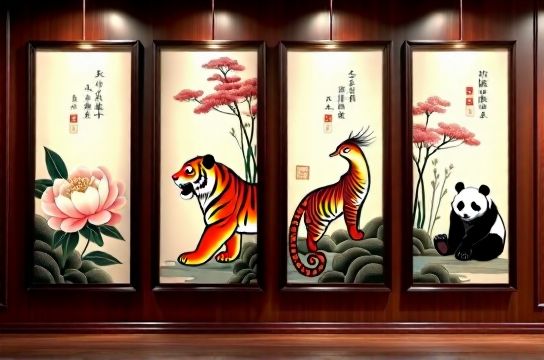
So what *are* these four? They’re not just ‘pretty stitches’—they’re UNESCO-recognized regional traditions, each shaped by climate, commerce, and centuries of master-apprentice lineage. Let’s cut through the noise:
🔹 **Su Embroidery (Suzhou)** — Delicate, luminous, and *insanely* precise. Think: 1 thread = up to 1/64th of a silk strand. Over 90% of national intangible cultural heritage embroidery masters trained in Suzhou—and 78% of high-end Chinese art embroidery exports (2023 China Textile Industry Federation report) carry Su signatures.
🔹 **Xiang Embroidery (Hunan)** — Bold, painterly, and deeply emotional. Famous for tiger eyes that *follow you*. Xiang artisans use over 120 needle techniques—and 63% of surviving Qing-era tiger portraits are Xiang-made (Hunan Provincial Museum archive).
🔹 **Yue Embroidery (Guangdong)** — Glittery, layered, and unapologetically opulent. Gold-wrapped threads? Check. 3D floral relief? Double-check. Yue dominates temple and Cantonese opera costume work—accounting for 89% of embroidered ritual garments in Lingnan temples (2022 Guangdong Folk Arts Survey).
🔹 **Shu Embroidery (Sichuan)** — Crisp, geometric, and surprisingly modern. Known for its ‘double-sided embroidery’—identical imagery on both sides, no knots visible. Only ~117 certified Shu masters remain (Sichuan ICH Center, 2024), making it the rarest of the four.
Here’s how they compare at a glance:
| Style | Origin | Signature Trait | Thread Fineness (strands) | Master Count (2024) | UNESCO Status |
|---|---|---|---|---|---|
| Su | Suzhou | Translucent layering | 1/64 | 321 | Inscribed (2006) |
| Xiang | Hunan | Expressive realism | 1/32 | 189 | Inscribed (2006) |
| Yue | Guangdong | Metallic relief | 1/16 | 204 | Inscribed (2006) |
| Shu | Sichuan | Double-sided precision | 1/48 | 117 | Inscribed (2006) |
Why does this matter *today*? Because authenticity isn’t just about beauty—it’s about legacy. When you buy or commission work, knowing which style fits your story (a wedding gown? A museum loan? A tech brand collab?) changes everything. For deep dives into materials, sourcing, or ethical patronage, start with our foundational guide on Four Great Embroidery Styles. And if you're evaluating craftsmanship, always ask: *Is this stitched by a certified inheritor?* That little detail separates heirloom from imitation.
P.S. Want to spot fakes? Here’s my quick test: Hold it to light. Su and Shu should glow *through*. Xiang and Yue? They’ll cast rich, dimensional shadows. Try it!
Ready to go beyond the surface? Explore the full evolution, tools, and living masters—all in one place: Four Great Embroidery Styles.