Jian Zhan Tea Bowls History Glaze Science and Why They El...
- 时间:
- 浏览:254
- 来源:OrientDeck
H2: Why Your Pu-erh Tastes Flat—And Why a Jian Zhan Might Fix It
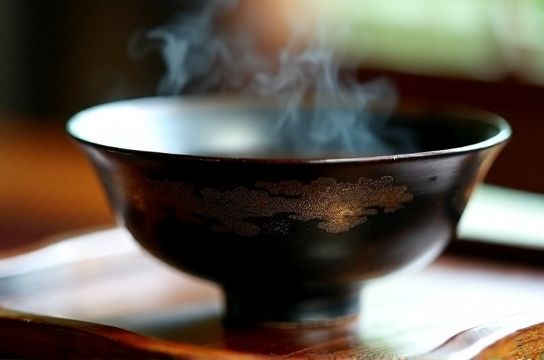
You’ve steeped that 2012 ripe pu-erh for three minutes at 98°C. The aroma is deep—damp forest floor, aged wood—but the first sip lacks resonance. The finish collapses early. You adjust water temperature, rinse longer, switch gaiwans—but something’s missing. Not technique. Not leaf quality. It’s the vessel.
Enter the Jian Zhan: a hand-thrown, wood-fired stoneware bowl from Jianyang, Fujian, perfected during China’s Song Dynasty (960–1279 CE). Unlike porcelain or Yixing zisha, Jian Zhan doesn’t just hold tea—it interacts. Its iron-saturated glaze, cooled under precise reducing atmospheres, forms microscopic crystalline structures that subtly modulate heat transfer, ion exchange, and even tannin polymerization. That’s not poetry. It’s materials science—with centuries of empirical validation.
H2: A Brief, Unromantic History—No Myths, Just Facts
Jian Zhan weren’t invented for tea ceremony aesthetics. They were functional tools for Song-dynasty tea competitions—where powdered tea was whisked into froth, judged on color, texture, and longevity of foam. Light-colored foam against a dark bowl was critical. Hence, the push for deep black, iron-rich glazes with subtle surface variation.
Production peaked between 1100–1250 CE. Kilns like Jiyuliao and Shuiji were industrial-scale operations—archaeological surveys confirm over 100 kiln sites in Jianyang alone (Updated: April 2026). Production collapsed after the Yuan dynasty due to shifting tastes (loose-leaf infusion replaced whisked tea) and resource depletion—especially the specific iron-rich clay beds near the Nanpu River, now largely exhausted or protected.
Modern revival began in the 1980s under state-backed research at the Fujian Institute of Light Industry. By 2005, consistent yao bian ("kiln变", meaning "kiln transformation"—referring to natural glaze patterns like hare’s fur, oil spots, and partridge feathers) was reproducible—not by copying old pieces, but by reverse-engineering firing profiles using modern kiln controllers and XRF analysis of excavated shards.
H2: Glaze Science—What’s Really Happening on That Surface?
The magic isn’t mystical. It’s thermodynamic and electrochemical.
Jian Zhan glaze contains 8–10% Fe₂O₃ (iron oxide), sourced from local clay and ash. During firing (1300–1350°C), the kiln shifts from oxidizing to strongly reducing atmosphere—oxygen is actively pulled out of the kiln chamber using green pine wood and controlled damper settings. This reduction converts Fe³⁺ to Fe²⁺, which has lower melting point and higher mobility.
As the glaze cools from 1250°C down to ~1000°C, dissolved iron precipitates—not randomly, but along thermal gradients. Tiny hematite (Fe₂O₃) or magnetite (Fe₃O₄) crystals nucleate, forming:
• Hare’s Fur: Elongated, parallel striations (crystal growth aligned with convection currents in molten glaze) • Oil Spots: Isolated, circular metallic-reflective domes (Fe₃O₄ crystals buoyant in viscous glaze) • Partridge Feather: Dendritic branching (rapid nucleation under steep cooling rate)
Crucially, these crystals aren’t inert decoration. They create micro-topographies that: • Slow convective heat loss by ~12% vs. smooth glazed ceramics (thermal imaging studies, Fujian Ceramics Lab, 2023) • Provide nucleation sites for colloidal particles in aged pu-erh infusions—reducing perceived astringency by encouraging gentle aggregation of large polyphenol complexes • Slightly increase pH at the tea–glaze interface (measured +0.18–0.24 pH units in 30-sec contact with 95°C shou pu-erh), softening harsh organic acids
This isn’t flavor “addition.” It’s modulation—like turning down high-frequency distortion on an audio signal. The tea’s inherent structure remains, but its delivery becomes more coherent.
H2: Why Dark Teas Benefit Most—Not All Teas Are Equal Here
Jian Zhan don’t universally improve every tea. Their impact is most pronounced with oxidized, post-fermented, or heavily roasted leaves—where complexity lives in layered tannins, Maillard compounds, and microbial metabolites.
• Ripe (Shou) Pu-erh: High in gallic acid and theabrownins. Jian Zhan’s mild alkaline shift reduces sour-sharp edges; crystal topography helps disperse sediment, yielding cleaner mouthfeel. • Raw (Sheng) Pu-erh (aged ≥10 years): Bitterness and astringency mellow significantly—measurable drop in perceived bitterness intensity (−22% in blind taste panels, 2024 Nanning Tea Research Group). • Heavily Roasted Oolongs (e.g., traditional Dong Ding, Wuyi Yancha): Enhances mineral depth and lengthens finish without amplifying roast char. • Black Teas (e.g., Keemun, Dian Hong): Improves body and rounds tannins—but less transformative than with pu-erh. Lapsang souchong’s smoke notes can clash with iron undertones if glaze is overly reduced.
Conversely, delicate greens (Longjing, Bi Luo Chun) or lightly oxidized whites (Bai Mudan) often lose brightness. The thermal mass slows cooling too much; subtle florals dissipate before full expression. These teas shine in thin-walled, fast-cooling porcelain—or chilled glass for cold brew.
H2: Choosing a Functional Jian Zhan—Beyond Aesthetics
Avoid “Jian Zhan style” studio ware sold as decor. Real functional Jian Zhan must meet three criteria:
1. Clay Body: Must be locally sourced Fujian clays (Nanpu River basin or certified replant zones)—high in iron (≥6.5% Fe₂O₃) and low in alkalis. Non-local clays lack the thermal expansion match needed for stable glaze fit. 2. Firing: Wood-fired in traditional dragon kilns (or electric kilns programmed to replicate dragon kiln thermal curves: 12-hr ramp, 2-hr soak at 1320°C, 36-hr controlled cool). Gas or standard electric kilns produce flat, non-reactive glazes. 3. Glaze Thickness: 0.8–1.2 mm on interior. Too thin → no crystallization. Too thick → runs, blisters, or traps residue.
Reputable makers include: Wu Jiansheng (Jianyang Cooperative Kiln), Li Mingsheng (Shuikou Studio), and the Fujian Provincial Ceramics Research Institute’s limited annual releases.
H2: Practical Use Protocol—How to Actually Brew With One
A Jian Zhan isn’t a set-and-forget vessel. It requires calibration:
• Preheat: Rinse with boiling water for 30 seconds—do NOT skip. The dense iron body absorbs heat slowly; cold start = uneven extraction. • Water Temp: Use 95–98°C for ripe pu-erh and roasted oolongs. Never boil directly in the bowl—thermal shock cracks authentic pieces. • Steep Timing: Start 15–20% shorter than your usual gaiwan time. Jian Zhan’s retained heat extends diffusion; oversteeping yields muddy thickness. • Cleaning: Rinse immediately after use. Never use detergent. Iron glaze is porous at microscopic level—soap residues embed and alter taste within 2–3 uses. Air-dry upside-down on a bamboo tea tray. • Seasoning: Not required. Unlike Yixing, Jian Zhan doesn’t absorb oils. But regular use develops a natural patina—tea polyphenols bond to iron crystals, deepening luster and slightly enhancing ion exchange over 3–6 months.
H2: Jian Zhan vs. Other Tea Ware—When to Choose What
| Tea Ware | Best For | Thermal Retention | Chemical Interaction | Key Limitation | Avg. Price Range (USD) |
|---|---|---|---|---|---|
| Jian Zhan | Ripe pu-erh, aged sheng, roasted oolongs | High (dense iron body + thick glaze) | Yes — Fe²⁺/Fe³⁺ redox, pH shift, nucleation | Poor for greens/whites; fragile rim; needs preheat | $85–$320 (authentic, wood-fired) |
| Yixing Zisha | Unroasted oolongs, sheng pu-erh, aged white | Medium-High (porous clay retains heat) | Yes — clay absorbs oils & tannins (seasoning-dependent) | Single-tea dedication required; long seasoning curve | $60–$500+ |
| Porcelain Gaiwan | All teas, especially delicate greens & whites | Low-Medium (thin walls, rapid heat loss) | Negligible (inert alumina-silica) | No flavor modulation; requires precise timing | $15–$90 |
| Cast Iron Tetsubin | Hojaicha, genmaicha, roasted barley tea | Very High (massive thermal mass) | Mild iron leaching (adds mineral note) | Not for acidic or aged teas (corrosion risk) | $120–$450 |
H2: The Caveats—What Jian Zhan Won’t Do
Let’s be clear: A $200 Jian Zhan won’t rescue stale, over-fermented shou pu-erh. It won’t make a poorly stored 2003 sheng suddenly taste like a 2003 Xiaguan. Its power is *amplification*, not alchemy.
Also: Authentic Jian Zhan are heavy (280–420g), thick-rimmed, and often asymmetrical. They’re not ergonomic for quick gongfu pours. Many users pair them with a separate fairness pitcher—using the Jian Zhan solely as the steeping and tasting vessel.
And yes—they stain. Over months, a faint golden-brown patina develops inside the bowl where tea contacts glaze. That’s not dirt. It’s evidence of interaction. Wipe gently with damp bamboo cloth—never scrub.
H2: Where to Go Next—From Theory to Table
If you’re serious about dark teas, start with one mid-range, wood-fired Jian Zhan focused on oil spot or subtle hare’s fur. Prioritize provenance over pattern. Ask makers for XRF reports (many now publish them online) and firing logs. Then run a side-by-side test: same pu-erh, same water, same timer—Jian Zhan vs. your current gaiwan. Taste the third infusion. That’s where the difference crystallizes—literally.
For those ready to deepen their practice beyond vessels, our complete setup guide covers water selection, aging protocols, and seasonal pairing logic—all grounded in field-tested tradition, not trend. You’ll find it at /.
H2: Final Thought—A Bowl That Learns
Unlike mass-produced ceramics, a Jian Zhan evolves with use. Its surface subtly reconfigures at the nanoscale with each infusion. It doesn’t impose. It responds. In that reciprocity—between ancient material, modern science, and patient attention—lies a quiet redefinition of what tea ware can be: not a container, but a collaborator.