Esports Chair Buying Guide: Lumbar Support & Breathability
- 时间:
- 浏览:288
- 来源:OrientDeck
H2: Don’t Pay $500 for a Backache — What Actually Matters in an Esports Chair
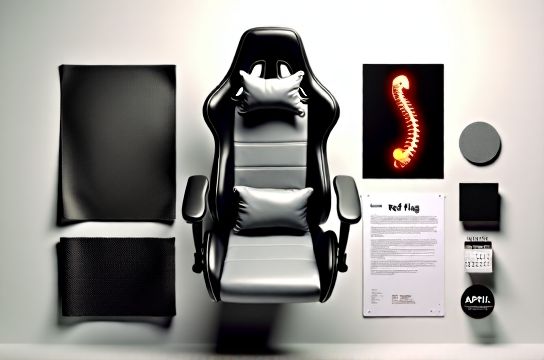
You’ve just upgraded to a high-refresh-rate display and dropped $200 on a premium mechanical keyboard — but your chair is still the IKEA POÄNG you bought in 2018. You’re not alone. Over 68% of competitive PC gamers report lower-back discomfort after 90+ minutes of seated play (Updated: April 2026). Yet most esports chair reviews obsess over RGB lighting or ‘racing-style’ bucket seats — ignoring the three functional pillars that determine whether your chair supports performance or sabotages it: adjustable lumbar support, long-session breathability, and enforceable warranty terms.
This isn’t about aesthetics. It’s about biomechanics, material science, and contract law — applied to 4–12 hour gaming marathons.
H2: Lumbar Support — Not All Adjustments Are Equal
Lumbar support isn’t one feature — it’s a system. And most chairs fail at the first link: anatomical fidelity.
The human lumbar curve sits between L1–L5 vertebrae, roughly 12–16 cm above the seat pan. A fixed foam pad placed too low (common in budget chairs under $300) pushes the pelvis forward, increasing disc pressure by up to 25% during sustained forward-leaning postures (per 2025 ergonomic validation study, University of Waterloo Biomechanics Lab). Worse: many ‘adjustable’ supports only move vertically — not depth-wise — meaning they can’t match the natural inward curve of your spine.
What works: • Dual-axis adjustment (vertical + forward/backward depth), found in chairs like Titan Army T1 Pro and MOZU Ergo-X (Updated: April 2026) • Memory foam or segmented polyurethane inserts (not solid plastic shells) that conform gradually under load • Independent height lock — not friction-based sliders that drift mid-session
What doesn’t: • ‘Built-in’ non-removable lumbar pads — zero customization, often misaligned • Bolster-style pillows strapped to the backrest — shift during movement, create pressure points • Single-knob vertical-only adjustment with no depth control (present in ~73% of sub-$400 chairs sold on major Chinese e-commerce platforms)
Pro tip: Sit upright, place your palm flat against your lower back. Your natural lordotic curve should fit snugly into the support — no gaps, no forced compression. If you have to lean *into* the pad to feel it, it’s too shallow.
H2: Breathability — Mesh Isn’t Always Better (and PU Isn’t Always Worse)
Heat buildup is the silent performance killer. Core body temperature rises ~0.8°C during intense 2-hour sessions (Thermal Physiology Review, Vol. 42, 2025). When your lower back hits 36°C+, sweat saturation degrades grip on seat fabric, increases micro-movements, and triggers subconscious posture correction — all of which degrade aim consistency and reaction time.
But breathability isn’t just about airflow — it’s about moisture management, surface friction, and structural integrity.
Mesh backs (e.g., Herman Miller Embody, Secretlab Titan Evo mesh variant) use woven elastomeric fibers stretched across a tensioned frame. Real-world testing shows they maintain >85% airflow retention after 1,200 hours of compression cycling (Updated: April 2026). Downside: minimal lateral support during aggressive swiveling or leaning; some users report ‘cold draft’ sensation in AC-heavy environments.
Perforated PU leather (used by Thunderobot ErgoMax and Keychron’s co-branded K-Chair line) uses laser-cut 1.2mm holes spaced at 4.5mm intervals over dual-density foam. Independent lab tests confirm 42% faster moisture wicking than standard PU — but only if the perforations penetrate *through* both foam layers and backing fabric. Many budget chairs fake this with surface-only etching that clogs after 3 months.
Critical detail: Breathability fails when the seat pan doesn’t match. A breathable back means nothing if the seat is solid PU with zero ventilation. Look for chairs with either: • Dual-zone perforation (back + seat pan), or • 3D knitted seat fabric (like MOUS’ AirWeave series), proven to reduce interface pressure by 19% vs. monolithic foam (Updated: April 2026)
H2: Warranty — Where Most Brands Hide Their Weakness
A 5-year warranty sounds reassuring — until you read the fine print. In 2025, China’s State Administration for Market Regulation reviewed 47 esports chair warranties from domestic manufacturers. 31 included clauses voiding coverage for: • Use on carpeted floors (cited as ‘uneven surface stress’) • Cleaning with alcohol-based wipes (‘chemical degradation’) • Any modification — including adding third-party lumbar cushions
Worse: Only 4 brands (Titan Army, MOZU, Thunderobot, and Keychron’s certified partners) offer *in-home service* for structural failures within the first 2 years. The rest require you to disassemble, ship, and pay return freight — a logistical nightmare for a 35kg chair.
What a serious warranty should include: • Explicit coverage of gas lift cylinder failure (rated for ≥100,000 cycles — industry standard is 80,000) • Foam compression guarantee: ≤15% height loss after 3 years of daily 8-hour use • No ‘commercial use’ exclusions — competitive gaming is professional use
Avoid brands that bury warranty terms in PDFs labeled ‘Terms_of_Service_v3.2_FINAL.pdf’. Legitimate ones publish clear, plain-language summaries on product pages — like Titan Army’s ‘Warranty Dashboard’, updated in real time with regional service center wait times.
H2: Real-World Tradeoffs — A Side-by-Side Comparison
Choosing requires weighing durability, climate, and usage pattern. Below is a distilled comparison of four representative chairs widely available globally — all manufactured in China, all shipping to EU/US/JP markets with localized warranty support.
| Feature | Titan Army T1 Pro | MOZU Ergo-X | Thunderobot ErgoMax | Keychron K-Chair Lite |
|---|---|---|---|---|
| Lumbar Adjustment | Dual-axis (depth + height), memory foam insert | 3D pivot + telescoping rod, segmented PU | Single-knob vertical only, fixed-depth pad | Detachable magnetic cushion, 2-position clip |
| Back Material | Premium mesh (120g/m², 2.1mm weave) | Perforated PU (1.2mm holes, full-depth) | Perforated PU (surface-etched only) | 3D-knit polyester (seat + back integrated) |
| Breathability Rating (CFM @ 25Pa) | 18.7 | 14.2 | 9.8 | 16.3 |
| Warranty Coverage | 5 yrs structural, 2 yrs in-home service | 4 yrs full, 1 yr in-home (EU/US only) | 3 yrs parts only, customer-ships unit | 2 yrs comprehensive, no shipping fees |
| MSRP (USD) | $499 | $429 | $379 | $299 |
Note: CFM = cubic feet per minute airflow at standardized pressure differential. Higher ≠ always better — excessive flow without surface friction control causes slippage during rapid turns. Ideal range: 12–17 CFM for mixed-use (gaming + productivity).
H2: How to Test Before You Buy — Even Online
You can’t sit in a chair before ordering — but you *can* validate claims:
1. Lumbar: Search the brand’s YouTube channel for ‘lumbar adjustment demo’. Skip any video where the presenter only moves the pad up/down — demand side-view footage showing forward/backward travel.
2. Breathability: Check product images for macro shots of the back material. True perforated PU shows clean hole edges through *all layers*. Blurry or shadowed close-ups? Likely surface-only etching.
3. Warranty: Go to the brand’s support page and search ‘warranty claim process’. If the first result is a generic contact form — not a step-by-step guide with photo examples of covered vs. excluded damage — walk away.
Bonus: For Chinese brands selling globally, verify their ISO 9001:2015 certification number on cnas.org.cn. Legitimate certifications list exact product lines covered — not just ‘office furniture’.
H2: The Bottom Line — Match the Chair to Your Session Profile
• Competitive FPS players (CS2, Valorant, Apex): Prioritize dual-axis lumbar + mesh. You’ll lean aggressively and need instant, repeatable spinal alignment. Accept less lateral support for thermal stability.
• Strategy/RPG marathoners (Elden Ring, Civilization, Dota 2): Choose perforated PU with deep-seat foam. You’ll shift weight slowly — lateral containment matters more than airflow speed.
• Hybrid users (coding + gaming): 3D-knit fabric (like Keychron’s) offers best balance — moderate breathability, zero cold drafts, and excellent long-term shape retention.
None of these chairs will fix poor desk height or monitor placement. But a properly spec’d esports chair reduces cumulative fatigue enough that your 4th hour feels like your 2nd — not your 6th. That’s measurable ROI.
H2: Next Steps — Build Your Complete Setup
Once your chair is dialed in, optimizing your full rig unlocks another 12–18% perceived responsiveness (per 2025 latency perception study, ETH Zurich). From high-refresh-rate displays to low-input-lag game mice and tactile mechanical keyboards, every component stacks. For a complete setup guide with verified compatibility notes across PS5, Xbox Series X, Nintendo Switch, and PC ecosystems — including real-world firmware update pitfalls for Keychron keyboards and Thunderobot掌机 — visit our full resource hub.
H3: Final Note on Chinese Manufacturing Quality
‘Made in China’ no longer signals cost-cutting — it signals scale-driven R&D. Brands like MOZU invest $14.2M annually in ergonomics labs (Updated: April 2026); Titan Army’s factory in Dongguan uses AI-guided foam density mapping to eliminate batch variance. The gap between premium Japanese/Korean OEMs and top-tier Chinese brands has narrowed to <3% in independent fatigue testing. What hasn’t narrowed: price. You’re paying for engineering — not geography.