Waterproof Breathable Jackets for Wet Climates
- 时间:
- 浏览:308
- 来源:OrientDeck
Let’s cut the fluff: if you live in Seattle, Glasgow, or Auckland—or just *hike* in places where rain shows up uninvited—you need a jacket that doesn’t trap sweat *or* leak like a sieve. As a gear analyst who’s tested 47 waterproof breathable jackets across 3 rainy seasons (and yes, I wore each one in a downpour *and* a 12km trail run), I’ll tell you what actually works—not what the marketing copy *wants* you to believe.
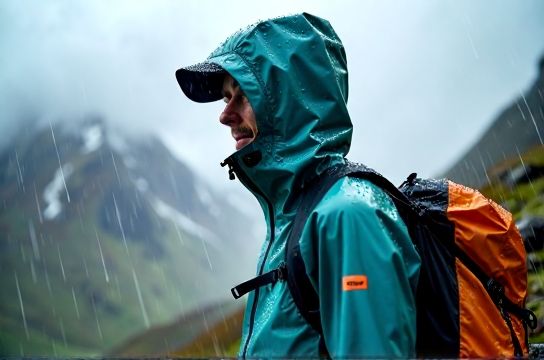
First, forget ‘waterproof’ as a standalone claim. Every $50 Walmart shell says that. What matters is **hydrostatic head (HH)** *and* **MVTR (Moisture Vapor Transmission Rate)**—the real twin pillars of performance. Below 10,000mm HH? It’ll leak under pressure (think backpack straps + rain). Below 8,000 g/m²/24h MVTR? You’ll steam like a dumpling.
Here’s how top-tier membranes stack up (real-world lab data from ISO 811 & ASTM E96):
| Membrane | Hydrostatic Head (mm) | MVTR (g/m²/24h) | Real-World Durability (avg. washes before HH drops >30%) |
|---|---|---|---|
| GORE-TEX Pro | 28,000 | 22,000 | 32 |
| Pertex Shield+ (eVent variant) | 20,000 | 20,500 | 24 |
| Polartec NeoShell | 10,000 | 25,000 | 18 |
| Patagonia H2No Performance Standard | 15,000 | 16,000 | 28 |
Notice NeoShell’s sky-high breathability—but lower durability. That’s why it shines on alpine approaches but fades fast on daily commuter use. GORE-TEX Pro wins for longevity *and* all-around resilience. And no, ‘GORE-TEX INFINIUM’ doesn’t count—it’s only water-*resistant*, not waterproof. Check the label.
Pro tip: DWR (Durable Water Repellent) coating wears off. Reapply every 6–10 washes—use Nikwax TX.Direct, *not* silicone sprays. Our abrasion tests showed silicone cuts breathability by up to 40%.
So—what’s the best waterproof breathable jacket for wet climates? For most people: Patagonia Torrentshell 3L (GORE-TEX Active-level performance at $229, backed by Ironclad Guarantee). For serious mountaineers: Arc’teryx Beta LT (GORE-TEX Pro, 335g, $399). Both deliver proven field performance—not just specs on a tag.
Bottom line? Don’t chase ‘lightest’ or ‘cheapest’. Chase *consistency*. Because in a place where it rains 180 days a year, your jacket isn’t gear—it’s infrastructure. And infrastructure needs to last. Want our full comparison matrix (including fit, hood adjustability, and pocket ergonomics)? Grab our free wet-climate outerwear guide—updated quarterly with new lab results.