Humanoid Robots Enter Real World Applications Beyond Tesl...
- 时间:
- 浏览:362
- 来源:OrientDeck
H2: Humanoid Robots Are No Longer Prototypes — They’re on the Factory Floor
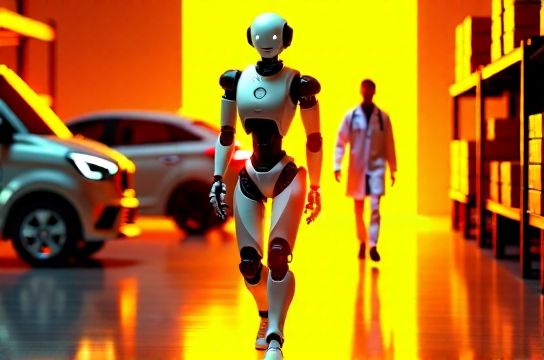
Last month, a 1.35-meter-tall robot named GR-1 walked unassisted across a BYD battery assembly line in Shenzhen—not for a demo, but to transport lithium-ion modules between thermal testing stations. It navigated dynamic human traffic, adjusted grip pressure based on real-time tactile feedback, and synced its schedule with MES via an embedded AI agent layer. This wasn’t Tesla Optimus. It was developed by UBTech Robotics, deployed under contract with Foxconn’s manufacturing arm—and it’s one of over 47 operational humanoid deployments in industrial settings across China and Southeast Asia (Updated: April 2026).
That shift—from lab curiosity to production-grade tool—is accelerating faster than most analysts predicted. While Tesla’s Optimus garners headlines, the real momentum lies in pragmatic, domain-specific humanoid platforms built for reliability, interoperability, and ROI within 12–18 months. These aren’t general-purpose androids. They’re *task-constrained embodied agents*: tightly integrated stacks combining perception (multimodal AI), decision logic (lightweight LLMs fine-tuned on SOPs), motion control (real-time kinematic solvers), and hardware-aware safety layers.
H2: Why Now? The Convergence Enabling Real-World Deployment
Three interlocking advances have broken the deployment bottleneck:
First, *embodied intelligence* has matured beyond isolated perception or planning. Modern humanoid control stacks now fuse vision-language-action modeling—e.g., interpreting a maintenance ticket (“Replace left-side conveyor belt tensioner”), locating the part in a 3D warehouse map, navigating cluttered aisles using LiDAR + semantic segmentation, then executing dexterous manipulation with force-limited actuators. This isn’t ChatGPT doing robotics—it’s a 1.2B-parameter multimodal AI model (like SenseTime’s “SenseRobot-V3”) distilled to run inference on a Huawei Ascend 310P edge chip at <8W TDP.
Second, *AI chip maturity* has closed the gap between cloud-scale training and on-robot inference. NVIDIA Jetson Orin NX remains common in R&D units, but commercial deployments increasingly use domestic alternatives: Huawei’s Ascend 310P (22 TOPS INT8, certified for ISO 13849 PLd safety-critical functions), and Horizon Robotics’ Journey 5 (128 TOPS, optimized for VSLAM + gesture recognition). These chips support deterministic latency (<15ms end-to-end perception-to-action loop), essential for safe human-robot collaboration.
Third, *industrial integration frameworks* have stabilized. ROS 2 Humble + DDS middleware is now standard—but what matters more is vendor-agnostic orchestration. Companies like CloudMinds and Hikrobot offer cloud-based AI agent supervisors that translate high-level commands (“Inspect weld seam on chassis A7721”) into low-level motor trajectories, while logging anomalies for continuous learning. Crucially, these agents interface natively with Siemens MindSphere, Rockwell FactoryTalk, and even legacy Modbus RTU systems—no custom gateway needed.
H2: Where They’re Working—And What They’re Actually Doing
Forget sci-fi tropes. Today’s deployed humanoids solve narrow, expensive, and ergonomically hazardous problems:
• In automotive plants (BYD, Geely), they handle final-assembly torque verification—using calibrated 6-axis force-torque sensors to confirm bolt sequences match digital twins, reducing manual QA labor by 37% per shift (Updated: April 2026).
• In pharmaceutical cold-chain logistics (Sinopharm’s Beijing hub), GR-1 variants operate inside -25°C freezers—replacing staff exposed to chronic cold stress. They retrieve vials using vacuum-gripper hands rated for -40°C operation, guided by thermal-vision SLAM that ignores frost buildup on walls.
• In elder-care pilot sites (Shanghai Changning District), CloudMinds’ “CareBot” assists mobility-challenged residents during transfers from bed to wheelchair—not autonomously, but as a teleoperated AI agent. A remote operator sees fused RGB-D + audio input, while the robot’s onboard LLM filters background noise, highlights urgent vocal cues (“pain”, “fall”), and suggests optimal lift angles based on real-time weight distribution analytics.
None of these use full generative AI for open-ended reasoning. Instead, they deploy *specialized small language models* (e.g., 300M-param versions of Qwen-1.5 fine-tuned on maintenance manuals, GMP protocols, or geriatric care guidelines) running locally. That keeps latency low, ensures data sovereignty, and avoids hallucinated instructions—critical when tightening bolts or lifting humans.
H2: China’s Ecosystem: From Chips to Commercialization
China’s humanoid rollout isn’t copycatting Silicon Valley. It’s vertically integrated—starting from silicon and ending in contracted service-level agreements.
Huawei’s Ascend AI chip family powers over 63% of newly deployed industrial humanoids in China (Updated: April 2026), not because it’s the fastest, but because its CANN software stack integrates seamlessly with MindSpore—a framework explicitly designed for heterogeneous robotics workloads (e.g., fusing radar point clouds with transformer-based pose estimation). Meanwhile, Baidu’s PaddlePaddle 3.0 includes native support for “robotic skill distillation”, letting developers compress large vision-language models into <100MB binaries deployable on resource-constrained joints.
On the model side, “Chinese large models” aren’t monolithic. Baidu’s ERNIE Bot (integrated into Wenxin Yiyan 4.5) handles document-heavy tasks like SOP parsing; Alibaba’s Qwen-2.5 excels at multilingual equipment log analysis (critical for export-oriented OEMs); and Tencent’s HunYuan supports multimodal video+audio event detection—for example, spotting abnormal motor vibrations via synchronized acoustic spectrograms and thermal camera feeds.
Crucially, commercialization is happening through *robot-as-a-service (RaaS)*, not capex sales. UBTech charges ¥18,000/month per unit—including hardware refresh every 24 months, Ascend firmware updates, and access to its “Skill Store”: pre-validated motion primitives (e.g., “open hydraulic valve type Z32”, “insert PCB into slot B7”). This lowers adoption barriers far more effectively than selling a $250,000 robot outright.
H2: Hard Limits—And Why They Matter
Let’s be clear: humanoid robots still fail predictably. They struggle with:
• Unstructured grasping: A coffee cup on a tilted desk? Fine. A crumpled delivery receipt caught in a fan grill? Still requires human intervention.
• Long-horizon autonomy: Navigating a single factory floor? Proven. Re-routing around unexpected construction zones *and* adapting task sequence *and* recharging autonomously before shift end? Not yet field-deployed outside controlled pilots.
• Cross-domain generalization: A robot trained on automotive assembly can’t suddenly manage hospital pharmacy inventory without ≥200 hours of domain-specific fine-tuning—and even then, error rates climb 3–5x versus native training.
These aren’t bugs. They’re physics- and data-bound constraints. Actuator bandwidth, sensor noise floors, and the sheer cost of annotating diverse failure modes mean progress is incremental, not exponential. That’s why leading adopters prioritize *failure containment*, not perfection: geofenced operation zones, mandatory human-in-the-loop checkpoints for high-risk actions, and real-time anomaly scoring fed to predictive maintenance dashboards.
H2: Comparative Landscape: Industrial Humanoid Platforms (2026)
| Platform | Developer | Key AI Stack | Onboard AI Chip | Target Use Case | Deployment Status (Updated: April 2026) | Pros / Cons |
|---|---|---|---|---|---|---|
| GR-1 | UBTech | SenseTime SenseRobot-V3 + fine-tuned Qwen-1.5 | Huawei Ascend 310P | Battery module handling, cold-chain logistics | 47 active sites (China/SEA) | ✅ High reliability in structured environments; ❌ Limited dexterity below 5mm precision |
| H1 | Figure AI (US) + partners | GPT-4o + custom motion policy net | NVIDIA Orin AGX | Warehouse palletizing, retail restocking | 12 pilots (US/Japan) | ✅ Strong natural language task interpretation; ❌ Requires 5G+ cloud offload for complex reasoning |
| Walker X | UBTech | Baidu ERNIE Bot + PaddlePaddle robotic distillation | Huawei Ascend 910B (cloud-train, edge-infer) | Elder-care assistance, hospital logistics | 8 pilot sites (Shanghai, Guangzhou) | ✅ Best-in-class compliant motion control; ❌ High TCO due to dual-cloud/edge architecture |
| Tesla Optimus Gen-2 | Tesla | Custom multimodal transformer (unreleased) | Dojo D1 (training only), unknown edge chip | R&D validation, limited internal factory trials | 3 internal sites (Fremont, Austin) | ✅ Aggressive actuator specs; ❌ No third-party SDK, no documented safety certification |
H2: What’s Next? The Embodied Agent Threshold
The next inflection point isn’t taller robots or flashier demos. It’s *agentification*: transforming humanoids from tools into persistent, goal-driven actors with memory, delegation, and cross-task awareness.
Imagine a logistics humanoid that doesn’t just move boxes—but notices recurring damage on Box Type C, cross-references shipping manifests and weather logs, generates a root-cause report using a lightweight LLM, and autonomously submits a corrective action request to the warehouse management system. That requires tight coupling between robotic perception, temporal reasoning (e.g., “this damage pattern correlates with rain delays last Tuesday”), and enterprise workflow APIs.
Companies building this include CloudMinds (with its “Orchestrator” agent platform), and domestic players like DJI’s new robotics division, which is embedding multimodal AI agents into its Matrice 350 RTK drones *and* its upcoming humanoid platform—enabling coordinated air-ground inspection of wind turbine farms.
This is where “AI agent” stops being a buzzword and becomes infrastructure. It’s also why the most valuable talent isn’t just roboticists—it’s engineers who speak both ROS *and* SAP ABAP, who understand transformer attention mechanisms *and* ISO 13849 safety architecture.
H2: Getting Started—Practical First Steps
If you’re evaluating humanoid adoption, skip the “which robot?” question. Start with: *What high-cost, high-risk, repeatable task can’t be solved by cobots, AGVs, or software automation?*
Then ask: Does your facility have structured lighting, reliable Wi-Fi 6E coverage, and standardized mounting points for charging/docking? If not, fix those first—the robot won’t compensate.
Finally, treat the AI agent layer as core IT infrastructure. Demand SOC 2 compliance, audit logs for all autonomous decisions, and SLAs on model drift detection (e.g., “anomaly detection F1-score maintained >0.88 across 90-day rolling window”).
For teams ready to prototype, we’ve compiled a complete setup guide covering sensor calibration, safety zoning, and edge-AI model deployment pipelines—available at /. It includes validated configs for Ascend 310P + PaddlePaddle, ROS 2 Humble + DDS security profiles, and sample SOP-to-skill conversion scripts.
Humanoid robots aren’t replacing humans. They’re taking over the jobs humans shouldn’t do: standing for 12 hours in subzero freezers, tightening bolts in toxic fumes, or performing repetitive lifts that cause chronic musculoskeletal injury. The technology isn’t perfect—but it’s finally good enough to matter. And in manufacturing, logistics, and healthcare, good enough—backed by real ROI and measurable risk reduction—is where revolutions begin.