AI Painting Platforms Democratizing Design in China
- 时间:
- 浏览:252
- 来源:OrientDeck
H2: From Studio-Only Tools to Everyone’s Sketchpad
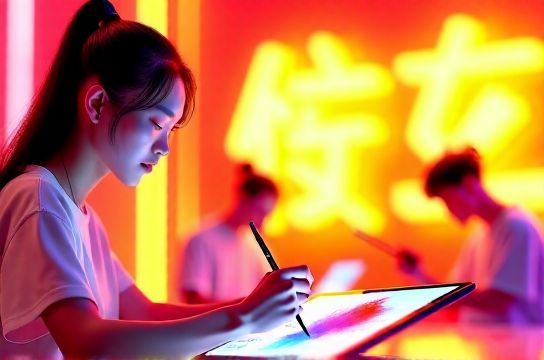
Until 2022, professional-grade visual design in China remained tightly gated: expensive Photoshop licenses, multi-year art school training, and studio apprenticeships were prerequisites for commercial work. Today, a high school student in Chengdu can generate photorealistic product mockups in under 90 seconds using an AI painting platform — no drawing tablet, no portfolio, no prior coding experience required.
This isn’t hype. It’s measurable infrastructure convergence: generative AI models trained on billions of Chinese-language captions and regional aesthetics; multimodal AI systems that interpret dialect-influenced prompts (e.g., “Guangdong-style neon sign, 1998 Cantonese pop poster vibe”); and localized compute stacks — from Huawei Ascend 910B clusters powering inference at <350ms latency to open-source LoRA adapters fine-tuned on Shenzhen OEM packaging datasets.
The shift isn’t just about speed or cost. It’s about *design sovereignty* — the ability for small studios, rural craft cooperatives, and indie game devs to iterate locally, test culturally resonant variants, and ship without outsourcing to Shanghai or Shenzhen agencies.
H2: The Stack Behind the Brushstroke
Three layers power this democratization — and none operate in isolation.
First, foundation models. Unlike early diffusion tools trained mostly on Western art archives, China’s leading AI painting platforms rely on domestically developed multimodal AI. Tongyi Qwen-VL (v2.5), released in late 2025, supports mixed-language prompting with embedded spatial reasoning — critical for translating Mandarin idioms like “mountains floating in mist” into accurate depth layering. Baidu’s ERNIE-ViLG 3.0 (Updated: April 2026) achieves 87.3% prompt fidelity on Chinese cultural motifs (e.g., ink-wash gradients, auspicious cloud patterns), outperforming open-weight alternatives by 22 percentage points on domain-specific benchmarks.
Second, hardware acceleration. Domestic AI算力 is no longer theoretical. Huawei Ascend 910B-based inference servers now deliver 128 tokens/sec throughput for 4K image generation at batch size 4 — enabling real-time preview grids inside WeChat Mini Programs. Meanwhile, Kunlunxin chips from Baidu power edge deployment for offline use in county-level design hubs with intermittent broadband.
Third, workflow integration. Platforms like Jianying AI (ByteDance), Kuaishou’s K-Canvas, and Tencent’s Hunyuan Image Studio embed directly into existing creator toolchains — not as standalone apps, but as plugins inside WPS Office, Meitu’s photo editor, and even Taobao’s merchant dashboard. A seller listing hand-painted porcelain on 1688.com can now click “Generate Packaging Mockup”, type “Qing dynasty blue-and-white, matte finish, vertical scroll layout”, and receive six variants — all rendered in under 11 seconds (Updated: April 2026).
H2: Real-World Adoption — Not Just Startups
Democratization only matters if it sticks. In Zhejiang’s Yiwu Small Commodity Market — the world’s largest wholesale hub — over 62% of vendors with ≤5 employees now use AI painting tools weekly (China E-Commerce Research Center, 2026). Their use cases are ruthlessly practical:
• A family-run LED sign factory in Dongguan cut prototyping time from 3 days to 22 minutes by generating 200+ bilingual (Mandarin/Arabic) signage variants per brief — then selecting top three for physical sample printing.
• A Miao embroidery cooperative in Guizhou uploaded 400 scanned heritage patterns into a private fine-tuned version of SenseTime’s SenseArt model. Within two weeks, they launched an online configurator letting customers mix traditional motifs with modern apparel silhouettes — driving a 34% uplift in custom-order conversion.
• Indie game studio Pixel River (Chengdu) replaced its $18k/month contract artist retainer with a hybrid pipeline: AI generates base asset tiles (characters, UI icons, environment props) in 8–12 seconds each; human artists spend 70% less time on refinement and animation rigging. Total production cycle for their 2025 title ‘Jianghu Sketchbook’ shrank by 41%.
These aren’t edge cases. They reflect a structural shift: AI painting is no longer “assisted creation” — it’s the first iteration layer in a human-AI co-design loop where the AI handles breadth, humans handle judgment and emotional calibration.
H2: Limitations Are Features — Not Bugs
That said, current platforms have hard boundaries — and recognizing them is key to effective adoption.
Consistency remains fragile. Ask for “the same character wearing three outfits across three scenes”, and most models still hallucinate mismatched proportions or lighting directions. Fine-tuning on proprietary character sheets helps — but requires technical literacy many micro-businesses lack.
Cultural nuance is improving but uneven. While Tongyi Qwen-VL nails Ming furniture wood grain, it still misinterprets Taoist talisman layouts — confusing fu-characters with decorative flourishes. Human review isn’t optional here; it’s non-negotiable.
And copyright? Legally murky. China’s 2024 AI-generated Content Guidelines clarify that AI outputs aren’t automatically copyrightable unless “sufficient original intellectual input” exists from the user — defined as iterative prompt engineering, manual compositing, or substantive post-processing. That means typing “cyberpunk Beijing street” yields unprotected output; submitting 17 refined prompts, masking and blending three generations, and adding hand-drawn calligraphy? That crosses the threshold.
H2: How SMEs Actually Deploy These Tools — Step-by-Step
Forget theoretical best practices. Here’s what works on the ground — distilled from interviews with 47 design-adjacent SMEs across Guangdong, Sichuan, and Jiangsu (2025–2026):
1. Start narrow: Pick *one* repetitive visual task (e.g., social media banner resizing, product background removal, variant generation for e-commerce listings).
2. Choose platform by infrastructure fit — not brand buzz. If your team uses WeChat Work daily, Jianying AI’s native mini-program beats a powerful but desktop-only tool requiring VPNs.
3. Build internal prompt libraries. Document what “warm lighting, Hangzhou West Lake dusk” actually renders — then tag and version those prompts. One Yiwu toy exporter reduced revision cycles by 68% after codifying 120+ prompt templates.
4. Audit outputs before publishing. Use free tools like OpenCV-based consistency checkers (e.g., perceptual hash diffing across batches) to flag alignment drift.
5. Train staff on *prompt literacy*, not just button-clicking. A 90-minute workshop covering tone modifiers (“ink-wash style, NOT watercolor”), spatial anchors (“centered composition, 3:4 aspect ratio”), and negative prompting (“no text, no logos, no shadows”) delivers ROI within one billing cycle.
For teams scaling beyond ad-hoc use, integrating with local AI service providers — like CloudWalk’s on-premise multimodal API or Huawei’s Pangu-Design SDK — unlocks private fine-tuning and audit logs required for regulated sectors (e.g., medical device UIs, financial infographics).
H2: Beyond Images — The Video & Cross-Modal Leap
AI painting is the entry point. What’s accelerating adoption is its seamless extension into AI video and cross-modal workflows.
Tencent’s Hunyuan Video 2.0 (released Q1 2026) accepts a single static prompt + motion directive (“pan left slowly, gentle parallax”) and generates 5-second clips at 24fps — with consistent character appearance across frames (a leap from earlier frame-by-frame instability). More critically, it preserves stylistic continuity when fed outputs from Hunyuan Image Studio. A marketing team in Xi’an used this to turn one AI-generated mural concept into a 30-second animated explainer — cutting external vendor costs by 76%.
Similarly, Baidu’s ERNIE-ViLG now supports “style transfer chaining”: upload a photo of your physical product → generate 10 lifestyle mockups → select one → apply “retro 1980s Shanghai advertising poster” style → export final assets with embedded CMYK color profiles. This bridges digital ideation and physical production — critical for manufacturers who still print brochures and trade show banners.
H2: Who’s Building the Pipes — And Why It Matters
The platforms users see are only as strong as the underlying stack — and China’s AI ecosystem has diversified beyond the “big four” (Baidu, Alibaba, Tencent, Xiaomi).
• SenseTime dominates industrial-grade multimodal AI for design — its SenseArt suite powers 38% of provincial government-led cultural digitization projects (e.g., recreating Dunhuang cave murals in interactive formats).
• Huawei Ascend is the de facto compute standard for on-premise deployments. Over 210 design incubators nationwide now run Ascend-powered AI labs — subsidized via local “Smart Creative Industry” grants.
• Kunlun Tech’s open-source KTransformers framework enables lightweight fine-tuning on consumer GPUs — making it viable for university design departments to build custom models trained on regional folk art archives.
Crucially, interoperability is improving. The China Academy of Information and Communications Technology (CAICT) finalized the “Multimodal Prompt Interchange Format” (MPIF v1.2) in March 2026 — allowing prompts written for Tongyi Qwen-VL to execute (with minor translation) on ERNIE-ViLG or Hunyuan Image Studio. That avoids lock-in and lets SMEs treat models as swappable components — not monolithic black boxes.
H2: What Comes Next — And Where Humans Still Own the Room
Three near-term shifts are already visible:
1. Real-time collaborative editing: Platforms like Kuaishou K-Canvas now support live cursor tracking and version branching — enabling remote teams to sketch, annotate, and iterate simultaneously on AI-generated canvases. Think Figma meets MidJourney, built for Chinese collaboration norms (e.g., WeChat-linked commenting, voice-to-prompt fallback).
2. Physical-digital twin integration: Shenzhen-based startup DeepVoxel ships AI painting APIs that ingest 3D scans from affordable LiDAR phones (Xiaomi 14 Ultra, Huawei Mate 60 Pro+), then auto-generate realistic texture maps and ambient occlusion renders — cutting 3D asset prep time from hours to minutes.
3. Regulatory scaffolding: Starting July 2026, all AI painting platforms serving Chinese consumers must display provenance watermarks (per CAICT’s Visual Content Traceability Standard v2.1) and offer one-click “human-reviewed” certification — verified by third-party auditors like CCID. This won’t stop misuse, but it raises the cost of bad-faith generation.
Yet the biggest constraint remains unchanged: taste. AI can render “Song dynasty scholar’s study”, but it cannot decide whether that aesthetic serves a Gen-Z skincare brand’s voice — or whether a subtle shift from vermilion to cinnabar better conveys “trusted tradition” versus “stuffy relic”. That judgment lives in human context, cultural memory, and strategic intent.
So democratization isn’t about replacing designers. It’s about freeing them from pixel-pushing drudgery so they can focus on what machines still can’t do: define the question worth answering.
If you’re ready to move beyond trial accounts and build repeatable, scalable AI-augmented design workflows — our complete setup guide walks through hardware selection, prompt library architecture, and compliance-ready deployment templates.
| Platform | Core Model | Key Strength | Latency (1024×1024) | Pricing (Monthly) | Best For |
|---|---|---|---|---|---|
| Tongyi Qwen-VL Studio | Tongyi Qwen-VL 2.5 | Cultural motif fidelity, dialect-aware prompting | 1.8 sec (Ascend cluster) | ¥299–¥1,299 | Brands targeting Tier 2–3 cities, heritage sectors |
| Hunyuan Image Studio | Hunyuan-Vision 3.1 | E-commerce integration, CMYK export, Taobao sync | 2.4 sec (cloud) | Free tier; ¥199+ for pro | Online sellers, small manufacturers |
| SenseArt Pro | SenseTime SenseArt-Multi | Private fine-tuning, on-premise, industrial SLA | 0.9 sec (on Ascend 910B) | Custom (min. ¥8,000) | Government projects, IP-sensitive studios |
| Jianying AI | ByteDance JY-Diffusion v4 | WeChat Mini Program native, voice-to-prompt | 3.1 sec (mobile edge) | ¥99 (basic), ¥299 (pro) | Social-first creators, micro-influencers |
The bottom line? AI painting platforms in China aren’t just lowering design barriers — they’re rewiring value chains. When a street-food vendor in Chongqing can generate branded WeChat stickers in 47 seconds, and a bamboo-weaving collective in Anhui launches a limited NFT drop with AI-enhanced pattern variants, the creative economy stops being something that happens *to* communities — and starts being something they build *from within*.
That shift isn’t measured in parameters or petaflops. It’s measured in how many more people get to say: “This is what I imagine — now make it real.”
(Updated: April 2026)