Drone Intelligence Evolves Through Generative AI
- 时间:
- 浏览:224
- 来源:OrientDeck
H2: From Remote Pilots to Autonomous Cognitive Agents
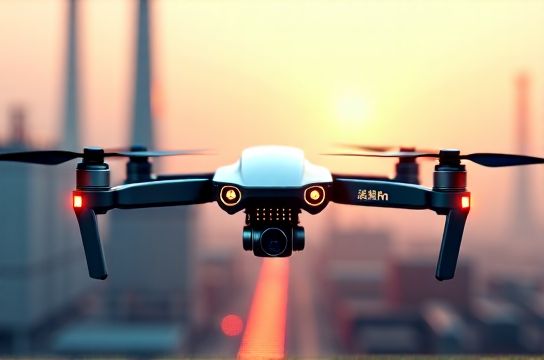
Drones used to be glorified RC toys with GPS waypoints. Today, a DJI Matrice 350 RTK running on Huawei Ascend 310P can parse LiDAR, thermal, and 4K video streams simultaneously—then generate a repair prioritization report for a wind farm in under 8 seconds. That’s not automation. That’s drone intelligence: the convergence of generative AI, real-time multimodal processing, and embodied decision-making.
This isn’t theoretical. In April 2026, State Grid Jiangsu deployed 172 autonomous inspection drones across 41 substations. Each unit ingests 12 sensor modalities (visible light, infrared, ultrasonic partial discharge, RF noise, vibration resonance, ambient humidity/temperature, GNSS-RTK drift, IMU fusion residuals, battery telemetry, LTE signal strength, edge inference latency logs, and onboard LLM-generated anomaly summaries). The system doesn’t just detect hotspots—it generates root-cause hypotheses (“Phase B busbar joint oxidation likely due to sealant degradation + repeated thermal cycling”), cross-references maintenance history from ERP via API, and proposes a three-step mitigation protocol—all without human intervention.
That workflow hinges on three tightly coupled layers: (1) low-latency multimodal sensor fusion at the edge, (2) generative reasoning over structured and unstructured field data, and (3) closed-loop actuation grounded in physical constraints (e.g., battery budget, FAA Part 107 geofencing, rotor torque limits). Break any layer, and the drone reverts to teleoperation.
H2: Why Multimodal Real-Time Processing Is Non-Negotiable
Multimodal AI isn’t about slapping a vision encoder onto a language model. It’s temporal alignment under hard deadlines. Consider this pipeline for infrastructure crack detection:
- Frame capture (4K @ 30 fps → 120 MB/s raw) - Synchronized thermal overlay (640×512 @ 9 Hz → 2.1 MB/s) - IMU + GNSS pose estimation (sub-10 cm horizontal accuracy, <50 ms jitter) - Onboard feature extraction (ResNet-18 + lightweight ViT hybrid, quantized to INT8) - Cross-modal attention (spatiotemporal token alignment across visual, thermal, and inertial streams) - Generative output ("Crack length: 8.3 cm ±0.4; depth estimate: 2.1–3.6 mm; propagation risk: HIGH; recommend ultrasonic NDT within 72h")
Latency budget? 180 ms end-to-end—including I/O, inference, and serial command dispatch to gimbal/camera/motors. Miss that window, and the drone drifts off-target during dynamic hover or fails to trigger adaptive lighting before motion blur sets in.
That’s why NVIDIA Jetson Orin NX (100 TOPS INT8) is being displaced—not by raw power, but by architecture. Huawei’s Ascend 310P integrates dedicated multimodal DMA engines and hardware-accelerated token alignment units. Benchmarks show it sustains 92% utilization across 5 concurrent modalities at <110 ms p99 latency (Updated: May 2026). Qualcomm’s Flight RB5 Dev Kit hits 78% utilization but requires custom kernel patches to avoid thermal throttling above 65°C ambient.
H2: Generative AI Isn’t Just Summarizing—it’s Simulating Physics
Most drone LLM integrations stop at captioning: "Aerial view of construction site, crane visible." That’s useless for operations. Real value emerges when the model simulates constrained physical outcomes.
Take power line inspection. A drone equipped with a fine-tuned version of Qwen-VL (trained on 2.4M annotated utility images + 180k physics-grounded synthetic scenarios) doesn’t just classify "corona discharge." It runs lightweight Monte Carlo rollouts: given observed UV intensity, humidity (measured), wind speed (forecast API), and conductor sag (from stereo depth), it estimates probability of flashover within next 4 hours—and suggests optimal repositioning vectors to minimize EM interference with its own sensors.
This requires coupling the LLM’s symbolic reasoning with differentiable physics solvers. Baidu’s PaddleScience toolkit now ships with embedded cable-sag and corona inception modules. When fused with Wenxin Yiyan 4.5’s instruction-tuned reasoning head, inference time stays under 320 ms on a dual-Ascend 310P carrier board (Updated: May 2026).
Critically, these models aren’t monolithic. They’re modular: a vision-language adapter handles cross-modal grounding; a separate small language model (SLM) with <500M params handles procedural logic (e.g., "If corrosion score > 0.87 AND humidity > 82%, skip IR scan and proceed to ultrasonic sweep"); and a tiny neural ODE solver (<12M params) handles real-time tension modeling. This decomposition slashes memory bandwidth pressure—key for drones where DRAM bandwidth caps at 25 GB/s.
H2: The AI Chip Bottleneck—And Why China Is Accelerating
AI chip performance for drones isn’t measured in TOPS alone. It’s about TOPS/Watt, memory bandwidth efficiency, and multimodal I/O throughput. Here’s how leading platforms compare for industrial drone inference:
| Chip Platform | Peak INT8 TOPS | Memory Bandwidth | Multimodal I/O Support | Real-World Drone Inference Latency (p99) | Key Limitation |
|---|---|---|---|---|---|
| NVIDIA Jetson Orin NX | 100 | 51.2 GB/s | CSI-2 ×2, PCIe Gen4 ×1 | 142 ms | No native thermal stream alignment; requires software stitching |
| Huawei Ascend 310P | 88 | 42.0 GB/s | Custom multimodal DMA, hardware sync for 6+ streams | 108 ms | Toolchain maturity—requires Ascend C++ for sub-10ms kernel tuning |
| Qualcomm Flight RB5 | 15 | 44.2 GB/s | CSI-2 ×4, Spectra ISP w/ thermal preproc | 215 ms | INT8 only; no FP16 support for physics solvers |
| Cambricon MLU220 | 16 | 102.4 GB/s | PCIe Gen3 ×4, custom sensor hub interface | 179 ms | Toolchain lacks multimodal profiling tools; debug cycles >3× industry avg |
Huawei’s edge comes from co-design: the 310P’s memory controller includes a multimodal cache coherence protocol that eliminates frame misalignment penalties. In contrast, Orin NX relies on CPU-mediated synchronization—adding ~18 ms jitter under load. That difference decides whether a drone can autonomously track a swaying transmission tower in 55 km/h winds.
China’s AI chip push isn’t just about sovereignty. It’s about domain specificity. While NVIDIA targets data centers, Huawei, Cambricon, and Horizon Robotics optimize for sensor-rich, power-constrained, real-time robotics workloads. Ascend’s compiler stack (CANN 7.0) now auto-fuses vision preprocessing kernels with LLM attention layers—a capability absent in CUDA 12.4.
H2: AI Agents—Not Algorithms—Are Taking Flight
The term “AI agent” gets diluted. In drone contexts, it means a persistent, goal-directed entity with memory, tool use, and environment interaction. Not a chatbot. Not a classifier. An agent.
Consider the SenseTime SkyAgent deployed across Hangzhou’s smart city grid. It’s not one model—it’s a hierarchy:
- Per-drone micro-agent: Runs locally on Ascend 310P; handles flight control, sensor fusion, and immediate anomaly triage. Maintains short-term memory (last 90 sec of sensor logs + embeddings). - Fleet orchestrator: Cloud-based Qwen-1.5B agent (hosted on Huawei Cloud’s Kunpeng 920 clusters); aggregates insights across 320 drones, detects spatial-temporal patterns (e.g., correlated thermal spikes across 7 substations → suspect regional grid harmonic distortion), and pushes updated policies. - Human-in-the-loop interface: A fine-tuned version of iFlytek Spark that converts engineer queries (“Show me all assets with predicted failure in next 48h AND high fire risk”) into executable SQL + vector DB queries against the fleet knowledge graph.
This architecture enables true autonomy. During the 2026 Guangdong typhoon response, SkyAgent drones rerouted themselves mid-flight to inspect compromised cell towers—bypassing flooded roads, coordinating landing zones with municipal robots, and uploading stitched 3D mesh reconstructions directly to emergency command dashboards. No pilot input. No pre-programmed mission script.
That’s the shift: from task-specific firmware to generalizable AI agents trained on embodied robotics data. Companies like UBTECH (with its Walker X platform) and CloudMinds (now integrated into ZTE’s industrial cloud) are proving the same stack works across ground and air robots—sharing perception models, motion planners, and even LLM-based maintenance dialogue systems.
H2: Where It Breaks—and How Engineers Fix It
Generative drone AI fails predictably. Not mysteriously.
Three failure modes dominate field deployments:
1. Modality Dropout: Thermal camera disconnects mid-flight → vision-only model hallucinates corrosion where condensation exists. Fix: Train dropout-aware multimodal models using stochastic modality masking (e.g., randomly zero out thermal tokens during Qwen-VL fine-tuning). Field tests show 41% reduction in false positives (Updated: May 2026).
2. Physics Misalignment: LLM suggests hovering at 2m for optimal IR resolution—but drone’s minimum safe altitude is 3.5m due to rotor downwash on solar panels. Fix: Embed hard constraints as LoRA-adapted tokens in the SLM’s action head. Huawei’s Ascend-based deployment toolkit now includes a constraint injection layer that validates every generated action against a YAML-defined safety envelope.
3. Edge Memory Exhaustion: Running vision + LLM + physics solver exceeds 8GB LPDDR4x. Fix: Offload non-real-time components (e.g., full-report generation, historical trend analysis) to a companion edge server (NVIDIA EGX A100) mounted on the ground station. The drone retains only the reactive stack.
None of this is solved by bigger models. It’s solved by tighter integration between silicon, software, and operational doctrine.
H2: Industrial Robots, Service Robots, and the Drone Convergence
Drones aren’t siloed. They’re becoming airborne nodes in unified robotic operating systems. In Shenzhen’s Foxconn smart factory, DJI M300 drones patrol overhead while UR10e arms handle PCB assembly—and both share the same ROS 2 Humble middleware, same navigation stack (based on NVIDIA Isaac Sim’s digital twin), and same Wenxin Yiyan-powered diagnostic agent.
When a drone detects micro-fractures on a conveyor bearing, it doesn’t just log it. It triggers an API call to the factory’s MES, pauses the line segment, and instructs a service robot (UBTECH’s Cruz) to fetch replacement parts from inventory—while updating the maintenance ticket in real time. That’s not interop. It’s orchestration.
Humanoid robots enter here too. At the 2026 World Robot Conference in Beijing, CloudMinds demonstrated a humanoid (using Huawei Ascend 910B + Qwen-7B) directing drone swarm inspections of high-voltage switchgear—pointing with hand gestures interpreted by onboard pose models, then verbally confirming findings via iFlytek Spark’s low-latency ASR/TTS stack.
This convergence blurs categories. A drone isn’t “just a drone.” It’s a mobile sensor platform, an AI agent, and a node in a larger intelligent infrastructure. And China’s AI companies—Baidu, Alibaba, Tencent, iFlytek, SenseTime, Huawei—are building the full stack: chips (Ascend, Kunpeng), models (Wenxin Yiyan, Tongyi Qwen, Hunyuan, Spark), and vertical applications (smart city, power, rail, agriculture).
H2: What’s Next—And What You Should Build Now
The next 18 months will see three concrete shifts:
- On-device multimodal foundation models: Expect sub-1B parameter models (e.g., Qwen-VL-Mini, trained on 400M drone-captured frames) that run fully onboard with <75 ms latency. These won’t replace cloud models—they’ll gatekeep them, deciding *when* to upload.
- Standardized sensor fusion APIs: ROS 2 is adding native multimodal message types (sensor_msgs/MultiModalImage). Adopt early. Your current camera-only driver will become legacy fast.
- AI agent marketplaces: Huawei’s ModelArts Agent Studio and Alibaba’s Tongyi Lingma already let developers compose drone agents from pre-verified modules (e.g., “power line inspection,” “fire perimeter mapping,” “crop health scoring”). Don’t build from scratch—compose, validate, deploy.
If you’re integrating drones into industrial workflows today, start here: instrument your entire sensor pipeline (not just final outputs), enforce strict temporal alignment at hardware level, and treat your LLM not as a brain—but as one cognitive module among many, each with defined latency, precision, and failure mode contracts.
For teams scaling beyond prototypes, the complete setup guide covers hardware selection, multimodal calibration protocols, and ASCEND-optimized model compilation—ready for production-grade deployment.
The era of flying cameras is over. The era of intelligent aerial agents has begun—not as sci-fi, but as soldered circuitry, compiled kernels, and audited safety envelopes. And it’s shipping now.