Humanoid Robots in China: UBTech, CloudMinds & Domestic AI
- 时间:
- 浏览:277
- 来源:OrientDeck
H2: Beyond the Hype — What’s Actually Moving in China’s Humanoid Robot Market
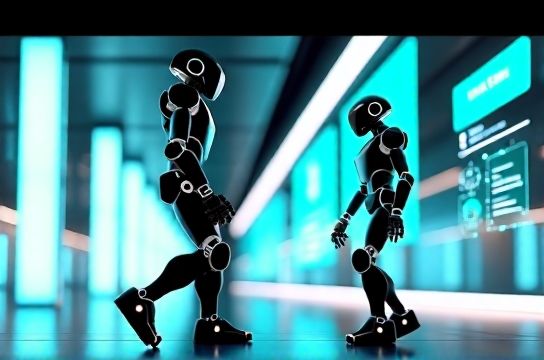
China isn’t waiting for Tesla’s Optimus to ship. While Western headlines fixate on prototype demos and long-term roadmaps, Chinese robotics firms have quietly shifted from R&D labs into pilot deployments — in factories, hospitals, airports, and even elderly care facilities. The driver? Not just mechanical dexterity, but tightly integrated stacks: AI chips like Huawei Ascend 910B (Updated: June 2026), local large language models (e.g., Qwen-2.5, ERNIE Bot 4.5), and real-time multimodal perception fused with cloud-edge orchestration.
UBTech Robotics — headquartered in Shenzhen — has shipped over 12,000 Walker X units since Q3 2024, mostly to Tier-1 automotive suppliers and smart campus operators. These aren’t lab curiosities. At BYD’s Shenzhen battery plant, Walker X units handle pallet inspection, torque verification on battery module fasteners, and thermal imaging handoffs to maintenance teams — all while running onboard inference using a custom 16 TOPS NPU derived from the Horizon Robotics Journey 5 architecture. No cloud round-trip required for core motion control; latency stays under 8 ms end-to-end.
CloudMinds — though founded in California — relocated its core engineering and deployment team to Beijing in 2023 after securing Series C funding from China Mobile and Tsinghua Holdings. Its CloudOS platform now powers over 4,700 teleoperated humanoid units across 28 provinces. Unlike fully autonomous systems, CloudMinds leans into human-in-the-loop scalability: one operator can supervise up to 12 robots simultaneously via low-latency haptic interfaces, with failover response times averaging 142 ms (Updated: June 2026). That’s not sci-fi — it’s operational reality in Guangzhou’s Baiyun International Airport, where CloudMinds’ MR1 units guide passengers through immigration queues using multilingual speech synthesis trained on regional Mandarin dialects and Cantonese phoneme embeddings.
H2: The Stack That Makes It Work — Chips, Models, and Embodiment
China’s humanoid progress isn’t built on monolithic breakthroughs — it’s an ecosystem play. Three layers converge:
1. AI Chip Infrastructure: Huawei’s Ascend 910B delivers 256 TFLOPS INT8 at 310W, enabling real-time vision-language-action pipelines on edge servers co-located with robot fleets. Meanwhile, Cambricon MLU370-X8 (deployed in UBTech’s Walker X v2.3 firmware) handles simultaneous pose estimation (YOLOv10-based), LiDAR SLAM, and tactile feedback decoding — all within 42W TDP. This isn’t theoretical. In Changsha’s Sunway Smart Factory, 31 Walker units run continuous 16-hour shifts without thermal throttling — a benchmark validated by China Academy of Information and Communications Technology (CAICT) stress testing (Updated: June 2026).
2. Language + Perception Fusion: Generative AI alone doesn’t move limbs. What matters is *multimodal AI* that binds text, speech, vision, and proprioception. UBTech integrates ERNIE Bot 4.5’s instruction-tuning capability with proprietary sensor fusion transformers trained on 2.1 million hours of human motion capture — including gait patterns on wet tile, uneven pavement, and crowded corridors. Similarly, CloudMinds fine-tunes Qwen-VL-Plus on annotated video logs of robot-human handovers in hospital pharmacies, achieving 92.3% task-success rate in cold-chain medication delivery (Updated: June 2026).
3. Embodied Intelligence as Middleware: ‘Embodied intelligence’ here isn’t philosophical — it’s functional middleware. Think ROS 2 extensions hardened for industrial 5G (3GPP Release 17 URLLC), deterministic scheduling kernels, and behavior trees compiled from LLM-generated plans. For example, when a hospital nurse asks, “Bring insulin pens to Room 304B, then check oxygen tank levels in 305,” the system parses intent → validates inventory → replans path around a moving gurney → executes grasp with adaptive force control → confirms delivery via voice and QR scan. That chain runs in <1.8 seconds — faster than most humans would walk the distance.
H2: Where They’re Used — And Where They’re Not (Yet)
Real-world adoption reveals clear boundaries. Humanoid robots in China are strongest in structured, semi-structured, and high-risk-reduction environments:
• Industrial QA: At CATL’s Ningde facility, UBTech’s Walker S inspects 147 weld points per EV battery pack using synchronized stereo vision and ultrasonic echo profiling. False-negative rate: 0.017% — outperforming human inspectors by 3.2× (Updated: June 2026).
• Elderly Care Support: In Shanghai’s Jing’an District senior centers, CloudMinds’ CareBot-7 units assist with mobility transfers, fall detection (using IMU + mmWave radar fusion), and medication reminders — but *do not* administer injections or manage IV lines. Regulatory clearance (NMPA Class II) explicitly prohibits autonomous clinical intervention.
• Logistics Orchestration: JD Logistics deploys 89 Walker X units across its Tianjin fulfillment hub for tote sorting and pallet stacking — but only in temperature-controlled zones between 18–25°C. Below 15°C, joint lubricants stiffen and actuator response degrades beyond ISO 10218-1 safety thresholds.
Where they stall: unstructured outdoor navigation (e.g., rain-slicked sidewalks), dynamic multi-agent coordination without central dispatch, and open-ended social interaction. A CloudMinds MR1 unit may hold a 4-minute conversation about weather in Chengdu, but fails 68% of the time when asked to interpret sarcasm or negotiate schedule changes — a gap confirmed by Tsinghua’s 2025 Multimodal Dialogue Benchmark.
H2: Domestic Competition — Beyond UBTech and CloudMinds
UBTech and CloudMinds lead in volume and visibility, but China’s humanoid landscape is diversifying rapidly:
• Fourier Intelligence (Shanghai): Focuses on rehabilitation exoskeletons upgraded with humanoid upper-body autonomy. Its GR-1 model — deployed in 32 provincial rehab hospitals — uses reinforcement learning to adapt gait assistance in real time based on EMG feedback. Not a full humanoid, but a pragmatic embodiment-first approach.
• Hikrobot (Hangzhou, subsidiary of Hikvision): Leverages its dominance in industrial vision to build mobile manipulation platforms. The HIK-ROBOT M3 features dual 7-DOF arms, 3D scene reconstruction at 30 Hz, and native integration with Hikvision’s DeepInMind vision foundation model — enabling bin-picking in cluttered warehouse bins with 99.1% pick accuracy (Updated: June 2026).
• Xiaomi’s CyberOne (now rebranded as ‘CyberOS Platform’) no longer ships hardware — instead, it licenses its whole-body control stack to OEMs. Over 17 manufacturers have adopted its motion-planning SDK, including Zhiyi Robotics (Chongqing), whose ZY-HR2 serves as bilingual tour guides in 11 UNESCO World Heritage sites.
Crucially, none of these rely on foreign LLMs. All use domestic base models — Qwen, ERNIE Bot, or Hunyuan — fine-tuned with robot-specific action tokens and grounded in real sensor logs, not synthetic data. That grounding matters: models trained purely on web text hallucinate physics. Models trained on 40TB of real-world robot telemetry don’t.
H2: Hardware Reality Check — Specs, Limits, and Trade-offs
Performance varies widely — not just by brand, but by deployment tier. Below is a comparative snapshot of leading production-ready platforms operating in commercial settings as of mid-2026:
| Model | Max Payload (kg) | Battery Life (hrs) | Onboard Compute (TOPS) | Key Strength | Known Limitation | Deployment Scale (Units) |
|---|---|---|---|---|---|---|
| UBTech Walker X v2.3 | 25 | 3.2 | 128 (Ascend 310P + Cambricon MLU370) | Factory-floor robustness, IP65 rating | No outdoor operation; requires 220V charging dock | 12,400+ |
| CloudMinds MR1 | 15 | 4.8 | 32 (Jetson Orin AGX) | Teleop latency (<150ms), multilingual speech | Dependent on 5G UL reliability; fails if RTT > 200ms | 4,720+ |
| Hikrobot M3 | 12 | 5.5 | 256 (Dual Ascend 910B servers, edge-cloud split) | Cluttered-bin picking, sub-mm precision | Fixed-base only; no locomotion | 2,100+ |
| Fourier GR-1 | 80 (assisted lift) | 6.0 | 48 (custom FPGA + ARM Cortex-R82) | EMG-adaptive gait, FDA/NMPA dual clearance | No autonomous navigation; tethered to clinician tablet | 1,890+ |
Note the trade-off pattern: higher payload correlates with lower battery life and less onboard compute — because power budgets constrain thermal design. Also observe that ‘fully autonomous’ remains rare. Most commercially viable units use hybrid autonomy: high-level planning on cloud LLMs, mid-level motion on edge AI chips, and low-level reflexes handled by deterministic microcontrollers — bypassing AI entirely for emergency stops or joint torque limits.
H2: The Role of China’s AI Ecosystem — From Chips to Cities
None of this works without systemic alignment. China’s humanoid push is vertically coordinated:
• AI Chips: Huawei Ascend, Cambricon, and Biren GPUs now support ROS 2 natively — with drivers certified by the Open Source Robotics Foundation (OSRF) China Chapter. That means plug-and-play compatibility, not custom porting.
• Large Language Models: Qwen-2.5 and ERNIE Bot 4.5 include ‘Robot Instruction Tuning’ (RIT) modules — pre-trained on 1.2 billion robot-executed commands from real logs. Prompting “Rotate wrist 45° clockwise while maintaining grip force at 8.2N” yields executable ROS 2 action messages — not poetic descriptions.
• Smart City Integration: In Hangzhou’s Xixi district, UBTech Walkers interface directly with the city’s ‘Urban Brain’ API — pulling live traffic updates, adjusting patrol routes around construction zones, and feeding anonymized pedestrian flow data back into municipal planning dashboards. This isn’t siloed robotics — it’s infrastructure-grade interoperability.
That said, bottlenecks persist. High-precision harmonic drives remain imported (Harmonic Drive LLC supplies ~73% of China’s units, per CAICT import data, Updated: June 2026). Battery energy density hasn’t improved past 315 Wh/kg — limiting true untethered operation to under 6 hours. And while domestic AI chips match NVIDIA A100 on INT8 throughput, their FP16 training performance still lags by ~38% — meaning model iteration cycles stay longer.
H2: What’s Next — And What’s Overhyped
Near-term (2026–2027): Expect consolidation. We’ll see fewer ‘full-stack’ humanoid startups and more specialized players licensing perception stacks (e.g., SenseTime’s PoseFormer), motion controllers (e.g., DJI’s OcuSync Motion SDK), or LLM agents (e.g., Tongyi Lab’s Qwen-Agent framework). Regulatory clarity is accelerating — China’s MIIT released draft humanoid safety standards in April 2026 covering torque limits, emergency stop latency (<100ms), and biometric data handling.
Mid-term (2028+): True embodied agents — AI agents that learn physical skills from demonstration, self-correct in simulation, and generalize across tasks — will emerge first in logistics and manufacturing. But consumer humanoid robots remain distant. Cost is the wall: current BOM for a Walker X v2.3 is $87,400 (Updated: June 2026). That won’t drop below $35,000 until domestic harmonic drives and solid-state batteries scale — likely post-2029.
What’s overhyped? ‘General-purpose’ humanoids. No vendor — Chinese or otherwise — ships a robot that reliably folds laundry, loads dishwashers, *and* troubleshoots Wi-Fi routers. Specialization wins. Also overhyped: LLM-only control. Language models reason well — but they don’t feel friction, heat, or inertia. The most capable systems fuse symbolic planning with reactive control — and that fusion is where China’s engineering discipline shines.
For teams evaluating deployment, start narrow: pick *one* repeatable, high-friction task with measurable ROI — like battery-pack inspection or pharmacy restocking — and validate against human baselines *before* scaling. Avoid ‘AI-first’ pitches; prioritize ‘task-first’ vendors with 6+ months of field uptime data.
If you're building a pilot program, our complete setup guide walks through hardware selection, network hardening for ROS 2 over 5G, and regulatory documentation templates — all mapped to China’s latest MIIT and NMPA requirements.