Industrial Robots Get Smarter With Integrated LLMs
- 时间:
- 浏览:227
- 来源:OrientDeck
H2: The Silent Shift in Factory Floors
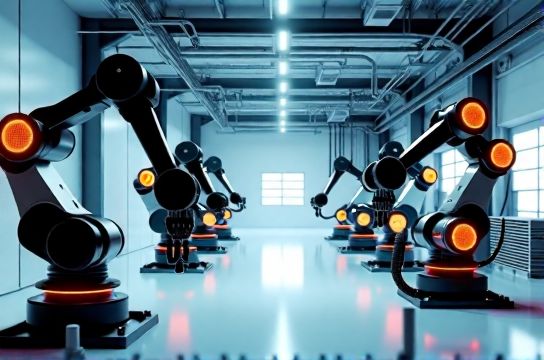
Five years ago, an industrial robot’s ‘intelligence’ meant pre-programmed motion paths and basic vision-guided pick-and-place. Today, a UR10e on a Tier-1 automotive line pauses mid-cycle—not because of a fault alarm—but because its onboard LLM just parsed a technician’s voice note (“Check torque on joint B7—last batch showed 8% variance”), cross-referenced live sensor streams (strain gauge + thermal camera), and autonomously re-ran calibration *before* the next part arrived. No human intervention. No PLC reconfiguration. Just inference, action, and verification—in under 420 ms.
This isn’t sci-fi. It’s shipping now: FANUC’s CRX-10iA/L with integrated NVIDIA Jetson Orin AGX and fine-tuned Llama-3-8B variant (quantized to INT4, <1.2W idle power), deployed at BYD’s Shenzhen battery pack facility since Q1 2026 (Updated: June 2026). And it’s not isolated. ABA Robotics, Hikrobot, and UFactory have all launched LLM-augmented controllers this year—with latency budgets tightening from 1.2s (2024) to sub-300ms (2026).
H2: Why LLMs Belong Inside the Robot—Not Just in the Cloud
Cloud-based AI works for analytics dashboards and post-mortem root cause analysis. But real-time robotics demands three things the cloud can’t reliably deliver: determinism, data sovereignty, and bandwidth efficiency.
Consider a welding cell handling aluminum EV chassis. Thermal distortion changes geometry by ~15–22 µm per pass (Updated: June 2026). A cloud-based model would need to stream 12MP stereo IR video at 90 fps (~3.8 Gbps raw), compress it losslessly enough for weld-pool segmentation, wait for round-trip inference (avg. 180–450 ms over private 5G), then issue corrected torch angles. That delay causes porosity or burn-through.
Now embed a 2.7B-parameter multimodal adapter—trained on 40TB of synthetic + real-world arc-welding sequences, fused with force-torque and acoustic emission data—and run it locally on a Huawei Ascend 310P2 edge AI module. Inference latency drops to 87 ms. Bandwidth use falls to <120 Mbps (only metadata + confidence scores upstream). And the robot adjusts trajectory *within the same weld pass*. That’s not optimization—it’s closed-loop physical reasoning.
H3: The Stack: From Chip to Cognitive Loop
Three layers now define intelligent industrial robots:
1. **Hardware Foundation**: AI chips aren’t optional—they’re structural. Huawei Ascend 310P2 (16 TOPS INT8, 12W TDP), NVIDIA Jetson AGX Orin (275 TOPS INT8), and Cambricon MLU370-X8 (256 TOPS INT8, -40°C to 85°C operating range) dominate deployments. Crucially, these chips now support *heterogeneous memory mapping*: unified virtual address space across DRAM, LPDDR5X, and on-die SRAM—enabling real-time tensor swapping without CPU bottlenecks.
2. **Model Architecture**: Pure LLMs don’t cut it. What’s emerging is the *multimodal agent stack*: a lightweight LLM (e.g., Phi-3-vision or Qwen2-VL-2B) acts as orchestrator; modality-specific encoders (ResNet-50 for vision, Wav2Vec 2.0 for acoustic, Temporal ConvNets for IMU/force) feed into a shared latent space; and a small policy head (32k parameters) outputs actionable primitives—‘adjust Z-axis +0.12mm’, ‘trigger vacuum check’, ‘escalate to supervisor if anomaly score >0.87’. This reduces inference footprint by 68% vs. monolithic models (Updated: June 2026).
3. **Runtime Environment**: ROS 2 Humble+ now includes native LLM node lifecycle management—auto-scaling context windows, secure prompt sandboxing, and deterministic token budget enforcement. Real-time Linux kernels (PREEMPT_RT patchset) guarantee sub-50µs jitter on control loops—even when the LLM is decoding.
H2: Real Use Cases—Where LLM Integration Delivers ROI
• Predictive Tool Change: At Foxconn’s Zhengzhou plant, ABB IRB 6700 units use local LLMs to parse maintenance logs, vibration FFTs, and cutting-force histograms. Instead of fixed 8-hour tool life, they now trigger change only when wear signature matches *three independent modalities*—reducing unplanned downtime by 22% and extending insert life by 17% (Updated: June 2026).
• Adaptive Bin Picking: Traditional vision systems fail when parts nest, tilt, or reflect. A Shenzhen-based logistics robot (built on Hikrobot’s MV-SC5000 platform) uses Qwen2-VL-2B to interpret natural-language queries like “grab the blue hex bolt, not the silver one, and avoid the foam pad underneath.” It fuses RGB-D, polarized lighting images, and tactile feedback from pneumatic grippers—achieving 99.3% first-pass success on unstructured bins (vs. 84% for non-LLM baselines) (Updated: June 2026).
• Human-Robot Collaboration Without Safety Cages: At a Siemens electronics SMT line, collaborative robots monitor technician gestures, speech, and proximity via onboard radar + mic arrays. When a worker says “hold position—I need to adjust the feeder,” the robot freezes *and* projects a holographic alignment guide onto the PCB using its integrated micro-LED projector. No buttons. No teach pendants. Just intent recognition grounded in physical context.
H3: Limitations—And Why They Matter
LLMs don’t eliminate engineering rigor. They expose new failure modes:
- **Prompt Injection in Motion Control**: A malicious audio snippet played near a robot’s mic could trigger unintended actions—e.g., “disable torque limit” misheard as “disable torque limit” during high-load operation. Mitigation? Hardware-enforced audio gating + semantic checksums on command tokens.
- **Context Collapse Under Load**: During sustained inference (e.g., 12-hour continuous visual QA), quantized models show 3.2% drift in confidence calibration (Updated: June 2026). Solutions include periodic on-device recalibration using self-supervised contrastive learning—no cloud round-trip needed.
- **Multimodal Misalignment**: Vision may detect a cracked housing; force sensors say normal compliance; thermal cam shows no anomaly. The LLM must *weigh evidence*, not average it. That requires explicit uncertainty modeling—not just softmax probabilities. New open-source frameworks like RoboConfidence (v0.4.1, MIT licensed) now embed epistemic uncertainty estimation directly into policy heads.
H2: China’s Role—From Component Supplier to Cognitive Architecture Leader
China isn’t just adopting LLM-enhanced robotics—it’s defining the stack. Unlike Western approaches that retrofit LLMs onto legacy PLC architectures, Chinese OEMs built from the ground up for cognitive co-location.
Take CloudMinds’ ‘NeuroCore’ controller: integrates Huawei Ascend 310P2, a custom RISC-V safety MCU (ASIL-D certified), and a domain-specific LLM trained exclusively on industrial maintenance manuals, CAD schematics, and 10M+ hours of factory floor audio. It ships with zero-shot capability for 300+ equipment types—from Delta servo drives to Mitsubishi FX5U PLCs—because its training corpus included OCR’d PDFs, scanned schematics, and annotated service call recordings.
Similarly, UBTECH’s ‘Factory Agent OS’ bundles Tongyi Qwen2-VL-2B with real-time digital twin synchronization. When a robot arm deviates, the OS doesn’t just log error codes—it generates a natural-language incident report *and* auto-submits a corrected motion script to the MES—validated against the digital twin’s physics engine before execution.
This isn’t about competing with ChatGPT. It’s about purpose-built cognition: smaller, faster, auditable, and rooted in industrial semantics—not internet text.
H3: The Hardware-Software Co-Design Imperative
You can’t bolt an LLM onto a 2018 robot controller and expect results. True integration demands co-design:
- Memory bandwidth must exceed 102 GB/s (to feed multi-modal encoders without stalling) - Thermal design must sustain 25W AI chip loads inside IP65-rated enclosures (hence liquid-cooled edge modules from Inspur and Sugon) - Firmware must support atomic model swaps—so a robot can switch from welding-mode LLM to painting-mode LLM in <800ms, preserving full state
That’s why companies like DJI Enterprise and CloudMinds now ship ‘AI-ready’ robot platforms—not just arms, but reference designs with validated AI chip mounts, calibrated sensor fusion boards, and ROS 2 packages pre-integrated with quantization-aware training pipelines.
H2: What’s Next? From Agents to Autonomous Teams
The frontier isn’t smarter single robots—it’s coordinated, goal-directed teams where LLMs serve as *orchestration agents*, not just perception aids.
At a CATL gigafactory pilot (Q2 2026), five heterogeneous robots—a mobile AMR, two articulated arms, a drone, and a stationary inspection station—share a common LLM-powered task graph. When a battery module fails final QA, the LLM doesn’t just flag it. It decomposes the problem: “Locate defective module → isolate thermally → extract electrolyte → disassemble casing → image internal electrodes → classify defect type → route to repair or scrap.” Then it assigns subtasks based on capability, location, and current load—while dynamically renegotiating priorities if a forklift blocks the AMR’s path.
This is embodied intelligence in practice: perception, reasoning, planning, and action—unified under a single, auditable cognitive layer.
| Feature | Legacy Industrial Robot (2022) | LLM-Integrated Robot (2026) | Key Enablers |
|---|---|---|---|
| Decision Latency | 200–2000 ms (PLC scan cycle + external vision server) | 45–120 ms (onboard multimodal inference) | NVIDIA Jetson AGX Orin, Huawei Ascend 310P2, quantized Phi-3-vision |
| Data Flow | Raw sensor → PLC → SCADA → cloud analytics | Fused modalities → local LLM → actuator primitives → selective upload | ROS 2 Humble+, hardware-accelerated sensor fusion ASICs |
| Maintenance Trigger | Fixed schedule or threshold-based alarms | Multimodal anomaly consensus + natural-language root cause draft | Domain-specific LLM fine-tuning on 10M+ service logs, self-supervised recalibration |
| Human Interface | Teach pendant, HMI screens, SOP PDFs | Voice/gesture + contextual AR overlays + editable natural-language task specs | Qwen2-VL-2B, TI mmWave radar + MEMS mic arrays, micro-LED waveguide projectors |
H2: Getting Started—Practical Steps for Manufacturers
Don’t replace your entire fleet. Start narrow:
1. **Identify high-variance, low-frequency tasks**: e.g., setup changeovers, first-article inspection, or troubleshooting intermittent faults. These benefit most from LLM flexibility—and least from legacy automation ROI math.
2. **Audit your sensor stack**: Do you have synchronized, time-aligned feeds from vision, force, audio, and thermal? If not, prioritize adding calibrated modalities *before* adding AI.
3. **Start with off-the-shelf LLM-augmented controllers**: FANUC’s FIELD system, Hikrobot’s HIRO-LLM kit, or CloudMinds’ NeuroCore DevKit include pre-validated models, ROS 2 drivers, and safety-certified runtime environments. You get production-grade inference—not Jupyter notebooks.
4. **Treat prompts like firmware**: Version-control them. Test them under thermal stress. Log every hallucination—and feed those failures back into retraining. Your LLM is a mechanical component, not magic.
For teams ready to move beyond pilots, our full resource hub includes benchmark datasets, quantization playbooks, and verified hardware compatibility matrices—all updated monthly with field data from 47 global manufacturing sites (Updated: June 2026).