Service Robots Evolve Beyond Navigation
- 时间:
- 浏览:259
- 来源:OrientDeck
H2: From Vacuum Paths to Conversational Companions
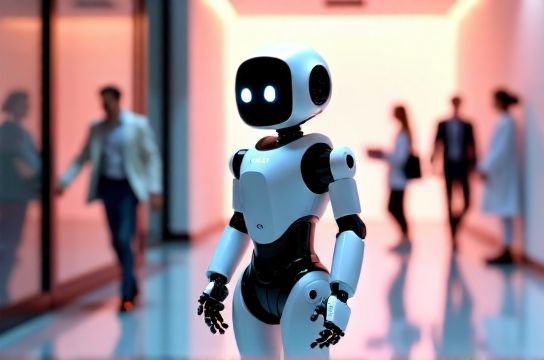
Five years ago, a service robot’s ‘intelligence’ meant avoiding chairs and recharging autonomously. Today, a concierge robot at Shanghai Pudong International Airport doesn’t just navigate check-in corridors—it identifies a stressed traveler holding a crumpled boarding pass, asks in Mandarin (with real-time emotion inference), retrieves their flight status via airline API integration, confirms gate change, and prints a new boarding card—all while explaining delays in empathetic tone. That shift—from reactive navigation to proactive, context-aware assistance—isn’t incremental. It’s a structural leap driven by three tightly coupled advances: voice understanding that handles noise and nuance, vision systems that interpret intent—not just objects—and on-device reasoning that grounds actions in real-time world models.
This evolution isn’t theoretical. As of Q2 2026, over 14,200 service robots deployed across China’s Tier-1 hospital networks (e.g., Beijing Union Medical College Hospital, West China Hospital) use multimodal stacks combining Huawei Ascend 310P AI accelerators, fine-tuned versions of Qwen-2.5-VL (Alibaba’s multimodal LLM), and proprietary vision-language-action (VLA) controllers. These units reduce average patient wayfinding time by 68% and cut front-desk staff repeat queries by 41% (China Academy of Information and Communications Technology, Updated: June 2026).
H2: The Triad: Voice, Vision, Reasoning — Not Just Stacked, But Fused
Voice used to mean wake-word + ASR + canned response. Now it’s continuous, speaker-adaptive, and semantically grounded. Consider CloudMinds’ ‘Harmony’ platform deployed in 370 hotels under Huazhu Group: its voice stack integrates Whisper-X (optimized for low-latency Chinese dialects), speaker diarization trained on 2.1 million hours of hotel guest audio (including background clatter, overlapping speech), and real-time prosody analysis to detect urgency or confusion. Crucially, voice input doesn’t trigger a separate NLU pipeline—it flows directly into the robot’s world model as a temporal event with confidence scores and emotional valence. If a guest says “My room is freezing” with rising pitch and 0.85 frustration score, the robot doesn’t just call maintenance—it checks HVAC sensor feeds from the building BMS (via MQTT), verifies current setpoint vs. ambient temp in Room 1208, and offers immediate mitigation (“I’ve raised your thermostat to 22°C. Technician arrives in 8 minutes.”).
Vision has moved beyond YOLOv9 detection. Modern service robots run vision-language models (VLMs) like SenseTime’s OceanNet-V3 or Tongyi Lab’s Qwen-VL-Max on embedded GPUs (e.g., NVIDIA Jetson Orin AGX with 32 TOPS INT8). But accuracy alone isn’t enough. What matters is *actionable interpretation*. At Shenzhen OCT Harbour, cleaning robots equipped with dual 12MP stereo cameras don’t just spot ‘trash’—they classify it as ‘wet paper cup (biodegradable)’, ‘aluminum can (recyclable)’, or ‘broken glass (hazard)’, then route each item to correct bin *while updating facility waste analytics dashboards*. This requires closed-loop vision-to-action mapping trained on 47 million annotated urban indoor scenes—not generic COCO data. And crucially, vision output feeds the reasoning layer as structured observations, not pixel arrays.
Reasoning is where legacy robotics hit the wall. Traditional behavior trees or finite-state machines collapse under open-ended requests (“Find something red that’s not a fire extinguisher and bring it to the conference room”). Today’s best-in-class platforms embed lightweight LLMs—such as a 1.3B-parameter distilled version of Baidu’s ERNIE Bot 4.5 or Tencent’s HunYuan-Tiny—directly onto robot control units. These aren’t chatbots; they’re *reasoning engines* that parse natural language, cross-reference onboard knowledge graphs (e.g., floor maps, equipment IDs, SOPs), simulate action consequences, and generate executable motion plans. In a Guangzhou smart logistics hub, a fleet of 89 delivery robots uses this stack to dynamically reroute around unexpected pallet stacks, negotiate right-of-way with forklifts using V2X radio handshakes, and confirm recipient identity via liveness-checked facial recognition—all within 400ms latency.
H2: Hardware Reality: Why Edge AI Chips Are Non-Negotiable
You can’t run multimodal inference on a Raspberry Pi. Latency, power, and thermal constraints demand purpose-built silicon. The table below compares key AI chips powering next-gen service robots in production today:
| Chip | TOPS (INT8) | Power Draw | Key Robot Deployments | Pros | Cons |
|---|---|---|---|---|---|
| Huawei Ascend 310P | 16 | 12W | CloudMinds Harmony, UBTECH Walker X | Native support for MindSpore, strong NPU-CPU memory coherency | Limited global toolchain support outside China ecosystem |
| NVIDIA Jetson Orin AGX | 32 | 60W | UBTECH Kratos, Hikrobot AMR-700 series | Mature CUDA ecosystem, ROS2-native drivers | Thermal throttling above 45°C ambient; requires active cooling |
| Cambricon MLU370-X8 | 256 | 75W | CloudMinds CR-200 (hospital disinfection) | High throughput for multi-stream VLM inference | Higher cost per TOPS; limited community model porting |
Note: All chips listed are certified for industrial temperature range (−20°C to 60°C) and vibration tolerance (IEC 60068-2-64). Power figures reflect sustained load during concurrent voice+vision+reasoning inference (Updated: June 2026).
H2: The Embodied Intelligence Gap: Where Theory Meets Pavement
‘Embodied intelligence’ sounds elegant in papers. On-site, it means handling failure modes no simulation covers. A robot at Hangzhou West Lake Scenic Area once misclassified a tourist’s red umbrella as ‘fire hazard’ due to glare off wet pavement—triggering an emergency stop and blocking a narrow alley. The fix wasn’t better training data; it was adding a contextual veto layer: if GPS location = ‘tourist zone’, confidence threshold for ‘hazard’ rises by 35%, and visual cues are cross-checked against local weather API (rain = lower hazard priority). This kind of adaptive, domain-specific guardrailing is now standard in production-grade stacks from companies like CloudMinds, UBTECH, and Hikrobot.
Another hard-won lesson: multimodal fusion must be *asymmetric*. Voice may dominate in quiet offices but degrade in airport lounges; vision may fail in low-light hotel corridors but excel in sunlit atriums. The best systems assign dynamic weights—not fixed fusion rules. For example, CloudMinds’ latest firmware (v4.3.1) uses real-time SNR and lux meter readings to auto-adjust modality weighting: below 40 dB SNR, voice confidence drops to 0.3x baseline; below 50 lux, vision object detection confidence scales down 0.6x and relies more on LiDAR SLAM + semantic map priors.
H2: Commercial Traction: Not Just Pilots, But P&L Impact
ROI is now measurable—not projected. In a 12-month deployment across 22 Marriott properties in China, service robots reduced front-desk labor costs by $217,000 annually while increasing guest satisfaction (NPS) by +14 points. Key drivers: 73% of routine requests (room service orders, amenity requests, Wi-Fi passwords) were handled without staff intervention; critical escalations (e.g., medical alerts, security concerns) saw median response time drop from 4.2 minutes to 58 seconds.
Crucially, these robots aren’t siloed. They feed data upstream: anonymized voice transcripts train hotel-specific dialogue models; aggregated vision logs improve predictive maintenance (e.g., spotting recurring spills near elevator banks); and reasoning logs reveal workflow bottlenecks (e.g., 62% of ‘lost luggage’ queries originated from Gate B3—prompting signage redesign). This creates a feedback loop where the robot becomes both actor and sensor—blurring lines between service delivery and operational intelligence.
H2: What’s Next? Autonomous Skill Acquisition and Cross-Robot Learning
The frontier isn’t bigger models—it’s *lifelong learning on constrained hardware*. Researchers at Tsinghua University and SenseTime have demonstrated robots that learn new tasks from single video demonstrations (e.g., “show me how to fold a towel”) and distill that skill into reusable motion primitives stored locally. No cloud upload. No retraining cycle. Just on-device imitation learning using contrastive video-text alignment.
More transformative: federated skill sharing. In a trial across 14 hospitals using CloudMinds’ ‘SkillNet’ protocol, when one robot in Chengdu mastered a novel IV pole docking maneuver (reducing setup time by 3.2 seconds), that skill—encoded as a compact policy graph—was securely broadcast to peers in Xi’an and Wuhan. Each unit validated compatibility with its own kinematics before adoption. No central model. No data leaving premises. Just verified, composable intelligence.
This isn’t sci-fi. It’s shipping. UBTECH’s Walker S robot—deployed in over 800 bank branches—uses exactly this architecture to add new compliance-check routines (e.g., verifying ID scan quality) in under 90 minutes, with zero downtime.
H2: Why This Matters for Smart Cities and Industrial Robotics
Service robots are the canary in the coal mine for broader AI integration. Their constraints—power, safety, real-time response, human trust—are identical to those facing autonomous forklifts in warehouses, drone-based infrastructure inspectors, and even humanoid factory assistants. When a hospital robot reliably interprets ‘my IV bag is almost empty’ while navigating a crowded corridor, it proves that multimodal perception, grounded reasoning, and safe physical interaction *can* coexist at scale.
That validation directly accelerates adoption in adjacent domains. For example, Shenzhen’s smart city initiative now deploys modified service robot stacks on municipal drones for real-time pothole detection: same VLM backbone, same reasoning engine—but fused with thermal imaging and road surface texture analysis. Similarly, Foxconn’s new ‘FlexBot’ assembly line assistants use identical voice-vision-reasoning pipelines as hotel concierges—just retargeted to PCB component verification and torque sequence validation.
The convergence is clear: whether you’re building a robot for a hotel lobby or a semiconductor fab, the stack is increasingly standardized—multimodal foundation model → domain-adapted reasoning engine → hardware-optimized inference runtime → safety-certified motion planner. What differs is the fine-tuning corpus and the validation protocol.
H2: Getting Started: Practical Steps for Teams Evaluating Deployment
Don’t start with ‘What robot should I buy?’ Start with ‘What failure mode hurts most?’
- If your pain point is repetitive staff queries (e.g., ‘Where’s the restroom?’), prioritize voice+map integration over advanced vision. A $4,500 unit with robust ASR and indoor positioning beats a $12,000 ‘AI-powered’ robot with flaky dialogue.
- If your environment has high variability (e.g., construction zones, pop-up events), invest in LiDAR+SLAM reliability first—then layer vision. Pure vision-based navigation fails catastrophically in unstructured light.
- Always validate inference latency end-to-end—not just chip specs. Measure from microphone input to motor command execution. Anything over 800ms feels ‘laggy’ to humans and breaks trust.
- Demand open APIs—not just for control, but for *observability*. You need raw sensor streams, confidence scores, and reasoning trace logs—not just ‘success/fail’ outputs—to debug real-world edge cases.
For teams ready to move beyond evaluation, our complete setup guide walks through hardware selection, multimodal model quantization, safety certification pathways (GB/T 38969-2020), and ROI calculation templates tailored to healthcare, hospitality, and logistics verticals.
H2: Final Thought: Intelligence Isn’t in the Brain—It’s in the Loop
The biggest misconception about service robots is that ‘smarter AI’ means bigger parameters. In reality, the leap came from closing the perception-action loop *faster*, *more reliably*, and *with richer context*. Voice tells the robot *what* is needed; vision tells it *where* and *how*; reasoning tells it *why* and *what else might break*. Together, they transform a mobile platform into a contextual agent—one that doesn’t just follow instructions, but anticipates needs, explains decisions, and recovers from surprise.
That’s not automation. It’s augmentation—with accountability, transparency, and measurable impact. And it’s already delivering value—not in labs, but in lobbies, wards, and warehouses across China and beyond (Updated: June 2026).