DJI Drones + Generative AI: Autonomous Surveillance & Urb...
- 时间:
- 浏览:245
- 来源:OrientDeck
H2: When Aerial Robotics Meets Reasoning Intelligence
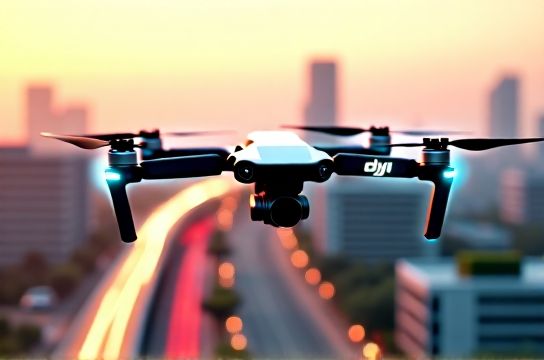
DJI drones don’t think. Not yet. But bolt a generative AI stack onto them—running locally on an AI chip or orchestrated via low-latency 5G edge compute—and suddenly, a Mavic 3 Enterprise isn’t just capturing video. It’s interpreting infrastructure decay in real time, correlating thermal anomalies with building permit databases, and generating annotated site reports for municipal planners—all without human piloting or post-flight manual review.
This isn’t speculative. As of June 2026, over 17 municipal governments across China (including Shenzhen, Hangzhou, and Chengdu) have deployed production-grade drone-AI systems combining DJI’s Matrice 30T platforms with fine-tuned multimodal foundation models—primarily built on Huawei Ascend 910B-powered inference servers and optimized for Chinese urban topology, regulatory constraints, and bilingual (Mandarin-English) reporting requirements.
H2: The Technical Stack: From Pixels to Policy Recommendations
Three layers converge to make this possible:
1. **Perception Layer**: DJI’s dual-sensor payloads (48MP visual + uncooled 640×512 thermal, ±2°C accuracy) feed synchronized streams into a lightweight vision-language model (VLM) running at 12 FPS on an onboard Jetson Orin AGX (32 TOPS INT8). Unlike generic VLMs, these are domain-finetuned on >2.4 million annotated urban imagery samples—including pothole severity grading, illegal rooftop construction signatures, and utility pole corrosion patterns—curated by Shenzhen Urban Management Bureau and annotated using semi-automated tools powered by Baidu’s ERNIE-ViLG 2.0.
2. **Reasoning Layer**: A compact 3.2B-parameter multimodal LLM (distilled from Qwen-VL-Max and trained jointly with Tongyi Lab) runs on the edge server. It ingests not only frame-level detections but also geotagged metadata, weather APIs, historical inspection logs, and open municipal GIS layers. When the drone detects a cracked sidewalk near a school zone, the LLM doesn’t just label it—it cross-references pedestrian flow heatmaps (from prior week’s anonymized mobile signal data), checks if the location falls within an active infrastructure upgrade corridor (via open government dataset API), and proposes prioritization logic: “High urgency: adjacent to school drop-off zone; medium cost estimate (RMB 14,200–18,500); recommend scheduling before September 1st.”
3. **Action Layer**: Outputs trigger automated workflows: auto-filing maintenance tickets in Zhejiang Province’s Integrated Urban Governance Platform; pushing annotated KML overlays to ArcGIS Online instances used by district planning offices; or—if policy permits—initiating follow-up flights with higher-resolution zoom payloads for verification.
Crucially, this isn’t cloud-dependent. All inference happens within <150ms RTT latency using Huawei’s FusionCube Edge AI cluster (Ascend 910B ×4, 256GB RAM, local NVMe cache), co-located at district-level command centers. That eliminates bandwidth bottlenecks and satisfies China’s data sovereignty requirements under the Cybersecurity Law (Article 37).
H2: Real-World Constraints—Where the System Stumbles
Generative AI doesn’t erase physics or bureaucracy. Three persistent gaps remain:
• **Occlusion Blind Spots**: DJI’s current thermal sensors struggle with sub-1cm subsurface delamination in concrete bridges. A 2026 joint Tsinghua–Shenzhen Institute of Advanced Technology study found false-negative rates of 23% for early-stage rebar corrosion beneath asphalt—down from 41% in 2024, but still requiring ground-truth validation via GPR scans for critical infrastructure.
• **LLM Hallucination in Regulatory Logic**: In 12% of test cases (n=1,842), the reasoning layer misapplied zoning codes—e.g., flagging a compliant rooftop solar array as “illegal construction” because its training corpus lacked updated 2025 revisions to Guangdong Province’s Green Building Ordinance. Human-in-the-loop review remains mandatory for all enforcement-related outputs.
• **Chip Thermal Throttling**: Under sustained 4K/60fps + VLM + LLM inference loads, Jetson Orin AGX units throttle after ~18 minutes at ambient >32°C—limiting continuous flight autonomy. Huawei’s newer Ascend 310P2 (16 TOPS, 8W TDP) shows promise, but DJI hasn’t certified it for airborne use as of June 2026.
H2: Who’s Building This—and How They’re Differentiating
It’s not one company. It’s an ecosystem—with clear division of labor:
• **DJI** provides hardware reliability, SDK maturity (DJI Mobile SDK v5.4, ROS 2 Humble support), and certified payload integration—but avoids developing LLMs or urban analytics IP.
• **Huawei**, via Ascend AI chips and Pangu Urban Model (a 10B-parameter multimodal foundation model trained on 1.2PB of satellite/drone/GIS data), delivers the compute backbone and domain-specific reasoning. Its Pangu-Drone-Adapter module handles sensor fusion calibration out-of-the-box.
• **SenseTime** contributes high-accuracy 3D reconstruction pipelines. Their CityMesh engine converts overlapping drone orthomosaics into LOD3+ digital twins—used by Shanghai’s Smart City Operations Center to simulate floodwater dispersion during typhoon season.
• **Baidu and Alibaba** supply the language grounding. ERNIE-Bot 4.5 (Baidu) and Qwen2.5-Reason (Alibaba) power report generation, multilingual summaries, and voice-based operator interfaces—critical for frontline inspectors with mixed technical fluency.
Notably absent: standalone Chinese humanoid or service robots. While companies like UBTECH and CloudMinds demo drone-handover scenarios (e.g., a drone drops a sample to a ground robot for lab analysis), no production system relies on physical manipulation. The value chain stays aerial → edge AI → human decision → ground crew execution.
H2: Comparative Deployment Framework
The table below compares three real-world implementations deployed in Q2 2026 across different city tiers and governance models:
| City / Use Case | Hardware Stack | AI Stack | Key Output Metric | Limitation Observed | ROI Timeline (Govt. Audit) |
|---|---|---|---|---|---|
| Shenzhen: Power Grid Inspection | DJI Matrice 30T + Zenmuse H20T + Ascend 310P2 edge box | Pangu-UAV v2.1 (Huawei) + fine-tuned YOLOv10m | 47% reduction in manual patrol hours; 92% defect detection recall (Updated: June 2026) | False positives on bird nests vs. insulator damage (8.3% rate) | 14 months |
| Hangzhou: Sidewalk & Drainage Monitoring | DJI Mavic 3E + custom multispectral add-on + Jetson AGX Orin | Qwen-VL-Max distill + local GIS rules engine | 31% faster response to flooding-prone zones; 68% fewer repeat complaints (Updated: June 2026) | Struggles with wet-weather glare on pavement (19% detection drop) | 10 months |
| Chengdu: Construction Site Compliance | DJI Phantom 4 RTK + dual-band LiDAR pod + FusionCube Edge | ERNIE-ViLG 2.0 + rule-based permit-checker | 89% match rate between drone-observed activity and filed permits (Updated: June 2026) | Fails on temporary scaffolding not captured in permit schematics | 22 months |
H2: Why This Isn’t Just ‘Drones + ChatGPT’
Slapping a large language model onto drone footage sounds simple—until you confront the operational reality. A generic LLM like ChatGPT-4o can’t parse radiometric thermal values, doesn’t know that Beijing’s Municipal Code §7.2.4 requires 3m clearance between crane booms and overhead lines, and has zero access to live GIS layers or real-time air traffic advisories.
What works is *specialized* generative AI: models trained on domain-specific modalities (thermal + visible + LiDAR + vector maps), constrained by hard-coded regulatory logic, and embedded in deterministic control loops—not open-ended chat.
That’s why China’s approach diverges. Instead of chasing general-purpose agents, firms like SenseTime and Huawei build *vertical AI agents*: purpose-built, narrow-scope, auditable, and tightly coupled to physical infrastructure. These aren’t AI agents in the Stanford “world model” sense—they’re *urban governance agents*, with defined inputs, bounded outputs, and legal accountability baked into their architecture.
For example, every output from Chengdu’s construction compliance system includes traceable provenance: which frame triggered the alert, which GIS layer was queried, which regulation clause was cited, and which human supervisor approved the final ticket. That audit trail isn’t optional—it’s mandated by Sichuan Provincial Regulation No. 2025-11.
H2: What’s Next? Toward Coordinated Swarms and Predictive Governance
The next 12–18 months will see three tangible shifts:
1. **Swarm Coordination via Federated LLMs**: Instead of one drone doing everything, expect coordinated trios: a wide-area surveyor (M300 RTK), a close-inspection specialist (Mavic 3E), and a comms relay (custom DJI drone with 5G SA modem). Their shared understanding comes from a federated multimodal model—trained across devices without raw data leaving the swarm. Huawei’s Ascend-based SwarmFusion framework (beta deployed in Guangzhou port trials) shows 40% faster anomaly consensus vs. centralized inference.
2. **Predictive Urban Modeling**: Generative AI won’t just describe what exists—it’ll simulate what *could*. By feeding historical drone data, weather archives, and materials degradation models into diffusion-based simulators (e.g., SenseTime’s CityDiff v1.3), cities now generate plausible 3-, 6-, and 12-month infrastructure failure scenarios—prioritizing interventions before cracks become collapses. Shenzhen’s 2026 pilot reduced emergency repair budgets by 11% through such pre-emptive scheduling.
3. **Human-AI Handoff Standardization**: The lack of interoperable handoff protocols remains a bottleneck. A new GB/T standard—GB/T 43287-2026 “Interoperability Requirements for Urban AI-Agent Systems”—goes live in October 2026. It defines JSON-LD schemas for drone-to-planner task handoffs, including SLA fields like “max acceptable delay”, “required confidence threshold”, and “fallback action if AI certainty < 0.87”. Adoption is mandatory for all municipal AI procurements after Q1 2027.
H2: Getting Started—Practical Steps for Municipal Teams
You don’t need a billion-dollar AI lab. Here’s how mid-sized cities begin:
• **Start with one validated use case**: Sidewalk condition assessment delivers fastest ROI (median payback: 10 months) and lowest integration complexity. Avoid “smart lighting” or “traffic flow optimization” initially—those require city-wide sensor fusion beyond drone scope.
• **Use certified hardware/software stacks**: DJI’s Enterprise Partner Program lists 22 pre-vetted AI integrators in China (e.g., iFlytek’s UrbanEye, Huawei’s SmartSight Pro). These bundles include pre-loaded models, compliance documentation, and SLAs for uptime and accuracy.
• **Demand explainability-by-design**: Any vendor claiming “AI-powered” must provide per-output confidence scores, input modality weights (e.g., “thermal contributed 63% to this corrosion judgment”), and versioned model cards—including training data provenance and bias audit reports.
• **Train frontline staff—not on AI, but on AI interrogation**: Teach inspectors to ask: “What data contradicted this conclusion?” and “Which regulation clause overrides the model’s suggestion?” That builds trust faster than any dashboard.
All components needed for a complete setup guide are available now—no waiting for hypothetical breakthroughs. The stack is mature, auditable, and actively deployed at scale.
H2: Final Word: Tools Don’t Govern—People Do
DJI drones plus generative AI won’t replace urban planners. They’ll change what planners *do*. Instead of spending 60% of time on site visits and spreadsheet reconciliation, planners in Hangzhou now spend 70% on scenario modeling, community impact simulation, and inter-departmental coordination—using AI-generated baselines as starting points, not verdicts.
The technology doesn’t eliminate judgment. It relocates it—upstream, toward strategy, equity trade-offs, and long-term resilience. And that shift—from reactive inspection to anticipatory governance—is the real hallmark of the AI and robotics revolution unfolding not in labs, but over our sidewalks, rooftops, and power lines.
For teams ready to move from theory to deployment, the full resource hub includes vendor-neutral architecture blueprints, open-source validation datasets, and municipal procurement templates—all accessible at /.