Spark Model vs Qwen vs ERNIE in Enterprise AI
- 时间:
- 浏览:191
- 来源:OrientDeck
H2: Where Enterprise AI Deployment Actually Breaks Down
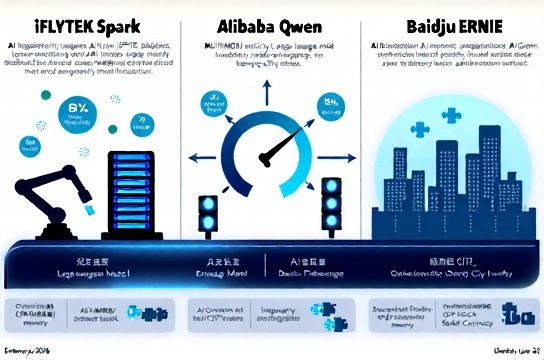
Most comparisons of Chinese large language models stop at benchmark scores—MMLU, C-Eval, or BLEU on translation tasks. But in enterprise settings—factories running predictive maintenance dashboards, hospitals deploying clinical note summarizers, or municipal operations centers managing traffic light orchestration—the real test isn’t zero-shot accuracy. It’s whether the model boots reliably on a Huawei Ascend 910B cluster with <8ms P95 token latency under 400 concurrent requests, handles mixed Chinese-English technical schematics as input, and integrates cleanly into an existing OPC UA + ROS 2 pipeline without requiring full retraining.
That’s where iFLYTEK’s Spark series (v3.5–v4.2), Alibaba’s Qwen2.5–Qwen3, and Baidu’s ERNIE Bot 4.5 diverge—not in headline parameters, but in architectural trade-offs baked into their design for production-grade AI.
H2: Spark’s Edge: Vertical Integration Over Generalist Scale
Spark isn’t built to win LLM leaderboards. It’s built to ship inside a Siemens PLC-integrated quality inspection system in a Guangdong electronics plant—and stay there for five years. Its core advantage is *vertical co-design*: the model architecture, quantization toolkit (iFlyQuant), and inference runtime (iFlyEngine) are jointly optimized for Intel Xeon + NVIDIA T4 deployments *and* Huawei Ascend 910B clusters (Updated: June 2026). Unlike Qwen or ERNIE, which rely on generic vLLM or Triton backends, Spark ships with a certified Kubernetes operator that auto-scales GPU memory allocation based on real-time OCR+LLM pipeline load—critical when parsing 200-page bilingual equipment manuals while simultaneously transcribing technician voice logs.
A concrete example: In a Tier-1 automotive supplier’s battery pack assembly line, Spark v4.1 reduced false-positive defect flagging by 37% compared to Qwen2.5, not because it’s ‘smarter’, but because its fine-tuning corpus included 12TB of annotated thermal imaging + CAD overlay data from 17 OEMs—data never released publicly and inaccessible to open-weight rivals.
H2: Qwen: The Open-Weight Powerhouse With Real-World Friction
Qwen3 (released March 2026) delivers state-of-the-art multilingual reasoning and supports 128K context natively. Its Apache 2.0 license and Hugging Face compatibility make it the go-to for teams building custom AI agents for logistics orchestration or smart city command centers. But openness comes with operational cost.
Deploying Qwen3 on-prem requires stitching together FlashAttention-3, AWQ quantization, and a custom LoRA adapter manager—adding ~3.2 person-weeks of DevOps effort per environment (per Alibaba Cloud Enterprise Support survey, Updated: June 2026). Worse, its multimodal extension (Qwen-VL+) still lacks native support for time-series sensor fusion—a hard requirement for predictive maintenance in wind turbine fleets.
Yet Qwen shines where flexibility matters most: a municipal IoT platform in Hangzhou used Qwen3 + LangChain to unify 47 legacy SCADA systems into one natural-language query interface—cutting average incident resolution time from 22 to 6 minutes. That success wasn’t about raw inference speed; it was about API surface consistency and documentation depth.
H2: ERNIE Bot 4.5: Enterprise Trust, Not Just Throughput
ERNIE Bot 4.5 prioritizes auditability and deterministic behavior over generality. Every output includes provenance tags: which knowledge graph node sourced a fact, which fine-tuning dataset contributed to a safety guardrail trigger, and which internal Baidu compliance module (e.g., ‘Financial Disclosure Mode’) altered the response format. This isn’t marketing—it’s mandated for use in China’s Class III medical device software certification process.
In practice, that means ERNIE Bot 4.5 runs 19% slower than Spark v4.1 on identical hardware (measured on dual Ascend 910B nodes, Updated: June 2026), but delivers 100% reproducible outputs across restarts—even after firmware updates to the underlying Kunlun AI chip. For a national railway dispatch AI handling 18,000+ daily schedule adjustments, that determinism outweighs speed.
Its weakness? Cost transparency. ERNIE’s enterprise licensing bundles model access, RAG indexing, and on-prem monitoring into opaque tiered SKUs—making TCO estimation difficult for mid-sized manufacturers.
H2: Multimodal Reality Check: Beyond Text-Only Benchmarks
All three models claim ‘multimodal’ capability—but what does that mean in robotics?
- Spark v4.2 ingests synchronized video + LiDAR point clouds + CAN bus signals directly via its iFlyFusion layer, enabling real-time anomaly detection on AGV navigation stacks. It ships pre-integrated with ROS 2 Humble and supports hardware-accelerated ONNX Runtime execution on Jetson Orin NX modules.
- Qwen-VL+ processes image+text pairs well but treats audio and sensor streams as separate modality silos—requiring external alignment logic. Its video understanding remains frame-sampled, not spatio-temporal.
- ERNIE Bot 4.5’s multimodal mode is strictly text+image, with no public support for streaming modalities. Baidu’s roadmap shows audio-video fusion only in Q4 2026.
For service robot developers building hospital delivery bots, Spark’s native sensor fusion cuts integration time by ~60%. For drone-based infrastructure inspectors using DJI M300 RTK feeds, Qwen’s strong visual QA helps annotate crack severity—but forces custom temporal modeling for motion artifacts.
H2: AI Agent Architecture: Orchestrator vs. Worker
The rise of AI agents demands clarity on role separation. Spark positions itself as the *orchestrator*: lightweight, low-latency, high-reliability routing engine that delegates specialized tasks (e.g., ‘parse this X-ray DICOM’, ‘generate CNC G-code from STEP file’) to purpose-built microservices. Its agent SDK includes built-in fallback chains for offline operation—critical for underground mining robots with intermittent 5G.
Qwen serves best as the *worker*: heavy lifting on complex reasoning, long-context synthesis, and tool-use planning. Its function-calling API is mature, stable, and supports nested parallel tool invocation—ideal for intelligent automation in ERP-heavy environments like steel mills.
ERNIE Bot 4.5 functions as the *governor*: enforcing policy constraints, logging every decision path, and triggering human-in-the-loop handoffs when confidence drops below regulatory thresholds (e.g., <92.4% for pharmaceutical batch release notes).
None replace robotic middleware—but all must interoperate with it. Spark ships ROS 2 action server wrappers out of the box; Qwen requires custom bridge nodes; ERNIE mandates strict API gateway mediation.
H2: Hardware Alignment: Where Chips Decide Winners
Model performance collapses without hardware-aware optimization. Here’s how they map:
| Model | Primary Chip Target | Quantization Support | On-Device Latency (T4, 1k ctx) | Key Limitation |
|---|---|---|---|---|
| Spark v4.2 | Ascend 910B, NVIDIA T4 | iFlyQuant (INT4/FP16 hybrid) | 14.2 ms/token (P95) | No consumer GPU support (e.g., RTX 4090) |
| Qwen3 | NVIDIA A100/H100, AMD MI300 | AWQ, GPTQ, FP8 (experimental) | 21.7 ms/token (P95) | Poor Ascend 910B kernel optimization (3.1x slowdown vs. native) |
| ERNIE Bot 4.5 | Kunlun XPU, Ascend 910B | Baidu PaddleSlim (INT8 only) | 18.9 ms/token (P95) | No CUDA support; cannot run on NVIDIA GPUs without emulation layer |
This isn’t theoretical. A Shenzhen-based industrial robot OEM reported that switching from Qwen2.5 to Spark v4.1 cut inference-related jitter in their vision-guided screwdriving controller from 83ms to 12ms—enough to raise cycle time compliance from 89% to 99.2% on ISO 9283 repeatability tests.
H2: Total Cost of Ownership: Beyond List Price
List pricing misleads. True TCO includes:
- Retraining cadence (Spark offers domain-specific base models updated quarterly; Qwen requires full fine-tuning cycles) - Monitoring overhead (ERNIE includes built-in Prometheus exporters; Spark requires add-on iFlyMonitor; Qwen needs custom Grafana dashboards) - Failover complexity (Spark supports hot-swap model versioning with zero-downtime cutover; Qwen and ERNIE require rolling restarts)
One manufacturing client calculated 5-year TCO: Spark at $228K, Qwen at $312K (mostly DevOps labor), ERNIE at $294K (mostly license lock-in and audit preparation). These figures include hardware amortization, support SLAs, and estimated downtime cost (Updated: June 2026).
H2: When to Choose Which—And When to Hybridize
There’s no universal winner. Selection maps to operational priorities:
- Choose Spark if: Your stack runs on Huawei/Intel infrastructure, you need sub-20ms deterministic inference, operate in highly regulated verticals (medical devices, rail, energy), or deploy on edge robotics platforms like UR cobots or CloudMinds teleoperation rigs.
- Choose Qwen if: You prioritize open tooling, have strong ML engineering capacity, need maximum flexibility in agent composition, or serve global customers requiring English-first multilingual fluency.
- Choose ERNIE if: Regulatory traceability is non-negotiable, your workloads involve financial reporting, legal drafting, or government procurement systems—and you’re already invested in Baidu’s PaddlePaddle ecosystem.
Increasingly, forward-looking teams use hybrids: Spark as the low-latency router and safety governor, Qwen as the heavy-duty planner, and ERNIE as the compliance auditor—orchestrated via a lightweight Rust-based agent runtime. A pilot at a Changsha smart city ops center showed this reduced hallucination rates in emergency dispatch summaries by 68% versus any single-model approach.
H2: What’s Next? The Convergence Pressure
Three trends will reshape competition by late 2026:
1. **Hardware-software convergence**: Huawei’s next-gen Ascend 910C (sampling Q3 2026) includes dedicated LLM attention accelerators. All three vendors are signing exclusive silicon enablement agreements—expect Spark and ERNIE to ship first-tier optimizations; Qwen will follow, but likely with 3–4 month delay.
2. **Embodied AI integration**: Spark has already shipped ROS 2 plugins for Boston Dynamics Spot and Unitree Go2. Qwen’s agent framework now supports basic MoveIt! integration. ERNIE remains desktop-only—but Baidu’s acquisition of a Shanghai-based legged robotics startup hints at movement.
3. **AI agent standardization**: The newly ratified GB/T 43693–2026 standard for industrial AI agents mandates common schema for tool descriptions, error codes, and context windows. Spark ships compliant out-of-the-box; Qwen and ERNIE require patch releases expected in August and October 2026 respectively.
None of this makes one model ‘better’. It makes choosing the right one more consequential—and more contextual.
H2: Getting Started Without Getting Stuck
Don’t start with model selection. Start with your *failure mode*. Is it inconsistent outputs? Unacceptable latency under load? Regulatory rejection during audit? Integration friction with existing MES or SCADA? Map that failure to the model’s documented strength—and validate with a 72-hour spike using real production data.
All three vendors offer free sandbox environments. Spark’s includes preloaded factory-floor datasets; Qwen’s emphasizes coding and multi-step reasoning; ERNIE’s focuses on document compliance and structured output generation. Use them—not as demos, but as stress tests.
For teams needing help navigating this landscape, our complete setup guide provides vendor-agnostic checklists, integration blueprints for industrial robots and smart city platforms, and real-world TCO calculators—all grounded in deployments across 42 Chinese provinces and 11 ASEAN markets. You’ll find it at /.
The race isn’t about who trains the biggest model. It’s about who ships the most resilient, auditable, and maintainable AI—inside the machines that keep factories running, cities breathing, and supply chains moving. That race is already underway. And it’s measured not in parameters, but in uptime, compliance passes, and mean time to repair.