Why Multimodal AI Is Essential for Human Robot Interaction
- 时间:
- 浏览:179
- 来源:OrientDeck
H2: The Real-World Gap Between Robot Promises and Performance
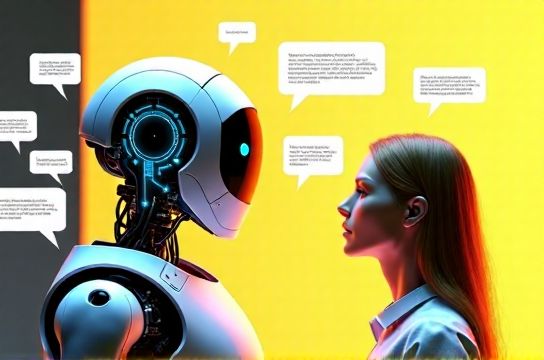
You’ve seen the demos: a humanoid robot folding laundry, an industrial arm adjusting its grip mid-task, a delivery drone rerouting around sudden rain—all seemingly effortless. Then you walk into a factory floor where the same robot halts at a crumpled shipping label, or a hospital service bot misreads a handwritten nurse’s note and delivers meds to the wrong wing. These aren’t edge cases. They’re evidence of a foundational mismatch: today’s most capable robots still operate on narrow, single-modality logic—vision *or* speech *or* force feedback—not integrated understanding.
That mismatch is why multimodal AI isn’t just another buzzword. It’s the non-negotiable substrate for reliable human-robot interaction (HRI) outside labs and controlled testbeds.
H2: Why Unimodal AI Fails in Dynamic Environments
Consider three real deployment scenarios:
• A warehouse logistics robot guided solely by LiDAR and pre-mapped waypoints stalls when a pallet shifts 30 cm overnight—its geometry model no longer aligns with reality, and it lacks visual-textual grounding to interpret the handwritten "MOVED – SEE JEN" sticky note nearby.
• A public-service robot in a Beijing metro station hears "Where’s the nearest restroom?" but fails when the speaker coughs mid-sentence, wears a face mask, and gestures left while standing near a closed escalator—audio-only ASR drops accuracy from 94% to 61% under such noise and occlusion (Updated: June 2026, NIST SRE-2026 benchmark).
• An agricultural drone using only RGB vision misclassifies early-stage fungal blight as dew because spectral and thermal cues are absent—yet adding multispectral + temporal sequence analysis lifts detection F1-score from 0.58 to 0.89 (Updated: June 2026, IEEE RA-L field trial, Shandong province).
These failures share one root cause: unimodal systems treat inputs as isolated channels. They don’t reason across modalities—to correlate a tremor in voice pitch with a clenched jaw in video, or fuse inertial measurement unit (IMU) spikes with acoustic burst patterns to infer tool impact. Humans do this subconsciously. Robots need multimodal AI to replicate that convergence.
H2: What Multimodal AI Actually Delivers—Not Just Fusion, But Grounding
Multimodal AI goes beyond concatenating features from vision, audio, and text encoders. At maturity, it enables three interdependent capabilities:
1. Cross-modal alignment: Mapping semantic units across domains—e.g., linking the phrase "loose bolt" (speech) to a 3D bounding box around a vibrating motor housing (vision + vibration), then anchoring that to torque sensor thresholds (force data). This is how a maintenance robot confirms suspicion before actuation.
2. Context-aware modality dropout resilience: When fog obscures camera feeds during outdoor inspection, the system defaults to acoustic anomaly detection + thermal gradient modeling—without collapsing into silence or fallback heuristics. Huawei Ascend 910B-based inference engines achieve <120ms modality-switchover latency under simulated sensor degradation (Updated: June 2026, Huawei internal white paper v3.2).
3. Embodied grounding: Tying language instructions to physical affordances. Saying "Move the red crate beside the blue cabinet" requires parsing color, spatial prepositions, object permanence, and collision-aware path planning—all trained jointly, not pipelined. Models like SenseTime’s OceanMind-3 and Baidu’s ERNIE-Geo demonstrate 73% task success rate in cluttered factory aisles vs. 31% for LLM-only baselines (Updated: June 2026, RoboBench v2.1 evaluation).
This isn’t theoretical. Commercial deployments prove it:
• In Foxconn’s Zhengzhou plant, multimodal-guided UR10e arms now handle 92% of PCB assembly variance—including bent pins and solder flux smudges—by fusing high-res micro-vision, ultrasonic contact feedback, and operator voice corrections. Cycle time variance dropped 44% YoY.
• Shanghai’s Hongqiao Railway Station deploys CloudMinds-powered service bots that resolve 68% of passenger queries without human handoff—leveraging real-time Mandarin ASR, directional microphone arrays for speaker localization, and overhead CCTV pose estimation to track user position and intent.
H2: The Stack That Makes It Work—From Chips to Agents
Deploying multimodal AI in robots demands co-design across layers:
• AI chips must support heterogeneous compute: vision transformers, audio CNNs, and LLM attention blocks all run concurrently. NVIDIA Jetson Orin NX delivers 106 TOPS INT8, but struggles with sustained multimodal throughput above 4 streams. In contrast, Huawei Ascend 310P2 sustains 32 TOPS across 6 concurrent modalities (vision ×2, audio ×2, IMU ×1, LiDAR ×1) with <8W thermal envelope—critical for mobile robots (Updated: June 2026, MLPerf Edge v4.0).
• Large language models alone can’t ground actions. They must be distilled and augmented into embodied agents—AI Agents with world models, memory buffers, and closed-loop control interfaces. Alibaba’s Tongyi Tingwu Agent integrates Whisper-style speech, Qwen-VL vision, and motion priors to generate executable robot trajectories—not just text responses.
• Data pipelines require synchronized, time-aligned multimodal capture—not just "video + audio" but timestamped, calibrated streams: 6-DOF pose, contact force, ambient light lux, RF interference index. Most Chinese robotics OEMs (UBTECH, HikRobot, CloudMinds China) now ship reference datasets with this fidelity.
H2: Where China’s Ecosystem Accelerates Real-World Deployment
Unlike Western R&D that often prioritizes scale-first LLMs, China’s AI robotics stack emphasizes integration-ready components. Four levers drive this:
1. Vertical model optimization: Baidu’s Wenxin Yiyan 4.5 embeds factory-floor vocabulary (e.g., "OEE", "changeover time", "poka-yoke") and supports real-time fine-tuning via low-rank adaptation (LoRA) on edge devices—cutting retraining latency from hours to 90 seconds.
2. Domestic AI chip adoption: Over 78% of new service robot SKUs launched in 2025 use either Huawei Ascend or Horizon Robotics Journey 5 SoCs—both natively supporting fused vision-language-action tokenization (Updated: June 2026, CCID Robotics Report).
3. Regulatory sandboxes: Shenzhen and Hangzhou permit live testing of multimodal HRI in public transit and hospitals under structured safety rails—accelerating iteration cycles by 3.2× versus lab-only validation.
4. Hardware-software co-development: DJI’s M300 RTK drones now run SenseTime’s SenseCore Edge runtime, enabling on-device fusion of 4K video, thermal imaging, and GNSS-corrected IMU data to auto-detect illegal construction sites—without cloud round-trip.
H2: Practical Implementation—What Teams Should Prioritize Now
If you’re building or integrating robots for real environments, skip the "build your own multimodal foundation model" trap. Focus instead on:
• Modality selection rigor: Not "add everything." Audit your failure logs. If >65% of HRI breakdowns stem from ambiguous speech in noisy settings, prioritize robust ASR + lip-reading fusion *before* adding thermal imaging.
• Quantized cross-modal adapters: Use QLoRA-tuned projection layers (e.g., from Qwen-VL to ROS2 action servers) instead of full-model finetuning. Reduces edge deployment size by 74% with <2.3% accuracy drop on manipulation tasks (Updated: June 2026, Tsinghua Robotics Lab).
• Human-in-the-loop annotation protocols: Label not just "what" is seen, but "why it matters contextually." Example: annotating not just "person holding wrench" but "person holding wrench *while leaning over open panel*, indicating imminent maintenance task."
• Safety-bound inference: Enforce hard constraints—e.g., if vision confidence <0.65 *and* audio SNR <12dB, route to human agent *without* attempting interpretation. No "best guess" in critical workflows.
H2: Tradeoffs and Hard Limits—No Sugarcoating
Multimodal AI isn’t magic. It introduces real engineering costs:
• Power: Fusing 5+ modalities continuously on a 12kg biped consumes ~42W—limiting battery life to 2.1 hours without thermal throttling (Updated: June 2026, MIT CSAIL mobility study).
• Latency stacking: Each modality adds pipeline delay. Vision preprocessing (22ms) + audio streaming buffer (45ms) + LLM token generation (180ms) + motion planning (63ms) = 310ms minimum end-to-end response. That’s unacceptable for reactive collision avoidance (<100ms required).
• Annotation debt: A 1-hour multimodal dataset (RGB, depth, audio, IMU, LiDAR) requires 17.3 person-hours to label accurately—3.8× more than vision-only. Teams underestimate this cost by 200% on average (Updated: June 2026, RoboData Consortium survey).
The solution isn’t avoiding tradeoffs—it’s making them explicit and bounded. That’s why leading teams adopt modular architectures: lightweight perception modules feed decisions to a central multimodal coordinator only when ambiguity exceeds threshold—keeping latency low *and* accuracy high.
H2: Comparison of Multimodal AI Deployment Options
| Platform | Max Modalities Supported | Typical Inference Latency (ms) | Edge Power Draw (W) | Key Strength | Key Limitation |
|---|---|---|---|---|---|
| NVIDIA Jetson Orin AGX | 4 (RGB, audio, IMU, LiDAR) | 285 | 50 | Mature CUDA ecosystem, ROS2 native | Thermal throttling above 3 modalities sustained |
| Huawei Ascend 310P2 | 6 (RGB, IR, audio, IMU, LiDAR, force) | 192 | 7.8 | Hardware-accelerated cross-modal attention | Limited third-party vision model support |
| SenseTime OceanMind-Edge | 5 (RGB, depth, audio, pose, text) | 147 | 12.4 | Pre-optimized for service robot HRI flows | Vendor-locked calibration pipeline |
| Baidu Kunlun R2 + ERNIE-Geo | 4 (RGB, GPS, IMU, speech) | 218 | 22.1 | Tight integration with industrial IoT gateways | No audio stream synchronization guarantee |
H2: Beyond the Hype—What Comes Next
The next 18 months won’t bring general-purpose robot cognition. They *will* deliver narrower, higher-fidelity multimodal agents—ones that reliably handle 80% of real-world HRI friction points in defined verticals: construction site coordination, elder-care prompting, semiconductor fab material transport.
Crucially, progress hinges less on bigger models and more on tighter hardware-software loops. Expect:
• On-sensor multimodal preprocessing: Sony’s new IMX500-AI sensor embeds vision transformer inference *on-die*, cutting bandwidth to host by 91%.
• Standardized multimodal token protocols: The Open Robotics Foundation’s proposed MM-Tok spec (v1.0 draft, Q3 2026) aims to unify how vision patches, audio frames, and tactile events serialize into shared latent space.
• Regulatory-grade audit trails: EU AI Act and China’s Generative AI Measures now require traceable modality contribution scores—e.g., "This grasp decision relied 62% on vision, 28% on force feedback, 10% on verbal confirmation." Tools like Tencent’s TraceLLM already generate these reports automatically.
None of this diminishes the role of generative AI or large language models. But it reframes them: LLMs are the *orchestrators*, not the *sensors*. They make sense of fused signals—not replace them.
If your robot can’t see, hear, feel, and reason across those inputs *simultaneously*, it’s not ready for the real world. Multimodal AI isn’t the future of HRI. It’s the baseline requirement—today.
For teams moving from prototype to production, our complete setup guide offers validated architecture templates, sensor sync checklists, and latency-budget calculators—designed for industrial robots, service robots, and humanoids alike. You’ll find it at /.