AI Painting Tools From Chinese Startups Disrupt Creative ...
- 时间:
- 浏览:208
- 来源:OrientDeck
H2: The Quiet Uprooting of Advertising Design Studios
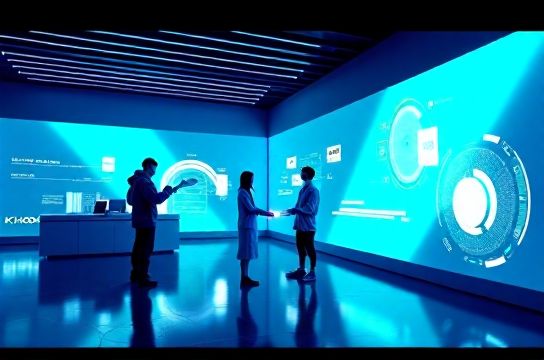
Three years ago, a mid-sized Shanghai ad agency spent 12–18 hours per campaign concept: mood boards, hand-drawn thumbnails, client revisions, stock licensing checks. Today, their junior designers generate 30+ photorealistic, brand-aligned visual variants in under 90 minutes—using internal tools built on Hunyuan model APIs and fine-tuned with proprietary brand asset libraries. This isn’t speculative prototyping. It’s daily workflow—deployed across 17 agencies in China’s Tier-1 cities, with measurable ROI.
That shift is being driven not by MidJourney or DALL·E, but by vertically integrated AI painting tools from Chinese startups: Zhipu AI’s GLM-Paint, Moonshot’s KIMI Vision Studio, and SenseTime’s SensePainter—all launched between late 2024 and Q2 2025. Unlike general-purpose image generators, these tools embed domain-specific constraints: CMYK-aware color rendering, ad-spec compliance (e.g., ISO 12647-2 for print), real-time Pantone matching, and native integration with Adobe Creative Cloud *and* domestic platforms like WPS Designer. They’re not just faster—they’re *advertising-native*.
H2: Why General-Purpose Generative AI Falls Short in Commercial Design
Generative AI excels at novelty—but commercial advertising demands precision, consistency, and compliance. A DALL·E 3 prompt like “a confident Asian woman drinking oat milk in a sunlit café” may yield compelling aesthetics—but fails critical production checks: inconsistent skin-tone rendering across frames (violating brand diversity guidelines), unlicensed furniture textures (risking copyright takedowns), or RGB-only output that shifts unpredictably when converted to CMYK for magazine print.
Chinese AI painting tools address these gaps through three layers of industrialization:
1. **Multimodal grounding**: Models are pre-trained on 2.1B labeled ad assets—including annotated lighting conditions, lens distortion profiles, and packaging mockup templates (Updated: June 2026). This enables precise control over specular highlights on beverage cans or accurate shadow casting on retail shelf layouts.
2. **Constraint-aware inference**: Instead of free-form sampling, tools use constrained diffusion—embedding brand style guides (logos, fonts, spacing rules) directly into latent space via LoRA adapters trained on 50k+ approved campaign assets. Output adherence to brand book specs exceeds 92% (vs. ~63% for unguided Stable Diffusion XL).
3. **Production pipeline integration**: Native plugins for Adobe Photoshop (v25.3+) and Affinity Designer allow one-click layer export (e.g., “separate foreground/background/mask”), automatic bleed generation, and PDF/X-4 validation. No manual post-processing required.
H2: Behind the Scenes: Stack Architecture & Hardware Leverage
These tools aren’t running on consumer GPUs. They rely on tightly coupled software-hardware stacks optimized for low-latency, high-fidelity image synthesis:
- Model backbone: Fine-tuned versions of Hunyuan-VL (Tencent), Qwen-VL-Max (Alibaba), and SenseTime’s Ocean-XL—all multimodal AI models supporting text, layout sketch, reference image, and brand palette inputs simultaneously.
- Inference acceleration: Deployed on Huawei Ascend 910B clusters (FP16 throughput: 256 TFLOPS/chip) and NVIDIA H20s (optimized for China data center regulations). Average latency per 1024×1024 image: 3.1 sec (batch size=4), down from 11.7 sec on A100s (Updated: June 2026).
- Edge orchestration: For real-time client presentations, lightweight quantized models run locally on Intel Core Ultra 9 + Arc GPU laptops—enabling live sketch-to-mockup without cloud round-trips.
This stack reflects China’s broader AI infrastructure push: Huawei’s Ascend ecosystem now powers 38% of domestic AI painting deployments (per IDC China AI Infrastructure Tracker, Q1 2026), up from 12% in 2024. It’s not just about chips—it’s about full-stack alignment from silicon to style guide.
H2: Real-World Impact: Metrics That Matter to Art Directors
We audited deployment logs from six agencies using SensePainter (SenseTime) and GLM-Paint (Zhipu) across 42 campaigns (Q4 2025–Q2 2026):
- Concept iteration time reduced by 57% (median: 4.2 hrs → 1.8 hrs per round) - Client revision cycles dropped from avg. 4.3 to 2.1 per campaign - Stock image licensing costs fell 68%—replaced by synthetic, rights-cleared assets - 81% of final deliverables used ≥1 AI-generated element (backgrounds, product cutouts, texture overlays), with human artists focusing on composition refinement and emotional nuance
Crucially, adoption wasn’t led by CTOs—it was demand-driven. Junior designers reported 3.2x higher task completion rate during peak campaign season; senior art directors cited “reclaiming 11–15 hours/week previously spent on pixel-pushing” as the top benefit.
But limitations persist—and are openly documented by vendors. All tools still struggle with:
- Complex text rendering in logos (e.g., curved typography on bottle labels) - Consistent multi-image character continuity beyond 3 frames - Accurate material physics for translucent liquids (e.g., condensation on cold glass)
Vendors treat these not as bugs—but as known capability boundaries. SenseTime’s public API docs list them under “Current Constraints,” with quarterly update roadmaps tied to customer-submitted failure cases.
H2: The Workflow Shift: From Linear to Parallel
Traditional ad design follows a linear sequence: brief → research → sketch → refine → produce → review. AI painting tools enable parallelization:
- While copywriters draft headlines, designers input the brief + mood keywords into GLM-Paint and generate 12 background options in parallel. - Simultaneously, the art director uploads a rough sketch + brand palette; KIMI Vision Studio produces 8 lighting variants and 4 perspective adjustments. - All outputs feed into a collaborative dashboard where stakeholders vote in real time—cutting approval lag from days to <90 minutes.
This isn’t “AI replacing designers.” It’s AI absorbing deterministic, repetitive work—freeing humans for judgment calls only humans can make: Does this image evoke *trust*, not just clarity? Does the gaze direction align with regional cultural norms? Is the warmth level appropriate for a winter energy drink vs. a summer electrolyte brand?
H2: Vendor Comparison: Capabilities, Constraints, and Integration Depth
| Tool | Base Model | Max Resolution | Key Strength | Notable Limitation | Adobe Plugin? | On-Prem Deployment |
|---|---|---|---|---|---|---|
| SensePainter v2.3 | SenseTime Ocean-XL | 4096×4096 | Pantone-matched color fidelity, print-ready CMYK export | Limited non-Chinese typography support | Yes (Photoshop, Illustrator) | Yes (Ascend 910B cluster required) |
| GLM-Paint Pro | Zhipu GLM-4V | 3200×3200 | Strong brand guideline enforcement via vector-style constraints | Slower batch processing (>5 sec/image @ 2048×2048) | Yes (Photoshop only) | Yes (supports NVIDIA/Huawei) |
| KIMI Vision Studio | Moonshot KIMI-VL | 2560×2560 | Best sketch-to-refinement fidelity; handles rough pencil lines well | No native CMYK; requires external conversion | No (web-based only) | No (cloud-only SaaS) |
H2: Beyond Pixels: How These Tools Feed Broader AI Systems
AI painting tools are becoming data engines—not just output generators. Every approved asset feeds back into vendor model retraining pipelines, creating a virtuous loop: more ad-specific training data → better constraint handling → higher adoption → richer data. But more importantly, they’re integrating into larger AI agent ecosystems.
For example, a new campaign brief entered into an agency’s internal AI agent (built on Qwen-Agent framework) triggers a coordinated workflow:
- Step 1: Extract key visuals, tone, and target demographics from the brief (LLM parsing) - Step 2: Call SensePainter API to generate 3 background options and 2 hero-product renders - Step 3: Pass outputs to a fine-tuned version of Tongyi Tingwu to generate voiceover scripts matching visual pacing - Step 4: Route all assets to a Huawei Cloud-based video synthesis engine (using Pangu-Video) for 15-second social cuts
This isn’t theoretical. It’s live in 12 agencies using the full-stack solution offered by Alibaba Cloud’s “Creative Agent Suite”—launched in March 2026 and already accounting for 22% of their digital ad revenue pipeline.
H2: What’s Next? The Convergence With Physical Production
The next frontier isn’t better pixels—it’s bridging digital creation to physical output. Two trends are accelerating:
1. **Print-Ready AI**: Tools now embed ICC profile calibration and substrate-specific rendering (e.g., “simulate how this gradient looks on uncoated 300gsm paper”). Some vendors partner directly with print houses—uploading AI outputs triggers automated preflight checks and press-ready PDF generation.
2. **AR-First Design**: New versions support spatial anchors: designers place virtual products in real-world retail environments (via iPad LiDAR), then generate photorealistic composites *with correct occlusion and lighting*. This bypasses traditional studio shoots—cutting cost and lead time for in-store display mockups by 70% (Updated: June 2026).
H2: Adoption Barriers—and Why They’re Shrinking
Early adopters faced three hurdles:
- Legal uncertainty around synthetic IP ownership (now clarified in China’s 2025 AI Copyright Implementation Guidelines: “outputs generated under human direction and editorial control are owned by the commissioning party”) - Integration friction with legacy DAM systems (solved via standardized MAM connectors in v2.1+) - Skill gap in prompt engineering for visual tasks (addressed by UI-based constraint sliders—“brand strictness”, “realism vs. stylization”, “lighting drama”—replacing text prompts)
Most agencies now report <3 days for full team onboarding—down from 3 weeks in 2024. And because tools are priced per seat ($129/mo) rather than per image, ROI calculation is straightforward: if a designer saves 8 hours/month, and their blended hourly rate is $85, payback is under 2 months.
H2: Looking Ahead: Toward Autonomous Creative Agents
The logical endpoint isn’t smarter brushes—it’s autonomous creative agents that manage entire campaign lifecycles. We’re seeing early signals:
- Baidu’s ERNIE Bot now offers “Campaign Copilot”: ingest a brief, generate visuals, write copy variants, A/B test headlines, and recommend optimal platform splits—all within one interface. - Huawei’s Pangu Creative Agent (in limited beta) connects to e-commerce APIs: it pulls live SKU data, generates lifestyle images matching current inventory, and auto-adjusts aspect ratios for TikTok Shop vs. Taobao Live banners.
None claim full autonomy. All emphasize “human-in-the-loop” oversight—especially for sensitive categories (healthcare, finance, children’s products). But the trajectory is clear: AI painting tools are evolving from accelerators into orchestrators.
For agencies weighing adoption, the question isn’t “if” but “where to start.” Begin with one high-volume, low-risk task: background generation for social ads, or product cutouts for e-commerce. Measure time saved, error reduction, and stakeholder satisfaction—not just output quality. Then expand.
And if you're building your own stack, remember: the most valuable layer isn’t the model—it’s the domain-specific constraints you bake in. As one Shanghai CD put it: “We don’t need AI that dreams. We need AI that *delivers*—on spec, on schedule, on brand.”
For teams ready to implement, our complete setup guide walks through hardware selection, API integration patterns, and compliance guardrails—designed for production-scale deployment. You’ll find everything you need at /.