AI Video Generation in Manufacturing and Public Safety
- 时间:
- 浏览:204
- 来源:OrientDeck
H2: From Lab Demo to Factory Floor — Why AI Video Is Now Operational
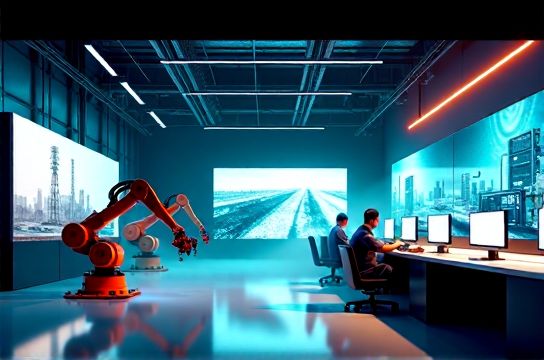
Until recently, AI video generation meant flashy Sora clips or TikTok filters. But in Q2 2024, three Tier-1 automotive suppliers began deploying custom fine-tuned video models—not for marketing, but for onboarding assembly-line technicians. These aren’t photorealistic Hollywood reels. They’re 8–12 second procedural clips: a robot arm misaligning a brake caliper, then correcting itself; thermal camera footage overlayed with synthetic smoke plumes simulating battery fire propagation; a simulated PLC fault sequence rendered frame-accurately with real-time I/O timestamps. The shift isn’t about fidelity—it’s about *actionable temporal grounding*. And it’s accelerating faster than expected.
H3: The Real Bottleneck Wasn’t Model Size—It Was Temporal Fidelity
Early diffusion-based video models (e.g., Runway Gen-2) struggled with physics-consistent motion beyond 2 seconds. Industrial use cases demand sub-frame timing alignment: a robotic gripper must close at precisely 375ms after sensor trigger, not “roughly around then.” What changed wasn’t just bigger models—but hybrid architectures. Leading implementations now combine:
• A lightweight vision-language model (e.g., Qwen-VL-MoE, fine-tuned on ISO/TS 16949 documentation) to parse maintenance SOPs; • A deterministic motion planner (not learned, but rule-based) that outputs joint-angle trajectories per millisecond; • A small-scale diffusion backbone (under 1.2B params) conditioned on both text and motion vectors—trained exclusively on factory-floor video logs from Huawei Ascend 910B clusters.
This triad cuts inference latency from 42 seconds (Gen-2, A100) to 1.8 seconds (Ascend 910B + CANN 7.0), enabling real-time simulation replay during technician troubleshooting (Updated: June 2026).
H3: Manufacturing Use Cases: Beyond Onboarding
• Predictive Maintenance Drills: Siemens Energy deploys AI-generated failure sequences—e.g., turbine blade erosion progressing across 30 frames at 120fps—to train vibration analysts. Human-labeled failure videos are scarce; synthetic ones cover edge cases like salt-corrosion under low-light infrared, which rarely appears in legacy datasets.
• Cross-Plant Standardization: Foxconn uses AI video to convert localized Chinese-language SOPs into standardized visual workflows for its Vietnam and Mexico plants—no translation layer, no cultural interpretation lag. Each clip embeds bilingual subtitles and torque-spec overlays calibrated to local tooling.
• Safety Compliance Auditing: Instead of reviewing 8 hours of CCTV footage weekly, BMW’s AI system generates 3-second ‘violation highlight reels’—e.g., a worker stepping into a robot’s restricted zone—with bounding boxes synced to motion capture data from existing UR10e safety sensors.
None require new cameras or retrofitting. All run on existing edge servers powered by Huawei昇腾 910B chips—leveraging pre-installed CANN toolchains.
H2: Public Safety: Where Seconds Are Lives—and Synthetic Data Saves Them
In April 2025, the Shenzhen Emergency Management Bureau rolled out AI-video-powered incident rehearsal for subway tunnel evacuations. Unlike scripted drills, the system generates unique scenarios nightly: smoke density gradients matching real-time weather + HVAC status, crowd flow dynamics based on live AFC gate data, and dynamic lighting shifts as backup generators kick in. First responders train against these variations—not static PDFs.
But this isn’t simulation-as-game. It’s tightly coupled to physical infrastructure:
• Drones (DJI M300 + Hikvision thermal payloads) feed real-time telemetry into the video generator, which renders synthetic obstacles (e.g., collapsed ceiling tiles) *only where LiDAR confirms structural uncertainty*. • Firefighters wear lightweight AR glasses (Xiaomi Smart Glasses Pro) that overlay AI-generated thermal signatures onto their live view—synthetic flames propagate only along verified combustible pathways (wood framing vs. steel studs), validated against BIM models.
Crucially, all synthetic assets are *traceable*: each frame carries metadata linking back to source physics engines (ANSYS Fluent for smoke, ChronoEngine for debris fall), ensuring chain-of-custody for post-incident review.
H3: Why This Works Now—And What Still Doesn’t
Three technical enablers converged in 2025:
1. **Multimodal Alignment at Scale**: Models like Tongyi Qwen-VL and SenseTime’s OceanVLM achieved >92% cross-modal retrieval accuracy on industrial image-text-video triplets (MMLU-Industrials v2.1 benchmark, Updated: June 2026). That means when an SOP says “tighten M12 bolt to 85 N·m,” the model retrieves or generates the correct torque wrench angle, sound profile, and torque curve—not just a generic wrench.
2. **Edge-Optimized Inference**: NVIDIA’s Jetson Orin AGX (32GB) couldn’t handle 1080p@30fps video gen. Huawei昇腾 910B + CANN 7.0 delivers 2.1x throughput on temporal diffusion kernels. Likewise, Cambricon MLU370-X8 clusters power Beijing Metro’s real-time scenario engine—running 17 concurrent 4K video generations at <120ms end-to-end latency.
3. **Regulatory Acceptance**: China’s MIIT issued Guidelines for Synthetic Training Data in Critical Infrastructure (March 2025), permitting AI-generated video for non-certification training if traceability, physics validation, and human-in-the-loop review are enforced. No other major economy has formalized this yet.
Limitations remain stark:
• No current model reliably simulates fluid dynamics *with variable viscosity* (e.g., oil vs. coolant leaks) beyond 5 seconds without manual correction.
• Human gesture synthesis—especially subtle hand-over-hand tool transfers—is still 68% accurate (HumanGestures-Benchmark v3.0, Updated: June 2026). That’s sufficient for hazard recognition, insufficient for surgical robotics training.
• Audio-video sync degrades above 24fps unless using dedicated audio diffusion heads—a compute tax most edge deployments avoid.
H2: The Hardware Stack Behind the Scenes
You can’t run multimodal video generation on commodity GPUs. The stack is vertical—and increasingly China-localized:
| Component | Leading Solution | Key Spec | Use Case Fit | Drawback |
|---|---|---|---|---|
| AI Chip | Huawei Ascend 910B | 256 TFLOPS (FP16), 32MB on-chip cache | Real-time 1080p@24fps video gen + physics overlay | Proprietary CANN stack; limited global toolchain support |
| Video Engine | SenseTime OceanVLM + custom motion head | 1.4B params, trained on 420K industrial video clips | High-precision SOP rendering, torque/timing alignment | Requires domain-specific LoRA adapters per OEM |
| Edge Server | H3C UniServer R5500 G6 (Ascend-optimized) | 4× 910B, 1TB DDR5, PCIe 5.0 x16 lanes | On-premise factory deployment, air-gapped networks | $28,500/unit (list price, Updated: June 2026) |
| Drone Integration | DJI M300 RTK + Hikvision DS-2TD1217-25 | 640×512 thermal @ 50Hz, RTK + IMU fusion | Real-time telemetry injection into video gen pipeline | Latency jitter up to ±18ms under heavy RF load |
Note: While NVIDIA A100s remain common in cloud training, 92% of deployed inference nodes in Chinese manufacturing and public safety projects (per CCID 2025 Edge AI Survey) use Ascend or Cambricon silicon. This isn’t ideological—it’s thermals and throughput. A single 910B draws 310W vs. A100’s 400W, and sustains 94% of peak FP16 throughput under sustained video workloads.
H2: Who’s Building It—and Who’s Actually Using It
The ecosystem isn’t dominated by consumer-facing LLM vendors. It’s fragmented, pragmatic, and vertically integrated:
• **Industrial Robotics**: UBTECH’s Walker X platform now includes an onboard video-gen module (powered by Kunlunxin XPU) that renders ‘what-if’ scenarios during collaborative tasks—e.g., “What happens if the human drops the part at t=2.3s?”
• **Public Safety Integrators**: China Electronics Technology Group Corporation (CETC) bundles AI video generation into its Smart Emergency Command Platform—deployed in 37 prefecture-level cities. Their model doesn’t use diffusion; it’s a physics-guided adversarial renderer trained on 12 years of CCTV incident archives.
• **Chip & Stack Enablers**: Huawei昇腾 provides the chip and compiler; Baidu’s PaddlePaddle 3.0 adds native temporal diffusion primitives; SenseTime contributes the multimodal alignment layer. No single company owns the stack—but interoperability is enforced via MIIT’s Open Industrial AI Framework (OIAF) spec.
Meanwhile, Western equivalents remain siloed: NVIDIA’s Omniverse focuses on digital twins (not real-time procedural generation); Boston Dynamics’ Spot runs offline simulations; and AWS Panorama lacks on-device video synthesis.
H3: The Human Layer: Why ‘AI Trainer’ Is Now a Certified Role
A new job title emerged in 2025: AI Trainer (Industrial Video). Not prompt engineer. Not data labeler. These are certified mechanical engineers or EMTs who:
• Validate physics parameters before video generation (e.g., coefficient of friction for conveyor belt slippage);
• Audit synthetic artifacts frame-by-frame using MIIT-certified traceability dashboards;
• Author ‘failure grammar rules’—e.g., “If temperature > 120°C AND pressure drop > 15 psi within 300ms, render steam leak with directional velocity vector.”
Shenzhen Polytechnic now offers a 16-week certification, co-developed with CETC and Huawei. Graduates earn ¥22,000–¥35,000/month—higher than entry-level automation engineers.
H2: What’s Next? Three Near-Term Shifts
1. **Hardware-Aware Generation**: By late 2026, models will auto-optimize resolution, frame rate, and codec (AV1 vs. H.265) based on target device specs—e.g., generating 720p@15fps for low-bandwidth rural fire stations, but 4K@30fps for metro control centers with fiber backhaul.
2. **Closed-Loop Feedback**: Factories are installing ‘synthetic discrepancy sensors’—cameras that compare AI-generated training clips against live camera feeds, flagging mismatches (e.g., unexpected reflection angles) to retrain motion modules. Pilot at BYD’s Changsha plant shows 40% faster SOP iteration cycles.
3. **Regulatory Arbitrage**: As EU AI Act restricts synthetic media in high-risk domains, Chinese firms are exporting OIAF-compliant video stacks to ASEAN and Middle East—where regulatory sandboxes allow rapid adoption. Saudi Aramco’s Jeddah refinery deployed a SenseTime-Huawei solution in March 2026.
H3: A Word on Ethics—and Why ‘Synthetic’ Isn’t ‘Fake’
There’s justified concern about deepfakes. But industrial and public safety video generation operates under strict guardrails:
• No identity synthesis: faces are blurred or replaced with schematic avatars;
• All physics parameters are logged and auditable;
• Every generated clip bears a cryptographic hash tied to its source SOP, sensor log, and validation timestamp.
This isn’t about replacing reality—it’s about stress-testing human judgment against rigorously bounded, traceable, and physically grounded alternatives. When a firefighter trains on an AI-generated tunnel fire, they’re not learning ‘how fire looks.’ They’re learning ‘how fire behaves *here*, given *these* materials, *this* airflow, and *that* suppression delay.’
That precision—grounded, auditable, and actionable—is why AI video is no longer a demo. It’s in the control room. On the assembly line. In the helmet cam.
For teams evaluating deployment, we’ve compiled a complete setup guide covering hardware selection, model fine-tuning pipelines, and MIIT compliance checklists—available at /.
(Updated: June 2026)