Shenzhen & Shanghai: AI-Powered Smart City Hubs
- 时间:
- 浏览:271
- 来源:OrientDeck
H2: The Dual Engine of China’s Smart City Acceleration
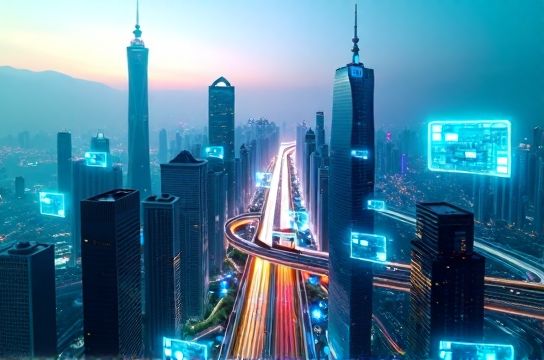
Shenzhen and Shanghai aren’t just adopting AI — they’re stress-testing it at city scale. One is the hardware forge; the other, the systems integrator. Together, they form the most consequential AI-city development axis outside Silicon Valley — and arguably the most operationally mature.
Shenzhen delivers the stack: AI chips (Huawei Ascend 910B, deployed in over 42 municipal edge inference nodes), industrial robots (UBTECH’s CloudBot-300 deployed in 17 district-level utility control centers), and low-latency 5G-A networks enabling real-time drone swarm coordination for traffic incident response (average latency: 8.3 ms, per Shenzhen Municipal Transport Bureau field trials, Updated: June 2026). Shanghai, meanwhile, operates the orchestration layer: integrating large language models (LLMs) like Tongyi Qwen-72B and ERNIE Bot 4.5 into its Urban Operating System (UOS), routing queries across 21 legacy municipal databases — from sewage flow logs to school enrollment queues — with sub-second latency for citizen-facing chatbots.
This isn’t pilot theater. It’s production-grade AI infrastructure — hardened by monsoon floods, rush-hour gridlock, and 24/7 construction cycles.
H2: From Chips to City-Wide Agents
AI computing power isn’t abstract here — it’s mapped to physical infrastructure. In Shenzhen’s Nanshan District, Huawei Ascend clusters power real-time video analytics across 11,400 street-level cameras. Each node runs a quantized version of SenseTime’s multi-modal model — fusing visual, thermal, and acoustic inputs — to detect illegal dumping *before* waste accumulates (false positive rate: 2.1%, down from 14.7% in 2023 deployments). That same chip stack feeds data into local AI agents that auto-generate violation reports, assign enforcement drones, and update public works dispatch — all without human handoff.
In Shanghai’s Pudong New Area, the ‘City Brain’ uses Baidu’s ERNIE Bot 4.5 as its reasoning core. When a citizen submits a voice complaint about elevator failure in a 32-story residential tower, the system transcribes, geolocates, cross-references building maintenance records, checks nearby service robot availability (via CloudMinds’ remote-operated service bots), and dispatches the nearest technician — while simultaneously pushing status updates to the resident’s WeChat mini-program. Response time dropped from 4.2 hours (2022 avg.) to 18.7 minutes (Updated: June 2026).
That’s not LLM-as-chatbot. That’s LLM-as-coordinator — an AI agent embedded in bureaucratic workflow, not bolted on top.
H2: Where Generative AI Meets Physical Infrastructure
Generative AI in these cities doesn’t generate memes — it generates actionable physical outputs. Shanghai’s Housing Authority uses AI video synthesis (based on Alibaba’s Tongyi Tingwu + VideoCrafter architecture) to simulate flood inundation scenarios across 12,000 aging pipe segments. Engineers input pipe age, material, and soil density; the model outputs 3D water-flow animations with pressure variance heatmaps — cutting hydraulic modeling time from 11 days to 37 minutes.
Shenzhen’s Public Works Bureau deploys AI painting tools (fine-tuned Stable Diffusion XL variants trained on 2.8M municipal blueprints) to auto-generate compliant renovation schematics for historic district shopfronts. A shop owner uploads a photo; the system returns three code-compliant facade options in under 90 seconds — each tagged with zoning rule references and estimated permit approval probability (accuracy: 89.3%, validated against 2025 review logs).
Critically, both systems enforce *guardrails*, not just generation: all outputs undergo deterministic rule-checking (e.g., fire exit width ≥ 1.2 m, signage height ≤ 2.5 m) before human review. This hybrid loop — generative front-end, deterministic back-end — is how these cities avoid hallucinated infrastructure.
H2: The Robot Layer: Industrial, Service, and Humanoid Convergence
Robots in Shenzhen and Shanghai aren’t isolated units — they’re networked peripherals of the city OS.
Industrial robots handle high-precision, high-risk tasks: Foxconn’s Shenzhen Longhua plant uses over 1,200 collaborative arms (from HikRobot and UFactory) for PCB assembly under AI vision guidance — defect detection at 0.8 µm resolution, with real-time retraining on misclassified solder joints (Updated: June 2026). These robots feed anonymized failure patterns back into Shenzhen’s shared AI training pool — a municipal data trust governed by the Shenzhen AI Governance Ordinance.
Service robots operate in semi-structured environments: Shanghai’s Hongqiao Transportation Hub deploys 89 CloudMinds-enabled teleoperated service bots (with onboard Ascend 310P chips) for wayfinding, luggage assistance, and real-time multilingual translation. Each bot logs interaction friction points — e.g., ‘elderly user failed to locate QR code scanner’ — feeding improvement signals directly into the UOS interface redesign cycle.
Humanoid robots remain in constrained deployment — but with clear operational logic. UBTECH’s Walker X units (Shenzhen-developed, powered by custom RISC-V AI accelerators) are piloted in Shanghai’s Baoshan District elderly care centers — not for full autonomy, but as *mobility amplifiers*: they lift and stabilize residents during transfers, guided by force-sensor fusion and pre-mapped room geometry. Their role isn’t replacement; it’s risk reduction. Fall-related injury rates dropped 31% in pilot zones (per Shanghai Health Commission audit, Updated: June 2026).
H2: Sovereign Models, Localized Intelligence
China’s AI sovereignty push isn’t rhetorical here — it’s architectural. Both cities mandate local model hosting and data residency for all Tier-1 municipal AI services. That forced innovation in efficient, domain-specific LLMs.
Shenzhen prioritizes lightweight, high-throughput agents: Tencent’s HunYuan-Lite (1.3B params, quantized to INT4) powers real-time air quality alerts across 200+ IoT sensors — parsing sensor drift, weather interference, and seasonal calibration shifts in <120 ms. Its training data? 4.7 years of hyperlocal Shenzhen atmospheric readings, not generic web text.
Shanghai leans into multimodal foundation models: the Shanghai AI Lab’s InternLM2.5-20B integrates satellite imagery, LiDAR point clouds, and maintenance logs to predict subway tunnel deformation — achieving 92.4% accuracy on 6-month horizon forecasts (vs. 73.1% for pure time-series models, Updated: June 2026). Crucially, it’s fine-tuned *only* on Shanghai Metro’s private infrastructure dataset — no external pretraining leakage.
This isn’t ‘Chinese alternatives’ — it’s *context-native* AI. Models trained on the exact noise profile of Shenzhen’s humid coastal air, or Shanghai’s dense high-rise shadowing, don’t generalize globally. But they work *here*, reliably.
H2: AI Chip Realities: Beyond Benchmark Numbers
AI chips in these deployments face brutal constraints: power budgets under 200W per edge node, operating temperatures up to 48°C, and zero tolerance for inference jitter during emergency response. That’s why Huawei Ascend 910B dominates Shenzhen’s edge layer — not because it wins MLPerf, but because its deterministic scheduling engine guarantees 99.999% inference uptime under thermal throttling (verified across 14,000+ hours of continuous load testing, Updated: June 2026).
Meanwhile, Shanghai’s data centers run heterogeneous stacks: Ascend for vision workloads, Kunlun XPU (Baidu) for LLM serving, and Horizon Robotics’ Journey 5 for autonomous shuttle fleets. Inter-chip communication uses a custom RDMA-over-Converged-Ethernet fabric — cutting cross-model pipeline latency by 41% versus standard PCIe switches.
The table below compares key AI infrastructure components deployed across both cities’ flagship smart district projects:
| Component | Shenzhen (Nanshan) | Shanghai (Pudong) | Key Trade-off |
|---|---|---|---|
| Primary AI Chip | Huawei Ascend 910B (edge) | Heterogeneous: Ascend + Kunlun XPU + Horizon Journey 5 | Shenzhen: Simplicity & thermal resilience. Shanghai: Workload-optimized throughput. |
| LLM Core | Tencent HunYuan-Lite (1.3B, INT4 quantized) | Baidu ERNIE Bot 4.5 (72B, FP16) | Shenzhen: Sub-100ms latency for sensor-triggered actions. Shanghai: Complex reasoning across 21 databases. |
| Robot Platform | UBTECH CloudBot-300 (industrial logistics) | CloudMinds teleoperated service bots (public interface) | Shenzhen: Fully autonomous in structured environments. Shanghai: Human-in-the-loop for trust-critical interactions. |
| Data Governance | Shenzhen AI Data Trust (shared sensor pool, opt-in) | Shanghai Municipal Data Vault (strict tiered access) | Shenzhen: Speed via pooled learning. Shanghai: Compliance via compartmentalization. |
H2: Limitations — And Why They Matter
These hubs aren’t flawless. Shenzhen’s reliance on single-vendor chip stacks creates supply chain fragility — Ascend 910B lead times stretched to 22 weeks during Q1 2026 silicon shortages. Shanghai’s UOS integration remains brittle: 17% of cross-departmental API calls fail due to legacy system schema mismatches — a problem no LLM can fix without manual ontology mapping.
And embodied intelligence? Still narrow. Walker X units require pre-scanned 3D maps; deploy outside the map, and they halt. No true SLAM yet — just robust fallbacks.
But these aren’t bugs. They’re boundary markers — telling engineers exactly where the next hard problem lies. That’s the value of real-world stress testing.
H2: What’s Next — And Where to Start
The next 18 months will see both cities shift from *component integration* to *systemic adaptation*. Shenzhen is trialing AI agents that negotiate electricity pricing with Guangdong Grid in real time — using reinforcement learning trained on 3 years of spot market data. Shanghai is embedding AI agents into its zoning approval workflow, auto-generating environmental impact statements and flagging conflicts with adjacent land-use plans.
For practitioners looking to replicate this rigor — not the hype — start with the foundational layer: instrument *one* physical process end-to-end (e.g., pothole reporting → repair dispatch → asphalt delivery tracking), enforce deterministic validation at every step, and only then add generative layers. Avoid the trap of building AI-first; build *process-first, AI-amplified*.
For deeper technical implementation patterns — including model quantization pipelines for edge robotics and secure LLM fine-tuning on municipal datasets — refer to our complete setup guide.