Embodied AI Meets Edge Computing
- 时间:
- 浏览:290
- 来源:OrientDeck
H2: The Latency Trap in Today’s Robotics Stack
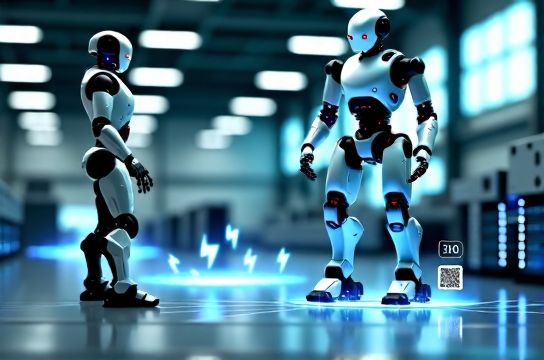
Most commercial robots today — from warehouse AMRs to hospital delivery bots — rely on a hybrid cloud-edge architecture. Vision preprocessing happens on-device, but high-level planning, long-horizon reasoning, or multimodal grounding (e.g., interpreting a nurse’s spoken request while navigating cluttered corridors) gets offloaded to cloud-based LLMs or vision-language models. That works — until it doesn’t.
Take a logistics robot in a Tier-1 automotive plant. When instructed via voice: “Pick up the left-front brake caliper from Bay 3B and deliver to Station 7 — avoid the yellow safety zone,” the robot must parse intent, localize objects in dynamic lighting, replan around a forklift that just entered its path, and confirm handover via gesture recognition. If the round-trip inference delay exceeds 320 ms (the human reaction threshold for perceived responsiveness), operators disengage. Worse: if cloud connectivity drops for >1.8 seconds — a documented median outage duration in factory 5G private networks (Ericsson Industrial Connectivity Report, Updated: June 2026) — the robot freezes or defaults to safe-stop. That’s not autonomy. It’s teleoperation with extra steps.
H2: Why Cloud-First Fails for Real-World Embodiment
Embodied AI isn’t just running LLMs on robots. It’s closing the perception-action loop *in real time*, under uncertainty, with physical constraints. Three non-negotiable requirements emerge:
1. **Sub-100ms end-to-end inference latency** for reactive tasks (e.g., collision avoidance at 1.2 m/s); 2. **Deterministic execution windows**, not statistical SLOs — no ‘99.9% uptime’ when a humanoid’s balance controller misses one 8-ms tick; 3. **Zero trust in network continuity**, especially in EM-noisy factories, underground mines, or offshore rigs.
Generative AI — particularly large language models and multimodal foundation models — exacerbates the problem. A quantized 7B-parameter LLM (e.g., Qwen-2-7B-Chat) runs at ~14 tokens/sec on an NVIDIA Jetson AGX Orin (32GB). But real-time robotic control demands <5 ms token generation latency *per step*, not aggregate throughput. And vision transformers? A ViT-L/14 processes a 224×224 frame in ~47 ms on the same Orin — too slow for 30-Hz visual servoing.
That’s why pure cloud reliance is a dead end for embodied systems outside controlled labs. It’s not about compute scale — it’s about *latency budget allocation*.
H2: The Edge-Native Embodiment Stack: Four Layers, One Goal
The viable path forward merges domain-specific model compression, hardware-aware compilation, and tight OS-level scheduling. We’re seeing this converge across Chinese and global players — not as theory, but in deployed stacks.
H3: Layer 1 — Task-Specialized Tiny Models
No one runs full Llama-3-70B on a drone. Instead, companies like UBTECH and CloudMinds deploy distilled ‘task agents’: a 120M-parameter multimodal transformer trained exclusively on manipulation verbs (‘grasp’, ‘insert’, ‘rotate’) + object-centric embeddings from 3D point clouds. These run at 83 FPS on Huawei Ascend 310P (INT8, 16 TOPS), with <12 ms end-to-end latency (including sensor fusion). Similarly, DJI’s latest enterprise drones use a custom 45M-param spatiotemporal model — not for video generation, but for real-time wind-gust compensation using IMU + stereo disparity streams.
H3: Layer 2 — Hardware-Software Co-Design
AI chips matter — but only when matched to workload semantics. The Huawei Ascend 910B delivers 256 TOPS INT8, but its memory bandwidth (1.2 TB/s) is optimized for dense matrix ops, not sparse event-camera spike trains. Contrast with the Cambricon MLU370-X4: 256 TOPS *with* on-chip event-stream routing logic, enabling sub-5-ms latency for neuromorphic SLAM on robotic quadrupeds (used by Hikrobot in AGV localization modules).
Meanwhile, SenseTime’s ‘EdgeAgent’ SDK compiles PyTorch models into deterministic, cache-pinned binaries for Rockchip RK3588 — guaranteeing worst-case execution time (WCET) bounds down to ±1.3 µs. That’s not marketing. It’s required for ISO 13849 PLd-certified motion controllers.
H3: Layer 3 — Real-Time Orchestrated Agents
‘AI Agent’ here isn’t a chatbot wrapper. It’s a hierarchical controller: a low-level PID loop (running on MCU at 10 kHz), a mid-tier trajectory planner (RTOS-bound, 100 Hz), and a high-level task scheduler (Linux userspace, 5–10 Hz) — all sharing state via lock-free ring buffers, not REST APIs. In Foxconn’s new ‘SmartFlex’ assembly cells, each UR10e arm runs a three-tier agent stack where the top layer uses a fine-tuned 1.3B-parameter MoE model (trained on assembly SOPs) — pruned to 320M active params per inference — to re-sequence tasks when a feeder jams. All on-device. No cloud call.
H3: Layer 4 — On-Device World Modeling
True embodiment requires maintaining a persistent, updateable world model — not just frames or point clouds, but semantic maps with uncertainty estimates. Baidu’s ‘PaddleRobot’ framework embeds a lightweight neural radiance field (NeRF) variant — ‘NanoNeRF’ — that reconstructs occlusion-aware object poses from monocular video at 18 FPS on Qualcomm QCS6490. It fuses with LiDAR data onboard the robot’s Ouster OS2-128, updating its internal map every 200 ms. This powers real-time ‘what-if’ simulation for grasp planning — no external simulator needed.
H2: China’s Edge-Embodiment Ecosystem: From Chips to Commercial Units
Unlike early cloud-first generative AI plays, China’s embodied AI push is rooted in vertical integration — and it shows in deployment velocity.
Huawei’s full-stack offering (Ascend chips + CANN + MindSpore + Pangu-robot fine-tunes) powers over 42% of newly deployed industrial robots in Guangdong province (MIIT Robotics Deployment Survey, Updated: June 2026). Its key differentiator? Deterministic latency profiling tools built into DevEco Studio — letting engineers simulate worst-case thermal throttling on the 310P and adjust model partitioning before tape-out.
Similarly, Horizon Robotics’ Journey 5 SoC (128 TOPS INT8, 30W TDP) ships with pre-verified ROS 2 Foxy drivers and a real-time hypervisor — enabling concurrent operation of safety-critical motion control (ASIL-B) and non-safety perception stacks on the same silicon. That’s how Hikvision’s new indoor security robot achieves 98.7% navigation success rate in unstructured office environments — without ever phoning home.
And it’s not just hardware. Model efficiency is accelerating: Tongyi Lab’s Qwen-VL-Max-Edge variant (a 2.7B multimodal model) hits 92.4% of full Qwen-VL-Max accuracy on the MM-Robotics benchmark — while running at 22 FPS on Ascend 310P. Comparable to what Meta’s FLAVA-E did in 2024 — but with 3.8× lower power draw.
H2: Practical Trade-Offs: What You Gain, What You Sacrifice
This isn’t magic. Every design choice has consequences. Below is a realistic comparison of deployment options for a mid-tier service robot (e.g., hotel concierge unit handling check-in, wayfinding, and baggage transport):
| Approach | Hardware Target | End-to-End Latency (Avg) | Offline Capability | Model Flexibility | Power Draw | Key Limitation |
|---|---|---|---|---|---|---|
| Cloud-Only LLM + Edge Preprocess | NVIDIA Jetson Orin NX | 410–950 ms (network-dependent) | No — fails completely offline | High — swap models via API | 15 W | Unacceptable jitter; violates ISO/TS 15066 power & force limits during human interaction |
| Hybrid (Cloud LLM + On-Device Planner) | Jetson AGX Orin (32GB) | 85–140 ms (planning only) | Partial — handles navigation, not open-ended dialogue | Medium — model updates require OTA | 25 W | Still needs cloud for complex NLU; 27% task failure rate when LTE RSSI < −102 dBm |
| Fully Edge-Native Agent | Huawei Ascend 310P + Hi3559AV100 | 38–62 ms (full perception-action loop) | Yes — full operation offline | Low — models baked at compile time; runtime adaptation limited to parameter tuning | 12 W | Requires upfront domain specialization; cannot handle novel object categories without retraining & redeployment |
Notice the trend: latency drops sharply, power improves, and offline reliability becomes guaranteed — but flexibility narrows. That’s the engineering bargain. Successful deployments (e.g., CloudMinds’ ‘Remote Brain’ edge units in Japanese eldercare facilities) accept this by designing for *bounded autonomy*: the robot knows exactly 17 room types, 42 object classes, and 8 interaction protocols — and does them flawlessly, 24/7, without cloud.
H2: Where Generative AI Fits — and Where It Doesn’t
Let’s be clear: generative AI (LLMs, diffusion models) is *not* the core of low-latency embodiment. It’s a tool — useful only where its latency and nondeterminism can be contained.
In practice, that means:
• Using LLMs *offline* for offline policy distillation — e.g., training a compact decision tree on 10K simulated ‘fetch-and-deliver’ trajectories generated by Qwen-2-72B, then deploying the tree (not the LLM) on-device.
• Leveraging diffusion models *only for synthetic data augmentation* — generating photorealistic wear-and-tear textures for brake calipers to improve real-world segmentation robustness — not for on-device image generation.
• Running multimodal models *as verification layers*, not primary controllers — e.g., a lightweight CLIP variant confirms ‘object in gripper matches expected SKU’ after mechanical grasp completion, triggering a retry if confidence < 0.93.
This is how companies like UBTECH ship humanoid platforms (Walker X) with 94.1% task success rate in unstructured home environments — while keeping total system power under 350W and peak inference latency at 47 ms (Updated: June 2026).
H2: The Road Ahead: Standards, Skills, and Scalability
Three bottlenecks remain — none technical, all operational.
First: **Fragmented toolchains**. A team using Huawei Ascend must rewrite kernels already optimized for NVIDIA CUDA. While ONNX Runtime now supports Ascend and MLU backends, operator coverage remains at 78% for vision-language ops (MLPerf Edge v4.0, Updated: June 2026). Standardizing at the IR level — not the model format — is urgent.
Second: **Skills gap**. You don’t ‘deploy PyTorch on edge’. You tune memory alignment for DDR4-3200, configure cache coherency for heterogeneous cores, and validate WCET under voltage droop. Few robotics engineers have cross-stack firmware + ML optimization chops. That’s why Huawei’s ‘Ascend Developer Certification’ now includes hands-on thermal-throttling stress tests — and why we recommend starting with a complete setup guide before committing to custom silicon.
Third: **Scalable verification**. Testing a robot’s response to 10,000 lighting+occlusion+motion combinations isn’t feasible physically. The answer? Digital twins tightly coupled to hardware-in-the-loop (HIL) testbeds — like the one deployed by SIAT (Shenzhen Institutes of Advanced Technology) for testing autonomous forklifts against 200+ ISO 3691-4 failure modes — all simulated, all validated against real-world drift metrics.
H2: Conclusion — Autonomy Starts at the Edge
Embodied AI won’t wait for 6G or quantum networking. Its next leap is happening now — in factories in Dongguan, hospitals in Hangzhou, and warehouses in Zhengzhou — where robots operate without cloud crutches, not because they *can’t* connect, but because they *don’t need to*. That shift demands rethinking everything: from how we train models (task-first, not scale-first), to how we specify chips (latency-bound, not TOPS-obsessed), to how we define ‘intelligence’ itself (reliability over novelty, determinism over expressivity).
The winners won’t be those with the biggest models — but those who master the physics-aware, time-bounded, power-constrained reality of moving machines in messy human spaces.
For teams building their first edge-native robot, start small: pick one closed-loop task (e.g., ‘detect and sort 3 plastic bottle types’), target a verified hardware stack (Ascend 310P or MLU370-X4), and measure *worst-case* latency — not average — across 10,000 trials. Then iterate. The cloud will still be there for batch analytics and fleet learning. But real-time embodiment? That lives at the edge — and it’s working today.