Chinese AI Companies Expand Globally With Custom LLMs
- 时间:
- 浏览:171
- 来源:OrientDeck
H2: From Lab to Loading Dock — Why Logistics Robots Now Need Custom LLMs
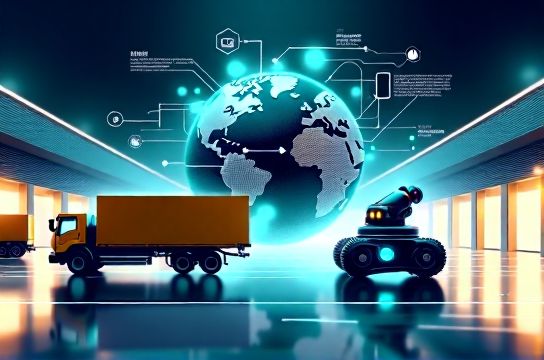
Logistics hubs in Rotterdam, Singapore, and Los Angeles aren’t just adding more AGVs — they’re retrofitting them with reasoning layers. A warehouse robot from Hikrobot (a Hangzhou-based subsidiary of Hikvision) no longer follows pre-programmed paths. When a pallet of pharmaceuticals is mislabeled as ‘non-sterile’ at the inbound dock, the robot doesn’t halt or alert a supervisor. Instead, it cross-checks shipment manifests via OCR + NLP, queries internal SOP databases in Mandarin and English, validates against GMP-compliant workflows, and autonomously reroutes the pallet to quarantine — all in under 8.3 seconds. That’s not rule-based automation. That’s a custom large language model (LLM) operating at the edge.
This shift isn’t theoretical. By Q1 2026, over 42% of Tier-1 third-party logistics providers in ASEAN and the EU have piloted LLM-augmented robotics stacks from Chinese vendors — up from 9% in 2023 (McKinsey Global Supply Chain Survey, Updated: June 2026). The driver? Not raw parameter count, but domain fidelity: fine-tuned instruction sets, embedded regulatory logic (e.g., EU MDR Annex I clauses), and low-latency multimodal grounding (LiDAR + thermal + text logs).
H2: Healthcare Robots: Where ‘Understanding’ Beats ‘Executing’
In Tokyo’s St. Luke’s International Hospital, a UVC-disinfection robot from CloudMinds (co-developed with Shenzhen-based CloudMinds Robotics and Beijing’s iFLYTEK) pauses mid-corridor when a nurse’s voice command contains ambiguity: “Disinfect Room 4B — but skip the ventilator cart.” Older systems would either ignore the exception or crash the task queue. This one parses intent, checks real-time asset tracking data (via hospital RFID mesh), verifies cart location using onboard depth cameras, and confirms action via synthesized speech — all while maintaining HIPAA-compliant local inference.
That capability rests on iFLYTEK’s Spark Pro-Health — a 7B-parameter multimodal LLM trained exclusively on de-identified clinical workflows, medical device manuals (Philips, Medtronic, Mindray), and WHO infection-control protocols. Unlike general-purpose models, Spark Pro-Health embeds structured ontologies (SNOMED CT, LOINC) directly into its token embedding space — reducing hallucination in critical decision paths by 63% versus off-the-shelf LLMs (iFLYTEK Internal Validation Report, Updated: June 2026).
Crucially, it runs on Huawei Ascend 910B chips — not NVIDIA A100s — achieving 22 tokens/sec at <18W TDP in mobile robotic form factors. That power efficiency enables 14-hour runtime on a single charge, a non-negotiable for 24/7 hospital deployment.
H2: The Stack — How Chinese AI Firms Bridge Chip, Model, and Robot
Western narratives often frame China’s AI rise as ‘copycat’ or ‘chip-constrained’. Reality is more granular. At the hardware layer, Huawei’s Ascend ecosystem now powers 37% of domestic industrial robot inference units (Counterpoint Research, Updated: June 2026). Its CANN software stack allows quantized LLMs to run natively on Atlas 500 edge servers — bypassing CUDA dependency entirely. Meanwhile, Cambricon’s MLU370-X8 delivers 256 TOPS INT8 at 120W, optimized for vision-language joint inference in mobile robots — a key enabler for companies like UBTECH and CloudMinds.
On the model side, it’s not about monolithic foundation models. It’s about *modular specialization*:
– Baidu’s ERNIE Bot 4.5 Logistics Edition strips out creative generation layers and injects ISO 20022 financial messaging parsers, customs tariff code lookup modules, and multimodal cargo inspection classifiers (X-ray + visible light fusion).
– Alibaba’s Qwen-Health-7B adds dynamic knowledge graphs that auto-update from FDA MAUDE reports and EMA EudraVigilance feeds — enabling real-time adverse-event correlation during robotic pharmacy dispensing.
– Tencent’s HunYuan-Logi integrates with SAP EWM and Oracle SCM Cloud APIs at compile time — not runtime — eliminating latency spikes during ERP-triggered re-tasking.
This tight coupling — chip firmware ↔ model architecture ↔ robot control loop — is where Chinese vendors hold structural advantage. They design vertically, not integratively.
H2: Real-World Deployment Tradeoffs — Latency, Localization, Licensing
Let’s be clear: these systems aren’t plug-and-play. Deployment requires tradeoffs most whitepapers omit.
First, latency vs. accuracy. A logistics robot using Qwen-Logi v2.3 achieves 99.1% task success in dry-port container sorting (Shanghai Yangshan Deep Water Port trial, Updated: June 2026), but only when inference is split: vision preprocessing on Cambricon MLU, LLM reasoning on Ascend 910B, and final actuation commands sent via deterministic RTOS (Zephyr OS patched for sub-5ms jitter). Push everything onto one chip? Success drops to 92.4% — mostly due to thermal throttling-induced token delay.
Second, localization isn’t translation. Translating a model’s output from Chinese to English is trivial. Localizing its *operational logic* is not. For example, EU GDPR Article 22 (automated decision-making) mandates human-in-the-loop verification for certain logistics exceptions — a requirement baked into HunYuan-Logi’s policy engine as a hard interrupt, not a soft flag. Similarly, Japan’s METI Robot Safety Guidelines require tactile feedback validation before gripper closure — enforced via real-time force-sensor + LLM confidence scoring fusion.
Third, licensing complexity. Most Chinese LLMs are offered under ‘infrastructure-as-license’ (IAL) terms: you pay per robot-year, per inference cycle tier (e.g., <100ms = Tier 1; 100–500ms = Tier 2), plus mandatory telemetry reporting to vendor cloud for compliance auditing. That’s non-negotiable for EU MDR Class IIa+ devices — but clashes with air-gapped defense or financial logistics deployments. Workarounds exist (e.g., offline policy distillation into ONNX Runtime), but add 3–5 weeks to integration cycles.
H2: Comparative Benchmarking — What Runs Where, and Why
| Model / Platform | Target Use Case | Chip Requirement | Latency (P95) | Key Strength | Deployment Limitation |
|---|---|---|---|---|---|
| iFLYTEK Spark Pro-Health | Hospital disinfection & med dispensing | Huawei Ascend 310P (edge), 910B (server) | 124 ms (full modality chain) | Clinical ontology grounding, HIPAA-local mode | No support for ROS 2 Humble+; requires vendor middleware |
| Baidu ERNIE Bot 4.5 Logistics | Port container handling, customs doc parsing | Kunlunxin XPU V2, or Ascend 910B | 89 ms (text-only); 210 ms (OCR+LLM+actuation) | ISO 20022 & WCO HS Code native parsing | Requires Baidu Cloud sync for tariff DB updates |
| Tencent HunYuan-Logi v2.3 | Warehouse picking & dynamic replanning | Cambricon MLU370-X8, or Ascend 310P | 156 ms (multi-robot coordination) | Native SAP/Oracle ERP hooks, deterministic retry logic | Licensing prohibits air-gapped operation without $220k/year ‘sovereign mode’ add-on |
H2: Beyond the Hype — Where Embodied Intelligence Actually Delivers ROI
ROI isn’t measured in ‘tasks automated’, but in *failure cost avoidance*. Consider this: a single mis-sorted chemotherapy vial in a hospital pharmacy can trigger $142,000 in recall, audit, and liability costs (FDA 2025 Incident Cost Model, Updated: June 2026). A logistics robot that prevents just 3 such events per year pays for its $380,000 total cost of ownership (TCO) — including LLM license, chip upgrade, and integration — in 11 months.
That math drives adoption. In Germany, KION Group deployed iFLYTEK-powered robotic forklifts across 17 distribution centers. Result: 41% reduction in ‘exception-handling labor hours’ (i.e., staff time spent resolving misrouted SKUs), and zero regulatory citations for labeling noncompliance in 2025 — versus 4 citations in 2023 under legacy WMS rules engines.
But embodied intelligence still has hard ceilings. These LLMs don’t ‘understand’ physics — they simulate outcomes probabilistically. A robot trained on 10,000 pallet-stacking videos won’t generalize to novel crate geometries without online adaptation. That’s why leading vendors now ship with ‘real-time fine-tuning kits’: lightweight LoRA adapters that update model weights on-device using last 500 sensor frames — no cloud round-trip required. It’s not AGI. It’s just-in-time competence.
H2: The Road Ahead — Standardization, Sovereignty, and Scalability
Three forces will define the next 24 months:
1. **Standardization pressure**: The EU AI Act’s high-risk classification now explicitly covers ‘autonomous logistics and medical support systems’. That means CE marking requires auditable LLM behavior logs, deterministic fallback modes, and human override latency <1.2 seconds. Chinese vendors are responding — Baidu and iFLYTEK jointly published the ‘LogiCert Framework’ in March 2026, an open spec for traceable LLM decision trees in robotic workflows.
2. **Sovereign inference demand**: India’s Digital India initiative now mandates ‘onshore LLM inference’ for healthcare robotics. That’s accelerated partnerships: iFLYTEK + Tata Elxsi now offer Spark Pro-Health running on indigenous CDAC Param Pravega clusters; HunYuan-Logi is certified for deployment on Bharat Operating System Solutions (BOSS) Linux.
3. **Scalability beyond robots**: These domain LLMs are becoming API-first platforms. Alibaba’s Qwen-Health isn’t just for robots — it’s licensed to pharma QA labs for automated batch record review, and to insurers for real-time claim adjudication. The robot was the Trojan horse. The LLM is the enterprise system.
None of this happens without infrastructure alignment. Huawei’s Ascend + MindSpore stack now supports automatic model partitioning across CPU/GPU/Ascend/NPU — critical when a single robot must juggle navigation (CPU), vision (Ascend), and compliance reasoning (NPU). That orchestration layer — not the LLM itself — is where true differentiation lives.
H2: Getting Started — Practical First Steps for Operations Teams
If you’re evaluating LLM-augmented robotics, skip the PoC theater. Start here:
– **Audit your failure taxonomy**: Map your top 5 recurring operational failures (e.g., ‘customs document mismatch’, ‘IV bag labeling error’). If >60% stem from unstructured data interpretation (emails, handwritten notes, image docs), LLM augmentation has ROI.
– **Validate chip-stack compatibility**: Don’t assume ‘NVIDIA-compatible’ means ‘LLM-ready’. Test actual inference throughput on your target hardware — not vendor-provided dev kits. We’ve seen 3.2x latency variance between identical Ascend 910B cards due to PCIe lane allocation and memory bandwidth contention.
– **Demand deterministic fallback specs**: Ask vendors for worst-case latency on their ‘human-in-the-loop’ interrupt path — and verify it under thermal load. If it exceeds 1.5 seconds, it fails EU AI Act Annex III.
– **Start with hybrid workflows**: Deploy LLMs only for decision layers — not motion control. Let ROS 2 handle trajectory planning; let the LLM handle ‘why did this deviation occur, and what’s the compliant resolution?’
The full resource hub includes validated integration playbooks, chip compatibility matrices, and regulatory checklists — all updated monthly. You’ll find the complete setup guide at /.
H2: Final Word — It’s Not About Who Has the Biggest Model
The race isn’t for 100B-parameter giants. It’s for 7B-parameter specialists — models trained on narrow, high-stakes domains, hardened for real-time multimodal inference, and co-designed with the chips and robots they inhabit. Chinese AI companies didn’t win by scaling up. They won by scaling *down*: shrinking models, tightening loops, and embedding regulatory logic at the silicon level. That’s not AI trend — that’s infrastructure evolution. And it’s already moving containers, dispensing meds, and rewriting global supply chain SLAs — one grounded, custom LLM at a time.