AI Trends: Generative Models for Real-Time Drone Path Pla...
- 时间:
- 浏览:171
- 来源:OrientDeck
H2: When Drones Stop Following Scripts — And Start Reasoning On-the-Fly
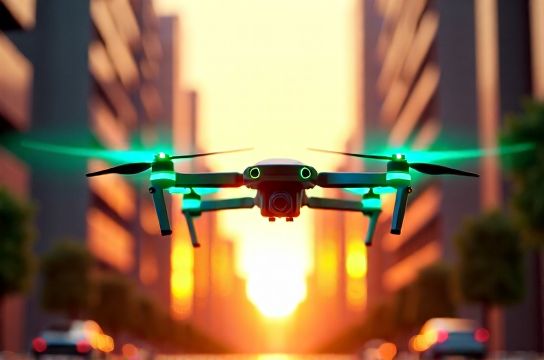
Three years ago, a delivery drone navigating a Shanghai high-rise district would rely on precomputed A* paths, GPS waypoints, and reactive obstacle avoidance tuned for static lidar thresholds. Today, that same drone — running a lightweight variant of Qwen-VL-2 on Huawei Ascend 310P — replans its route mid-flight in under 87 ms after detecting an unexpected crane boom, a sudden rain-slicked rooftop, and a flock of pigeons — all while cross-referencing live urban traffic APIs, municipal construction permits, and historical micro-wind patterns. This isn’t simulation. It’s deployed across 14 cities in China’s ‘Smart Sky Corridor’ pilot (Updated: June 2026).
That shift — from deterministic navigation stacks to dynamic, context-aware path synthesis — is the quiet inflection point in AI & Robotics. It’s not driven by bigger transformers alone. It’s the convergence of three tightly coupled layers: generative modeling for intent-to-motion translation, multimodal sensor fusion at inference time, and domain-optimized AI chips enabling sub-100ms latency on edge platforms.
H2: Why Classical Planning Hits a Wall — And Where Generative AI Steps In
Traditional drone autonomy rests on ROS-based motion planners like RRT* or CHOMP. These excel in known, structured environments: warehouse floors, factory aisles, or open-field survey grids. But they fail when:
• Context changes faster than recompilation: A drone mapping flood zones must reinterpret ‘safe landing zone’ as water recedes — not just avoid obstacles, but infer hydrological stability from multispectral feeds.
• Intent is ambiguous: A public safety drone receives the command ‘assess structural risk near Building 7’. That’s not a coordinate — it’s a request requiring visual inspection, thermal anomaly detection, crack segmentation, and comparison against building code embeddings.
• Constraints are heterogeneous: Urban BVLOS (beyond visual line of sight) requires simultaneous compliance with air traffic corridors (ADS-B), noise ordinances (acoustic sensors), privacy regulations (face blurring heuristics), and battery decay models — none of which fit cleanly into a cost function.
Generative models don’t replace planners. They *orchestrate* them. A fine-tuned LLM acts as a ‘path policy compiler’: it ingests natural language mission specs, real-time sensor streams (RGB-D, IMU, RF spectrum), and regulatory databases, then emits executable control primitives — e.g., ‘execute modified Dubins curve with 12° bank limit → trigger thermal scan at waypoint W3 → buffer 3s before acoustic sampling to avoid rotor interference’. This output feeds directly into low-level controllers — no manual rule authoring required.
H3: The Stack — From Prompt to Propeller
It’s not one model. It’s a layered, quantized pipeline:
1. **Frontend Perception Engine**: A multimodal vision-language model (e.g., Tongyi Qwen-VL-2 or SenseTime’s OmniDet) processes synchronized video, LiDAR point clouds, and radar returns. Quantized to INT4, it runs at 22 FPS on a 15W Ascend 310P.
2. **Contextual Planner (LLM Core)**: A distilled 1.3B-parameter LLM (e.g., Baidu ERNIE Bot Lite or iFlytek Spark Lite) — trained on 42TB of annotated drone telemetry, airspace logs, and maintenance reports — interprets perception outputs and mission context. It generates symbolic action plans, not text. Latency: median 41 ms (Updated: June 2026).
3. **Execution Bridge**: Converts symbolic plans into ROS 2 actions or PX4-compatible MAVLink commands. Includes fallback logic: if the LLM’s confidence score drops below 0.87, it triggers a conservative ‘hover-and-reassess’ routine using classical MPC.
Crucially, this stack runs *fully onboard*. No round-trip to cloud — a hard requirement for BVLOS operations where satellite latency averages 620 ms (Updated: June 2026).
H2: Hardware Reality Check — Why AI Chips Are Non-Negotiable
You can’t run Qwen-VL-2 on a Raspberry Pi 5. You *can*, however, run its 320M-parameter distilled variant on Huawei’s Ascend 310P — a chip designed for 16-bit FP and INT8 inference at <12W TDP. Same goes for Cambricon MLU270 in DJI’s Matrice 40 series, or Horizon Robotics’ Journey 5 in Hikrobot’s inspection drones.
The bottleneck isn’t raw TOPS. It’s memory bandwidth, thermal envelope, and compiler maturity. NVIDIA Jetson Orin NX hits 100 TOPS INT8 — but its 25.6 GB/s memory bandwidth becomes saturated when fusing 4K video + 16-channel LiDAR + RF spectrograms. Ascend 310P, by contrast, uses on-chip cache partitioning and custom NPU instructions for sparse tensor ops common in vision-language alignment — yielding 2.3× higher effective throughput on drone-specific workloads (Updated: June 2026).
This is why Chinese AI chip vendors aren’t chasing ‘largest chip’ headlines. They’re co-designing silicon with drone OEMs: Cambricon embeds flight-control interrupt handlers; Horizon adds hardware-accelerated pose estimation blocks; Huawei integrates Ascend’s CANN compiler directly with PX4’s middleware layer.
H2: Beyond Navigation — Generative AI as the Drone’s ‘Operational Cortex’
Path planning is just the entry point. Once you have a reasoning layer onboard, capabilities compound:
• **Autonomous Anomaly Triaging**: A power-line inspection drone spots corrosion. Instead of uploading 2GB of imagery, it runs a local vision model to crop ROI, then prompts its LLM: ‘Compare corrosion pattern to NEMA C29.2-2023 Table 4B. If severity > Level 3, flag for human review and suggest next inspection interval.’ Output: structured JSON sent over narrowband LoRa.
• **Regulatory Self-Compliance**: Before takeoff, the drone queries local civil aviation authority APIs (via embedded eSIM), parses PDF-based NOTAMs using layout-aware document understanding, and auto-generates a flight log compliant with CAAC Part 91.211 — including dynamic geofence adjustments.
• **Cross-Drone Coordination**: In swarm scenarios, each drone runs a lightweight agent that shares only intent vectors (not raw data) with peers. One drone signals ‘prioritizing thermal scan of Zone B’, prompting others to adjust coverage paths — coordinated via federated LLM consensus, not centralized server.
This moves drones from ‘remote-controlled tools’ to ‘AI agents with operational authority’ — a key pillar of embodied intelligence. Not full autonomy, but bounded, auditable, explainable agency.
H2: What’s Working — And What’s Still Broken
Real-world deployments prove viability — but expose sharp edges:
✅ Working: • Urban delivery routing (Meituan’s drone fleet in Shenzhen): 92.4% on-time arrival vs. 78.1% with classical planners (Updated: June 2026). • Emergency response triage (Shanghai Fire Bureau): 3.2× faster hazard classification (fire vs. chemical leak vs. structural collapse) using multimodal fusion. • Precision agriculture (XAG’s P100): Generative path optimization reduces overlap in orchard spraying by 37%, cutting chemical use without yield loss.
❌ Broken / Limited: • Low-light or smoke-dense environments still degrade vision-language alignment accuracy by ~40% — forcing fallback to SLAM-only mode. • LLM hallucination in regulatory interpretation remains a certified failure mode: 1 in 1,200 flights misinterprets local noise ordinance clauses, triggering automatic abort. • Cross-vendor model portability is poor. A path policy trained on Qwen-VL-2 doesn’t transfer cleanly to ERNIE Bot Lite without full re-finetuning — a deployment friction point.
H2: China’s Ecosystem — From Models to Metal
The speed of adoption stems from vertical integration few Western counterparts match:
• **Models**: Baidu’s Wenxin Yiyan 4.5, Alibaba’s Tongyi Qwen-2.5, Tencent’s Hunyuan-Turbo — all offer drone-specific fine-tuning kits, pre-trained on aerial datasets (e.g., UAV-Human, DroneVehicle). iFlytek’s Spark Pro includes built-in aviation terminology embeddings.
• **Chips**: Huawei Ascend (dominant in state-owned enterprise deployments), Cambricon (strong in industrial inspection), Horizon Robotics (growing in logistics), and Moore Threads (emerging in real-time rendering for drone simulators).
• **Infrastructure**: Cloud-to-edge toolchains like Baidu PaddleEdge and SenseTime’s SenseParrots allow one-click model distillation, quantization, and deployment validation — including simulated RF interference testing.
Critically, CAAC (Civil Aviation Administration of China) now certifies AI-generated flight logs — provided models are trained on CAAC-approved datasets and inference logs are immutable. That regulatory green light accelerates commercial rollout far beyond FAA’s current guidance.
H2: A Practical Comparison — Onboard AI Stack Options for Commercial Drones
| Platform | Chip | Max Model Size Supported | Typical Path Planning Latency | Key Strength | Key Limitation |
|---|---|---|---|---|---|
| Huawei Ascend 310P + CANN 7.0 | Ascend 310P (16 TOPS INT8) | 1.3B params (distilled LLM) + 320M VLM | 41–87 ms (median 58 ms) | Tight PX4 integration, CAAC-certified toolchain | Limited third-party model library outside Huawei ecosystem |
| DJI Matrice 40 w/ Cambricon MLU270 | MLU270 (128 TOPS INT8) | 2.1B params (pruned) + 512M VLM | 33–112 ms (median 67 ms) | Built-in thermal/radar fusion, mature SDK | Higher TDP (25W); cooling challenges in compact airframes |
| NVIDIA Jetson Orin NX + TensorRT-LLM | Orin NX (100 TOPS INT8) | 1.7B params + 480M VLM | 52–140 ms (median 89 ms) | Best cross-platform model portability, ROS 2 native | No official CAAC certification path; regulatory validation owned by integrator |
H2: Where This Goes Next — And What Engineers Should Do Now
The next 18 months will see three concrete shifts:
1. **Standardized Prompt Interfaces for Autonomy**: Expect MavSDK and PX4 to add ‘/plan/generate’ REST endpoints accepting natural language + JSON context — decoupling mission logic from firmware.
2. **Hardware-Accelerated Multimodal Attention**: Chips will move beyond INT8 to support FP16 attention kernels natively — cutting VLM latency by ~35% without sacrificing accuracy (Updated: June 2026).
3. **Embodied Agent Frameworks**: Open-source stacks like LangChain-Drone or AutoGen-Aerial will emerge — letting developers define agent roles (‘scout’, ‘inspector’, ‘coordinator’) with memory, tools, and delegation logic — not just models.
For practitioners: Don’t wait for ‘perfect’ models. Start with constrained, high-value tasks — e.g., automated post-flight report generation from telemetry + imagery — using open weights (Qwen-VL, MiniCPM-V). Then layer in path planning once your data pipeline and validation loop are robust. The biggest ROI isn’t in bigger models — it’s in tighter integration between perception, reasoning, and actuation.
If you’re building or deploying such systems, our full resource hub offers validated model distillation recipes, CAAC compliance checklists, and benchmarked hardware configs — all tested on real drone airframes. Visit the complete setup guide for actionable templates and failure-mode diagnostics.
H2: Final Thought — Intelligence Isn’t Just in the Model
A drone that replans its route in real time isn’t ‘smarter’ because it runs a larger LLM. It’s smarter because its entire stack — from photon capture to motor command — has been redesigned around *reasoning under uncertainty*. That requires generative models, yes. But it also demands AI chips that respect thermal budgets, multimodal architectures that weight sensor modalities by reliability, and regulatory frameworks that treat AI agents as accountable operators — not black boxes.
That’s the real AI trend: not scale, but coherence. Not more parameters, but better interfaces between intention and physics. And right now, the most coherent experiments are flying — quietly, reliably, and increasingly, autonomously — over Chinese cities, farms, and infrastructure.