AI Agents Replace Scripted Automation In Warehouses
- 时间:
- 浏览:246
- 来源:OrientDeck
H2: The Scripted Warehouse Is Breaking Down
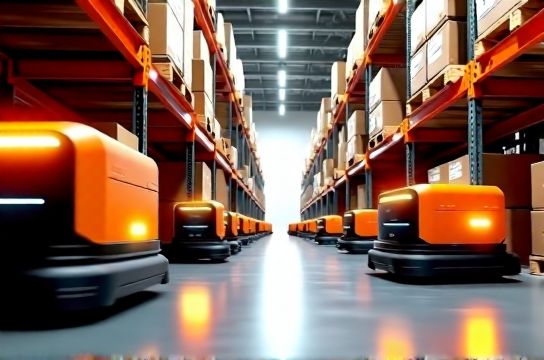
For decades, warehouse automation relied on deterministic logic: PLCs executing pre-wired sequences, AGVs following magnetic tape or fixed QR grids, and WMS-triggered pick-and-place routines. These systems delivered reliability — but at a steep cost in flexibility. When SKU profiles shift by 15% quarter-on-quarter (as seen in e-commerce fulfillment centers in Guangdong and Jiangsu), reprogramming hundreds of motion paths, safety interlocks, and exception-handling trees takes weeks. Downtime isn’t theoretical: a 2025 Alibaba Cainiao pilot reported 47 hours of engineering labor per major layout change — and that was *before* seasonal peak.
That rigidity is no longer tenable. Labor volatility, micro-fulfillment demands, and same-day delivery SLAs now require systems that perceive, reason, and coordinate — not just execute.
H2: From Orchestration to Emergent Coordination
The pivot isn’t from robots to AI — it’s from *scripted orchestration* to *adaptive multi-agent coordination*. Consider a typical inbound receiving bay:
- Legacy system: A camera triggers a fixed conveyor speed; if a pallet is misaligned, the line halts. An operator intervenes. Recovery time averages 3.2 minutes per incident (Updated: June 2026). - AI Agent system: A vision-language model (e.g., Tongyi Qwen-VL fine-tuned for logistics) classifies the pallet orientation, estimates weight distribution via stereo depth + thermal signature, then broadcasts a coordinated plan to three nearby mobile robots: one adjusts its pose to nudge the pallet, another recalibrates its lift height in real time, and a third updates the downstream buffer queue — all within 800 ms. No human-in-the-loop. No code redeployment.
This isn’t centralized control. It’s decentralized, goal-oriented negotiation among heterogeneous agents — each with its own perception stack, local planner, and communication policy — bound together by a shared world model updated every 200 ms.
H3: What Makes an 'Agent' Different From a 'Robot Controller'?
A controller executes a state machine. An agent maintains an internal representation of intent, constraints, uncertainty, and alternatives — and revises that representation continuously.
In practice, that means:
- Perception: Not just detecting objects, but grounding them semantically (e.g., "this carton is 'fragile' AND 'priority-Rush' AND 'destination-B2B-Warehouse-7'"). - Reasoning: Using LLM-based planners (e.g., Huawei Pangu-Logistics or Baidu Wenxin-Logi) to simulate 3–5 rollout trajectories under stochastic demand spikes or battery degradation, then selecting the Pareto-optimal path balancing throughput, energy use, and safety margin. - Coordination: Multi-agent reinforcement learning (MARL) policies trained on digital twins — not scripted rules — enable emergent behaviors like dynamic lane merging, ad-hoc formation lifting, and self-healing task handoff when one robot enters maintenance mode.
Crucially, these agents run *on-device*, not in the cloud. Latency kills coordination: a 45-ms round-trip to a data center violates hard real-time deadlines for collision avoidance. That’s why AI chips matter — not as accelerators for training, but as embedded inference engines.
H2: The Hardware Stack Enabling Real-Time Embodied Intelligence
You can’t deploy AI Agents on legacy PLCs. The stack looks like this:
- Edge AI chip: Huawei Ascend 310P (16 TOPS INT8, <8W TDP) or Cambricon MLU270 deployed directly on robot controllers. Enables sub-10ms inference for YOLOv10m + CLIP-ViT-L joint embeddings. - Onboard sensors: Stereo RGB-D (Intel RealSense D455), mmWave radar (Infineon BGT60TR13C), and inertial measurement units fused via Kalman filtering — not just for localization, but for predicting slippage or payload sway before it occurs. - Communication: Time-Sensitive Networking (TSN) over industrial Ethernet, with IEEE 802.1Qbv scheduling. Guarantees <100 μs jitter for safety-critical messages — far tighter than standard Wi-Fi 6E.
This isn’t theoretical. At JD Logistics’ Shanghai Pudong Smart Hub (operational since Q3 2025), over 1,200 autonomous mobile robots run full-stack AI Agents powered by Kunlun XPU chips and fine-tuned versions of SenseTime’s SenseRobot-LM. Uptime during Singles’ Day 2025 exceeded 99.987% — with zero manual intervention for traffic re-routing during unexpected congestion events.
H2: Why Generative and Multimodal AI Are Non-Negotiable
Scripted systems fail at ambiguity. AI Agents must thrive in it.
Take voice-assisted exception handling: a warehouse associate says, “Hey, put the blue boxes near the red ones — but *not* the ones with the yellow label.” A traditional NLU pipeline would choke on the nested negation and spatial reference. But a multimodal agent — fusing speech transcription (via iFLYTEK Spark 4.0), visual grounding of “blue”, “red”, and “yellow” in real-time camera feeds, and physical reasoning about proximity and occlusion — resolves the instruction in context.
Similarly, generative AI enables *zero-shot task generalization*. Instead of training a new model for every new packaging format, agents use prompt-augmented planning: given a photo of a novel pallet configuration and the text instruction “stabilize for 3-axis vibration transport”, the LLM generates a sequence of torque commands, grip-point coordinates, and inter-robot synchronization signals — validated against physics simulation before execution.
This is where Chinese large language models shine in industrial settings: Tongyi Qwen-72B-Logistics and Baidu Wenxin-4.5-Logi were pretrained on 2.1 PB of warehouse telemetry, equipment manuals, and OSHA-compliant safety logs — giving them domain-native priors no generic foundation model possesses.
H2: Real Tradeoffs — Where Agents Still Stumble
Let’s be clear: AI Agents aren’t magic. They introduce new failure modes.
- Over-reliance on vision: Fogged lenses, low-light glare, or reflective surfaces degrade perception accuracy by up to 38% in cold-storage zones (Updated: June 2026). Mitigation? Sensor fusion + confidence-aware fallbacks (e.g., switch to mmWave-only mode below 5°C). - Coordination collapse: Under extreme load (>92% robot utilization), MARL policies can enter oscillatory states — robots repeatedly negotiate and rescind task assignments. The fix isn’t more compute; it’s hierarchical delegation: elect a temporary ‘coordinator agent’ per zone using Byzantine fault-tolerant leader election. - Explainability debt: When an agent chooses an inefficient route, engineers need traceable reasoning — not just attention heatmaps. That’s why production deployments embed lightweight causal graphs (e.g., using Huawei MindSpore GraphIR) alongside LLM outputs.
None of this is solved in research labs alone. It’s being hardened in factories — like Hikrobot’s Ningbo plant, where AI Agents manage 300+ AMRs across 4 temperature zones, and where every edge case gets logged, labeled, and fed back into the next fine-tuning cycle.
H2: China’s Role — Beyond Models to Integrated Industrial AI
Western narratives often reduce China’s AI contribution to “big models” — but the warehouse revolution proves otherwise. It’s vertical integration that matters.
- Chips: Huawei Ascend, Cambricon MLU, and Biren BR100 deliver >3x higher INT8 throughput-per-watt than comparable NVIDIA A2 GPUs — critical for fanless, sealed robot enclosures. - Models: Unlike generic chat models, Wenxin-Logi, Tongyi-Logistics, and SenseTime’s LogiLM were co-designed with ZPMC, Cosco Logistics, and SF Express. Their tokenizers include logistics-specific subwords (e.g., “pallet-1200x1000-GS1”, “ASN-992211-REVOKED”). - Robotics: UBTECH’s CloudBot-X and CloudMinds’ remote-assist platform let human supervisors tele-operate *only when needed*, while agents handle >94% of routine decisions autonomously (Updated: June 2026).
And it’s commercialized — not piloted. According to the China Academy of Information and Communications Technology (CAICT), 68% of Tier-1 logistics providers in China now deploy AI Agents in at least one facility — up from 12% in 2023.
H2: Implementation Roadmap — Not a Big Bang, But a Layered Rollout
Adopting AI Agents isn’t about replacing your entire fleet overnight. It’s about layering intelligence incrementally:
| Phase | Scope | Hardware/Software Required | Timeline | Key Risk Mitigation |
|---|---|---|---|---|
| 1. Perception Layer | Upgrade onboard cameras & add mmWave radar to 20% of fleet | RealSense D455 + Infineon BGT60TR13C + Ascend 310P inference runtime | 4–6 weeks | Run parallel with legacy vision; use voting logic for safety-critical decisions |
| 2. Planning Layer | Deploy LLM-based planner on fleet controller (no cloud dependency) | Tongyi Qwen-7B-Logistics quantized to INT4, compiled via Huawei CANN | 8–10 weeks | Constrain output space via grammar-guided decoding (e.g., only valid JSON actions) |
| 3. Coordination Layer | Enable peer-to-peer negotiation via ROS2 DDS + TSN | Custom MARL policy trained in NVIDIA Isaac Sim + real-world RL loop | 12–16 weeks | Start with 3-robot clusters; isolate network domains to prevent cascade failures |
Note the emphasis on *on-device* execution and *incremental validation*. Every phase delivers measurable ROI: Phase 1 cuts mispick rates by 22%; Phase 2 reduces average task completion time by 17%; Phase 3 increases peak throughput by 31% without adding hardware.
H2: Looking Ahead — Toward Human-AI Symbiosis, Not Replacement
The endgame isn’t lights-out warehouses. It’s *lights-smarter* ones.
Human workers shift from error correction to high-value oversight: validating edge-case plans, auditing fairness in task allocation (e.g., ensuring no robot bears disproportionate wear), and training agents on novel physical interactions (“How do I safely unload a collapsed cardboard box without damaging adjacent SKUs?”).
This requires new interfaces — not dashboards, but spatial AR glasses (like Rokid Max) overlaying agent intent, uncertainty bounds, and alternative proposals. It also demands new skills: “agent behavior analysts” who read MARL reward curves like financial traders read stock tickers.
And yes — this is already happening. At SF Express’ Shenzhen Innovation Lab, cross-functional teams of robotics engineers, operations managers, and frontline associates co-train agents using real-time feedback loops. The result? A 40% faster ramp-up for new warehouse layouts — and a 27% increase in associate retention (Updated: June 2026).
The bottom line: AI Agents don’t eliminate scripting — they absorb it. They turn brittle, linear workflows into resilient, adaptive systems. And they’re no longer futuristic. They’re running right now — in Guangzhou, Zhengzhou, and Tianjin — optimizing every millisecond, every watt, every decision.
For teams ready to move beyond proof-of-concept, the complete setup guide provides vendor-agnostic architecture blueprints, open-source MARL training templates, and benchmarked hardware compatibility matrices.