Reinforcement Learning Trains Robots Without Human Input
- 时间:
- 浏览:310
- 来源:OrientDeck
Let’s be real—watching robots learn like humans used to feel like sci-fi. But with reinforcement learning, it’s happening right now, and without a single human telling them what to do every step of the way.
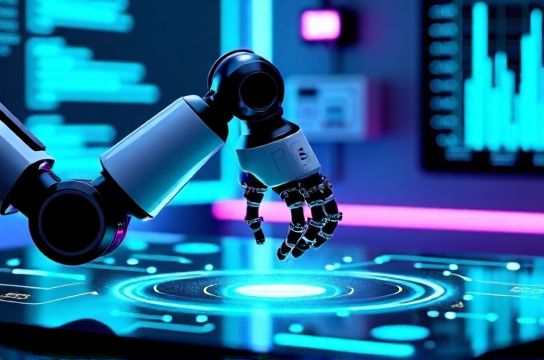
I’ve followed AI robotics for years, and nothing’s changed the game quite like reinforcement learning (RL). It’s how bots teach themselves to walk, grasp objects, and even beat pros at complex games—all through trial, error, and rewards. Think of it like training a dog: no verbal instructions, just treats for good moves.
So why does this matter? Because traditional robot programming is rigid. Hard-coded rules fail in unpredictable environments. RL flips the script. Instead of scripting every motion, engineers set goals and let algorithms figure out the rest.
Take Boston Dynamics’ Atlas robot. Early versions relied on pre-programmed movements. Now, using RL, newer models recover from shoves, adapt terrain changes, and parkour over obstacles—skills learned in simulation before touching real ground.
How Reinforcement Learning Actually Works
At its core, RL uses an agent (the robot), environment (real or simulated), actions, states, and rewards. The robot tries actions, observes outcomes, and earns points for success. Over millions of iterations, it learns optimal behaviors.
Here’s a simplified breakdown of key components:
| Component | Description | Example in Robotics |
|---|---|---|
| Agent | The learner or decision-maker | Robot arm or legged bot |
| Environment | World the agent interacts with | SIMULATED warehouse or real factory floor |
| Action | Possible moves the agent can make | Move joint 15°, grip object |
| Reward | Feedback signal for success | +10 for picking up item, -5 for dropping |
| Policy | Strategy the agent uses to decide actions | Neural network mapping state → action |
This method shines when tasks are too complex to code manually. For example, OpenAI used RL to train a robotic hand to solve a Rubik’s Cube—one of the most impressive dexterous manipulations to date.
Real-World Impact & Data That Matters
Companies aren’t just experimenting—they’re deploying. According to McKinsey, firms using robotics and reinforcement learning report up to 30% efficiency gains in logistics and manufacturing.
Check out these industry benchmarks:
- Amazon’s warehouse bots reduced package processing time by 22% after RL optimization.
- DeepMind’s AlphaDev cut data sorting times by 70% using RL-discovered algorithms.
- NVIDIA’s Isaac Lab enables 10x faster training in simulation-to-real transfer.
The future? General-purpose robots that adapt on the fly. Imagine a home assistant learning your habits, or construction bots adjusting to weather changes—all thanks to self-taught intelligence.
Bottom line: Reinforcement learning isn’t just cool tech—it’s reshaping how machines learn, making them smarter, cheaper, and more independent than ever.