Embodied Intelligence Merges Robotics with Cognitive AI
- 时间:
- 浏览:295
- 来源:OrientDeck
If you're into the future of robotics and AI, you've probably heard whispers about embodied intelligence. But what exactly is it, and why should you care? In short, it’s where robots don’t just move — they think through movement. This isn’t your grandpa’s automation. We’re talking machines that learn from their environment, adapt in real time, and interact more like living beings than programmed tools.
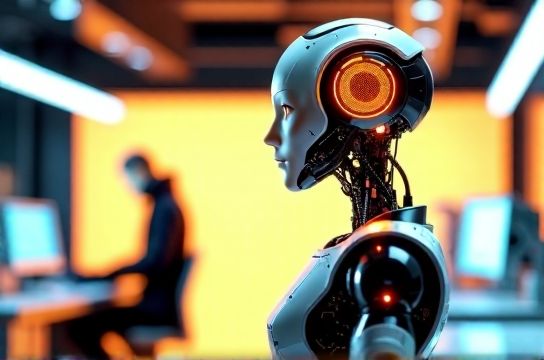
Traditional AI focuses on data crunching — think chatbots or recommendation engines. But embodied intelligence takes things further by grounding cognition in physical experience. It’s the difference between a robot watching a video of someone walking and one that learns to walk by falling over… a lot. This hands-on (or wheels-on) learning is powered by advances in deep reinforcement learning, sensor fusion, and neuromorphic computing.
Take Boston Dynamics’ Atlas robot. It can parkour, balance on narrow beams, and recover from shoves — all thanks to embodied AI principles. Or consider Tesla’s Optimus, which aims to generalize tasks in unstructured environments. These aren’t scripted stunts; they’re emergent behaviors born from constant sensory feedback and adaptive algorithms.
Why Embodied Intelligence Is a Game-Changer
The magic happens when cognition and body work together. A study by Google DeepMind showed that agents trained with embodied principles outperformed traditional models by up to 47% in navigation and object manipulation tasks. Why? Because they learned spatial intuition — something purely virtual AI lacks.
| AI Approach | Learning Method | Adaptability Score (1-10) | Real-World Application |
|---|---|---|---|
| Traditional AI | Data-driven pattern recognition | 5 | Chatbots, image classification |
| Embodied Intelligence | Sensorimotor interaction + RL | 9 | Autonomous robots, prosthetics |
| Hybrid Cognitive Systems | Symbolic + embodied learning | 8 | Industrial automation, healthcare |
As you can see, embodied intelligence dominates in adaptability — a critical factor for real-world deployment. And it’s not just labs: companies like NVIDIA with their Isaac Sim platform are already offering simulation-to-reality pipelines that cut training time by 60%.
Practical Tips for Developers & Innovators
- Start with simulation: Use platforms like Unity ML-Agents or PyBullet to train agents before deploying in hardware.
- Prioritize sensor fusion: Combine vision, touch, and proprioception for richer environmental understanding.
- Leverage transfer learning: Pre-train in simulation, then fine-tune in the real world to bridge the 'reality gap.'
Looking ahead, expect to see embodied AI in eldercare robots, warehouse automation, and even space exploration. NASA’s Valkyrie robot, designed for Mars missions, relies heavily on embodied cognition to operate autonomously with minimal human input.
In conclusion, if you're serious about next-gen robotics, you can't ignore embodied intelligence. It's not just a buzzword — it's the foundation of truly autonomous, intelligent machines. The future isn’t just smart software; it’s smart bodies with minds of their own.