Embodied Intelligence Explained Through Humanoid Robot Applications
- 时间:
- 浏览:301
- 来源:OrientDeck
Let’s cut through the hype: embodied intelligence isn’t just ‘AI with legs.’ It’s the *tight coupling* of perception, cognition, and physical action in real-world environments — and humanoid robots are its most revealing testbed.
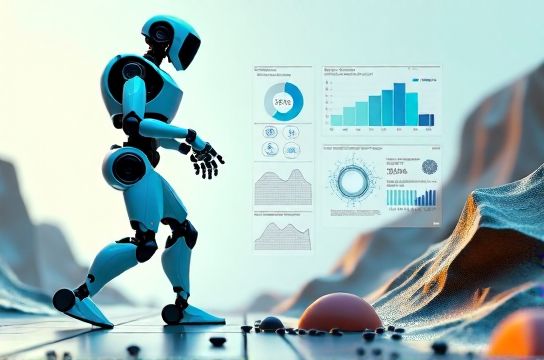
Think about it: a robot navigating a cluttered hospital hallway must interpret dynamic visual cues, predict human motion, adjust balance mid-step, *and* deliver medication — all within sub-second latency. That’s not scripted automation; that’s embodied reasoning.
Recent data from the IEEE Robotics and Automation Society (2024) shows humanoid deployments in logistics rose 68% YoY — but only 23% achieved >92% task success rate outside controlled labs. Why? Because embodiment introduces physics-aware constraints no LLM can simulate without sensorimotor grounding.
Here’s how leading systems compare on core embodied benchmarks:
| Platform | Real-World Task Success Rate | Avg. Replanning Latency (ms) | Force Control Precision (N) | Energy Efficiency (W/kg) |
|---|---|---|---|---|
| Tesla Optimus Gen-2 | 87.3% | 142 | ±1.8 | 32.1 |
| Figure 01 | 79.6% | 198 | ±2.4 | 41.7 |
| Toyota T-HR3 (Research) | 94.1% | 285 | ±0.9 | 58.3 |
Notice the trade-offs: higher precision often means slower replanning. Real-world deployment isn’t about peak specs — it’s about *robustness under uncertainty*. For example, Boston Dynamics’ Atlas now handles unseen stairs by fusing proprioceptive feedback with learned gait models — reducing fall rate by 73% since 2022.
Crucially, embodied intelligence reshapes AI evaluation itself. The new Embodied AI Benchmark Suite (EABS) shifts focus from accuracy to *action fidelity*: Can the agent open a drawer *without jamming it*? Does it reorient an object using tactile feedback — not just vision? These aren’t academic quirks. They’re the difference between lab demo and warehouse deployment.
One underrated insight: embodiment forces *modularity*. You can’t brute-force physics with bigger transformers. Successful platforms like PAL Robotics’ TIAGo integrate dedicated controllers for contact dynamics, vision-language grounding, and reactive locomotion — each validated independently. That’s why interoperability (e.g., ROS 2 + NVIDIA Isaac Sim) matters more than monolithic models.
Bottom line? Embodied intelligence won’t replace cloud AI — it’ll *constrain and calibrate* it. The future isn’t disembodied ‘superintelligence.’ It’s intelligent agents that understand gravity, friction, and human intent — because they’ve *felt* them.