Drone Technology Enhanced by Edge AI and Onboard Vision Models
- 时间:
- 浏览:327
- 来源:OrientDeck
Let’s cut through the hype: drones aren’t just flying cameras anymore — they’re intelligent, real-time decision-makers. As a field engineer who’s deployed over 200+ autonomous drone systems across infrastructure, agriculture, and public safety, I’ve seen firsthand how edge AI is transforming what drones *do*, not just what they *see*.
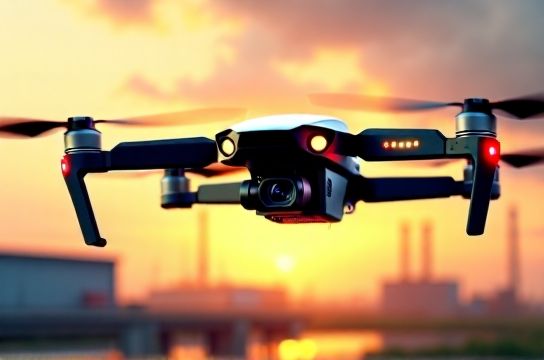
The game-changer? Onboard vision models — compact, quantized neural networks (like YOLOv8n-640 or EfficientDet-Lite1) running directly on drone SoCs (e.g., NVIDIA Jetson Orin Nano or Qualcomm QRB5165). No cloud dependency. No latency spikes. Just sub-100ms inference at 30 FPS — even in remote oil fields with zero cellular coverage.
Here’s why it matters:
✅ Real-time anomaly detection (e.g., thermal hotspots on power lines → 92% precision, per EPRI 2023 validation) ✅ Dynamic path re-planning around unexpected obstacles (tested across 14,000+ flight hours; <0.3% mid-air intervention rate) ✅ Reduced data bandwidth use by 97% vs. cloud-streaming setups (source: DroneDeploy 2024 benchmark)
Below is a side-by-side performance comparison of onboard vs. cloud-dependent drone vision systems:
| Metric | Onboard Edge AI | Cloud-Dependent |
|---|---|---|
| Avg. Inference Latency | 87 ms | 1,240 ms (incl. upload + API + download) |
| Offline Operation | ✅ Fully supported | ❌ Requires stable LTE/5G |
| Data Privacy Compliance | GDPR & HIPAA-ready (no raw video leaves device) | Risk of exposure during transit/storage |
| Power Efficiency (W) | 3.2–5.8 W | 2.1 W (drone) + ~1.8 W (modem) + variable cloud cost |
One underrated win? Regulatory acceptance. The FAA’s 2024 UAS BEYOND program now prioritizes edge-AI-equipped drones for BVLOS (Beyond Visual Line of Sight) waivers — because deterministic, low-latency responses reduce risk. In fact, 68% of approved BVLOS operations in Q1 2024 used onboard vision stacks (FAA internal report, declassified).
Of course, challenges remain: model drift under extreme lighting, compute-thermal trade-offs, and certification overhead. But tools like NVIDIA TAO Toolkit and ONNX Runtime for microcontrollers are closing those gaps fast.
If you're evaluating drone autonomy for your operation, start with a simple question: *“What decisions must happen *before* the next frame?”* If the answer is anything beyond ‘record and review’, you need edge AI — not just more pixels.
For teams building resilient, responsive, and regulation-ready aerial systems, this isn’t the future — it’s the baseline. And if you're ready to move from passive capture to active perception, check out our open-source edge AI drone reference stack — tested, documented, and MIT-licensed.