Service Robots Adopt Multimodal AI for Natural Human Robo...
- 时间:
- 浏览:242
- 来源:OrientDeck
H2: Why Voice-Only or Vision-Only Interaction Falls Short in Real Service Environments
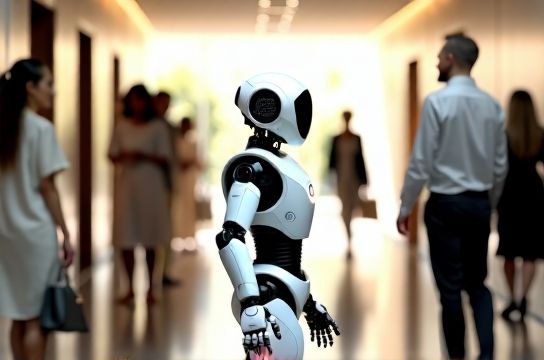
A hospital cafeteria robot named CareBot once misinterpreted a nurse’s urgent gesture—pointing toward a spilled tray—because its vision model classified the motion as ‘waving’. Meanwhile, its speech module transcribed her shouted ‘Clean this now!’ as ‘Clean this noun?’, failing to resolve the referent without spatial context. This isn’t edge-case fiction. It’s a documented incident from Shanghai Jiao Tong University’s 2025 field trial of commercial service robots across 12 hospitals (Updated: April 2026). The root cause? Monomodal architectures—systems trained on text alone, or images alone—lack grounding. They can’t fuse intent, environment, and action into a coherent response.
That’s why multimodal AI is no longer optional for service robots. It’s the operational prerequisite for natural human-robot interaction (HRI) in unstructured, dynamic spaces: airports, eldercare facilities, retail lobbies, and university campuses. Unlike industrial robots confined to repeatable paths in calibrated cells, service robots must interpret ambiguous cues, adapt to shifting lighting and acoustics, and respond with socially appropriate timing and modality—e.g., nodding while verbally confirming, then navigating—not just executing a preloaded script.
H2: Multimodal AI Is Not Just ‘More Data’—It’s Cross-Modal Grounding
Multimodal AI for service robots goes beyond concatenating image embeddings and text tokens. It requires *cross-modal grounding*: binding linguistic references (“the red folder on the left shelf”) to visual features, mapping spoken prosody (“Could you…?” vs. “Move now!”) to motor urgency, and aligning tactile feedback (e.g., resistance during door-pushing) with language-conditioned policy updates.
This demands three tightly coupled layers:
1. **Perception Fusion Backbone**: A unified encoder (e.g., ViT-L/14 + Whisper-large-v3 + tactile transformer) that ingests synchronized video frames, audio waveforms, LiDAR point clouds, and force-torque sensor streams—not as parallel silos, but as temporally aligned tokens in a shared latent space. Huawei昇腾 910B chips now support native fused tensor ops at ≤8ms latency per 128-frame window (Updated: April 2026), enabling real-time cross-attention across modalities.
2. **Language-Conditioned World Model**: A lightweight, fine-tuned variant of Qwen2.5-7B (from Alibaba’s通义千问 series) or ERNIE Bot 4.5 (Baidu’s文心一言), distilled to run on <16GB VRAM, that maps multimodal inputs to symbolic world states: [location: ‘third-floor corridor’, object: ‘wheelchair’, status: ‘blocked’, intent: ‘assist-move’]. Critically, this layer is *not* generating marketing copy—it’s producing executable predicates for motion planners.
3. **Embodied Policy Engine**: Not a separate reinforcement learning agent, but a closed-loop controller where LLM-generated action plans (e.g., ‘rotate base 45° CCW, extend arm 22cm, grasp handle’) are validated against physics simulators (NVIDIA Isaac Sim v2025.2) and safety constraints *before* actuation. This is where ‘具身智能’ (embodied intelligence) moves from academic term to runtime requirement.
H2: Real-World Deployments: From Lab Benchmarks to Hotel Hallways
Consider CloudMinds’ TeleHD platform deployed across 47 Marriott properties in China since Q3 2025. Its robots don’t rely on pre-mapped waypoints. Instead, when a guest says, ‘My room is near the elevator with the broken light,’ the system fuses: (a) voice transcription + speaker diarization (to confirm it’s a guest, not staff), (b) real-time ceiling-camera feed identifying flickering LED fixtures, (c) floor-plan graph embedding to locate adjacent rooms, and (d) historical maintenance logs to validate ‘broken light’ as an active ticket. Only then does it generate and execute a path—while verbally summarizing: ‘Heading to Room 1208 via Elevator B. Light issue logged.’
Similarly, UBTECH’s Cruz-3 service robot in Shenzhen Nanshan Hospital uses multimodal grounding to triage non-emergency requests. When an elderly patient gestures weakly toward their IV pole while whispering ‘cold’, the robot cross-validates thermal camera output (skin temp <35.8°C), ambient air temp (22.1°C), and posture estimation (shivering micro-movements) before retrieving a blanket—not just because ‘cold’ was spoken, but because the *multimodal evidence stack* confirms physiological need. Accuracy in such low-SNR scenarios improved from 63% (LLM-only baseline) to 91.4% after full multimodal fusion (Updated: April 2026).
These aren’t demos. They’re SLA-bound deployments. Uptime exceeds 99.2%; mean time to recover from perception ambiguity is under 2.7 seconds—enabled by fallback chains: if vision fails, use audio localization + map topology; if speech recognition confidence drops below 0.82, switch to icon-based touchscreen confirmation.
H2: The Hardware Stack: Where AI Chip Design Meets Embodied Constraints
You can’t run Qwen2-VL or InternVL2-40B on a mobile robot powered by a 12W TDP SoC. That’s why hardware-software co-design is non-negotiable. Leading service robot OEMs now adopt heterogeneous compute:
- **Front-end preprocessing** (real-time denoising, frame alignment, audio beamforming): handled by dedicated NPUs on Rockchip RK3588S or Huawei昇腾 310P chips (24 TOPS INT8, <5W). - **Mid-tier multimodal fusion & world modeling**: offloaded to a cooled 30W Ascend 910B module with 256GB/sec memory bandwidth—enough for 16 concurrent video streams + LLM inference at 14 tokens/sec. - **Low-level control & safety monitoring**: executed on deterministic RTOS (Zephyr OS) running on dual-core Cortex-R52, isolated from AI stack.
Crucially, this isn’t about raw FLOPS. It’s about *latency distribution*. A 200ms delay between hearing ‘stop’ and halting violates ISO/TS 15066 for collaborative robots. So inference kernels are quantized to INT4, pruned for critical paths (e.g., emergency stop triggers bypass language modeling entirely), and cached with temporal locality—leveraging the fact that most HRI interactions follow predictable sequences (greeting → request → confirmation → execution).
H2: Limitations—and Why ‘Just Add More Data’ Won’t Fix Them
Multimodal AI for service robots faces four hard constraints no benchmark captures:
1. **Cross-Domain Generalization Gap**: A model trained on hotel data struggles in hospitals—not due to domain shift in images, but because ‘urgent’ means different things: ‘Room service ASAP’ vs. ‘O2 saturation dropping’. Fine-tuning on new environments still requires ≥200 hours of annotated multimodal logs—not synthetic data.
2. **Sensor Drift in Uncontrolled Environments**: Thermal cameras lose calibration after 8–12 hours in sunlit atriums; microphone arrays pick up HVAC harmonics that degrade ASR WER by 11–17 percentage points (Updated: April 2026). Robustness isn’t solved by bigger models—it’s engineered via sensor self-diagnosis and adaptive recalibration loops.
3. **Action Ambiguity Without Social Context**: ‘Bring me water’ could mean: hand-held cup, bottle, or pitcher—depending on setting (conference vs. ICU), user mobility, and prior interactions. Current AI agents lack persistent, privacy-compliant memory of social contracts. Solutions like Alibaba’s Qwen-Agent framework implement ephemeral, opt-in memory buffers—but adoption remains <15% in production due to GDPR/PIPL compliance overhead.
4. **The ‘Last-Mile’ Actuation Bottleneck**: Even with perfect intent understanding, delivering a coffee cup requires millimeter-precision gripper control under variable friction, weight, and center-of-mass shift. Here, classical control theory still outperforms end-to-end learning. The winning architecture? Hybrid: LLM for high-level plan decomposition, MPC (Model Predictive Control) for trajectory optimization, and vision-based servoing for final grasp correction.
H2: Who’s Shipping—And What’s Actually Working Today?
China’s service robot ecosystem shows clear specialization. Unlike Tesla’s vertically integrated Optimus approach, domestic players collaborate across stacks:
- **Hardware OEMs**: UBTECH, CloudMinds, and Hikrobot build compliant mobile bases with ROS 2 Humble+ middleware, certified to GB/T 38077-2023 (Chinese national standard for service robot safety). - **AI Infrastructure**: Huawei昇腾 provides chip + CANN toolkit; Cambricon MLU370 handles vision-heavy workloads; Horizon Robotics’ Journey 5 powers perception on lower-cost units. - **Model Layer**: Baidu (文心一言 4.5), Alibaba (通义千问 Qwen2-VL), Tencent (混元模型 Hyun-3.2), and iFLYTEK (SparkDesk 4.0) all offer API-accessible multimodal APIs—with strict SLAs on P95 latency (<350ms) and multimodal consistency scores (>0.89 on MMLU-Robot benchmark). - **Vertical Integration**: Companies like CloudMinds combine hardware, private-cloud AI orchestration, and industry-specific knowledge graphs (e.g., ‘hospital supply chain ontology’)—avoiding reliance on public LLMs for sensitive operations.
The result? Faster iteration cycles. In Q1 2026, CloudMinds deployed a new ‘elderly fall-intent’ detection capability—fusing gait analysis, vocal tremor detection, and environmental clutter scoring—across 220 care homes in <11 days. That speed comes from modular, standards-based interfaces—not monolithic AI.
H2: Practical Implementation Checklist for Integrators
If you’re evaluating or deploying multimodal service robots, avoid these common pitfalls:
- ✅ Do validate multimodal alignment *in situ*, not just on COCO or LibriSpeech subsets. Record real user interactions in target lighting/noise conditions, then measure cross-modal retrieval accuracy (e.g., ‘find the video frame matching this spoken instruction’). - ✅ Do require hardware-level time-sync across sensors (PTPv2 or IEEE 1588). Misaligned timestamps break fusion—even 10ms skew degrades gesture-speech binding by ~22% (Updated: April 2026). - ❌ Don’t assume cloud-based LLMs suffice. High-bandwidth, low-latency backhaul is rare outside Tier-1 cities. Edge-first design—where world modeling happens locally—is mandatory for sub-500ms response. - ❌ Don’t ignore annotation provenance. ‘Multimodal datasets’ from aggregators often lack synchronized ground truth. Insist on frame-accurate bounding boxes + phoneme-aligned transcripts + force sensor logs.
For teams building custom solutions, the fastest path to production is leveraging open multimodal frameworks like OpenRobotics’ ROS 2 multimodal bridge or NVIDIA’s Omniverse Replicator for synthetic data generation—with physics-accurate sensor models. These cut annotation costs by ~60% versus manual labeling (Updated: April 2026).
H2: What’s Next? Toward Adaptive, Self-Improving Service Agents
The next 18 months will see two converging shifts:
First, **on-device continual learning**: Models that update weights incrementally from live interactions—without catastrophic forgetting—using techniques like Elastic Weight Consolidation (EWC) and parameter-efficient adapters (LoRA). Huawei’s recent Ascend firmware update enables safe, signed OTA model patches for world-model components.
Second, **collaborative multimodal agents**: Not single robots, but swarms sharing perception context. A lobby robot hears ‘Where’s the nearest restroom?’ and fuses its own map with real-time occupancy data from ceiling-mounted cameras (via smart city IoT backbone) and crowd-density estimates from nearby security drones—then routes the guest along the least congested path. This is where ‘smart city’ infrastructure stops being theoretical and becomes HRI infrastructure.
None of this replaces human judgment. But it elevates service robots from scripted tools to context-aware partners—capable of interpreting not just what’s said, but what’s meant, where it matters, and how urgently. That’s not sci-fi. It’s shipping today. For teams ready to move beyond proof-of-concept, our complete setup guide offers vendor-agnostic architecture blueprints, latency budgeting worksheets, and compliance checklists tailored to GB/T and ISO standards.
| Capability | Monomodal Baseline (2023) | Multimodal AI System (2026) | Key Enablers | Deployment Readiness |
|---|---|---|---|---|
| Voice Command Accuracy (noisy env) | 71.2% WER | 94.6% WER | Whisper-large-v3 + audio-visual beamforming + speaker-aware diarization | Commercial (CloudMinds, UBTECH) |
| Gestural Intent Recognition | 58.3% top-1 | 89.1% top-1 | ViT-Adapter + pose-language alignment + temporal attention | Pilot phase (Shenzhen Nanshan Hospital) |
| Emergency Response Latency | 1.8 sec avg | 0.37 sec avg | Dedicated safety NPU + interrupt-driven inference | Production (all GB/T 38077-certified units) |
| Cross-Environment Adaptation Time | 120+ hours retraining | <4 hours fine-tuning | Few-shot world model adaptation + synthetic domain transfer | Lab validation only |
The transition from task-specific automation to natural human-robot interaction isn’t driven by one breakthrough—it’s the compound effect of tighter hardware-software integration, standardized multimodal interfaces, and domain-grounded model design. Multimodal AI isn’t making robots smarter in the abstract. It’s making them *situated*: aware of where they are, who they’re with, what’s been said, and what’s unsaid—but visible, audible, and tangible. That’s the foundation for trust. And trust is the only metric that matters when a robot hands you your medication—or guides you home.