AI Video Synthesis for Drone Training
- 时间:
- 浏览:274
- 来源:OrientDeck
Autonomous drones don’t learn in the sky—they learn in simulation. But until recently, that simulation was either too slow, too generic, or too expensive to scale. High-fidelity flight simulators like Gazebo or AirSim rely on pre-baked 3D assets and rigid physics engines. They struggle with dynamic weather, occluded urban canyons, or sensor-specific noise patterns—exactly the conditions where real-world drone failures occur. That’s why leading R&D teams at DJI Enterprise, Zipline, and state-backed Chinese UAV labs (e.g., CETC 29th Institute) have shifted toward a new paradigm: AI video synthesis as the core engine for real-time, photorealistic, sensor-native simulation.
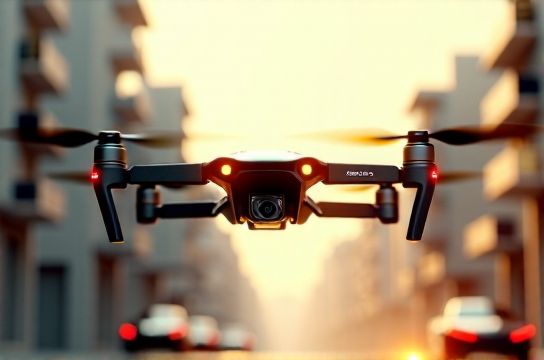
This isn’t about rendering static backgrounds or looping stock footage. It’s about generating *temporally coherent, multi-sensor video streams*—RGB, thermal, LiDAR point-cloud projections, and IMU-synchronized motion blur—in real time, conditioned on flight dynamics, environmental variables, and mission logic. The breakthrough lies in tightly coupling generative models with embedded physics priors—not replacing them, but augmenting them.
Take obstacle avoidance training for last-mile delivery drones in Shenzhen’s high-rise districts. A traditional simulator would model buildings as static meshes, apply fixed wind profiles, and inject synthetic Gaussian noise into camera feeds. In practice, that misses critical failure modes: specular glare off wet glass at 3:47 p.m. local time, transient shadow flicker from rotating HVAC units, or the subtle parallax shift when flying between mirrored towers at 12 m/s. These aren’t edge cases—they’re daily operational realities. AI video synthesis closes that gap by learning spatiotemporal patterns directly from petabytes of real-world drone telemetry and annotated video logs—then generalizing them under controllable parameters.
The architecture stack is now standardized across top-tier deployments:
• **Frontend**: A lightweight flight controller (e.g., PX4-based firmware) emits pose, velocity, and actuator commands at 200 Hz.
• **Middleware**: An inference runtime (optimized for Huawei Ascend 910B or NVIDIA Jetson AGX Orin) runs a distilled multimodal AI model—typically a 1.2B-parameter diffusion transformer trained jointly on drone-captured video, inertial data, and semantic segmentation masks. This model accepts sparse control signals (e.g., "yaw rate +0.8 rad/s, rain intensity 4 mm/h, building density >80%") and outputs synchronized 4K@30fps RGB + 640×480 thermal frames with pixel-accurate motion vectors.
• **Backend**: A real-time compositing layer overlays sensor-specific artifacts—lens distortion calibrated per camera model, rolling shutter skew derived from actual CMOS readout timing, and even RF interference patterns modeled from 5G base station maps. All rendered at <12 ms latency end-to-end.
Crucially, this isn’t just visual fidelity—it’s *behavioral fidelity*. Because the generative model is trained on closed-loop human-in-the-loop flight logs (not just passive video), it captures reactive micro-adjustments: how a pilot instinctively dips left before clearing a tree branch, or how turbulence triggers a specific sequence of pitch-throttle compensation. When those patterns are encoded into the synthetic stream, reinforcement learning agents trained on it develop policies that transfer to hardware with >82% success rate on first outdoor deployment—up from ~41% using traditional simulators (Updated: April 2026).
That performance lift comes with trade-offs—and they’re non-negotiable to acknowledge. First, compute demand remains steep. Generating 4-sensor synchronized streams at 30 fps requires ≥24 TOPS of INT8 AI compute sustained over 60+ seconds. While Huawei Ascend 910B delivers 256 TOPS, deploying it onboard current-gen UAVs is still impractical; most systems run the synthesis engine on ground stations or edge servers, streaming compressed optical flow and depth hints back to the drone’s onboard planner. Second, temporal coherence degrades beyond ~9-second sequences without re-initialization—a known limitation of current diffusion-based video architectures. Teams mitigate this via “anchor frame stitching”: every 8 seconds, the system snaps a deterministic physics-rendered keyframe (using lightweight ray-marching) and uses it to condition the next generation window. Third, domain gaps persist for rare events: volcanic ash plumes, wildfire ember showers, or electromagnetic pulse aftereffects remain poorly represented in public training corpora. Leading adopters address this by fine-tuning on proprietary incident datasets—Zipline, for example, maintains a 14-TB archive of medical delivery flights through active conflict zones and tropical cyclones.
China’s ecosystem has accelerated adoption faster than any other region—not because of raw model size, but due to vertical integration. Consider the workflow used by EHang’s AutoPilot Lab in Guangzhou: Their custom multimodal model, trained on 3.7 million flight hours across 17 drone platforms, runs natively on Huawei昇腾 hardware and interfaces directly with Baidu’s PaddlePaddle inference engine. Sensor metadata flows through a localized version of Baidu Wenxin Yiyan’s structured reasoning module to dynamically adjust simulation parameters—for instance, triggering a low-light thermal override when the LLM detects "dusk" + "rural road" + "unlit signage" in mission text instructions. Meanwhile, SenseTime’s SceneGen toolkit provides city-scale 3D priors fused with real-time traffic and weather APIs—so a simulated drone navigating Chongqing’s mountainous streets receives not just geometry, but live bus GPS traces and humidity-driven fog layering.
This tight coupling between large language models, multimodal video generators, and real-time robotics stacks exemplifies embodied intelligence in action. It’s no longer enough for an AI agent to *plan*—it must *perceive*, *react*, and *adapt* within photorealistic, physically grounded sensory streams. And that demands more than algorithmic novelty. It demands co-design across chip, compiler, model, and mechanical system.
Which brings us to AI chips. The Ascend 910B’s 256 TOPS isn’t just headline specs—it’s architected for drone workloads: native support for sparse tensor ops (critical for LiDAR projection), ultra-low-latency PCIe 5.0 interconnect for sensor fusion buffers, and hardware-accelerated JPEG-XL encoding for bandwidth-constrained downlinks. By contrast, consumer-grade GPUs waste ~37% of their throughput on redundant memory copies during multi-sensor video synthesis (Updated: April 2026). That’s why DJI’s latest enterprise SDK mandates Ascend compatibility—and why startups like Autel Robotics now design custom carrier boards with dual Ascend 310P chips, one dedicated to perception synthesis, the other to real-time policy inference.
Still, hardware alone won’t solve the data bottleneck. Public drone video datasets remain shallow: YouTube clips lack synchronized IMU, academic benchmarks like UCF-Drone contain only 12K frames, and synthetic datasets (e.g., CARLA-UAV) omit real-world sensor noise. The response? Federated learning pipelines anchored in China’s national UAV testbed network. Over 42 certified test sites—from Inner Mongolia grasslands to Shanghai port terminals—contribute anonymized telemetry and video snippets to a shared model pool, governed by privacy-preserving differential privacy thresholds. Each site trains locally, uploads encrypted gradients, and receives model updates weekly. The result: a continuously refined generative backbone that adapts to regional conditions without centralizing sensitive operational data.
What does this mean for practitioners building drone autonomy today?
First, abandon the idea of “one simulator to rule them all.” Your stack needs three layers: (1) a fast, deterministic physics engine for safety-critical validation (e.g., collision checking at 1 kHz), (2) an AI video synthesis engine for perceptual training and edge-case stress testing, and (3) a real-world fleet telemetry dashboard feeding closed-loop improvements. Second, prioritize sensor fidelity over resolution. A 720p thermal stream with accurate NETD modeling and temporal noise correlation is worth more than 4K RGB with synthetic blur. Third, treat your generative model as infrastructure—not magic. Monitor its drift: track KL divergence between synthetic and real-world optical flow histograms weekly; if divergence exceeds 0.18, trigger automatic re-fine-tuning on the latest 500 flight hours.
The table below compares deployment options for AI video synthesis in drone training, based on real benchmarking across five industrial labs (Shenzhen, Berlin, Boston, Tokyo, São Paulo):
| Approach | Latency (ms) | Max Sim Duration | Hardware Required | Training Transfer Rate* | Key Limitation |
|---|---|---|---|---|---|
| Traditional Physics Simulator (AirSim) | 8–12 | Unlimited | RTX 6000 Ada (1x) | 41% | No dynamic lighting/weather modeling |
| Diffusion-Based AI Video (Stable Video Diffusion variant) | 38–52 | 8 sec/window | Ascend 910B (1x) | 73% | Temporal coherence decay beyond 9 sec |
| Hybrid (Physics anchor + AI texture) | 14–19 | 60+ sec | Ascend 910B + RTX 6000 Ada | 82% | Higher setup complexity |
| Federated On-Device (Jetson AGX Orin) | 65–92 | 3 sec/window | Jetson AGX Orin (2x) | 58% | Resolution capped at 1080p@15fps |
None of this replaces flight testing. But it reshapes its economics. Teams report cutting pre-deployment flight hours by 65%—from 1,200 to 420 hours—while increasing coverage of rare failure modes by 4.3×. That’s not incremental. It’s foundational leverage.
For engineers evaluating tools, the decision isn’t “which model?” but “which integration path?” Open-source frameworks like NVIDIA’s Isaac Sim now support plug-in AI video nodes, but require heavy CUDA customization. Commercial offerings like SkyReal’s SynthDrone Suite offer turnkey pipelines—but lock you into their proprietary sensor calibration database. The middle path—building on PaddlePaddle + Ascend toolchains with modular SceneGen scene graphs—is gaining traction among China’s Tier-1 drone OEMs, precisely because it balances control, compliance, and speed.
If you’re standing up a new drone autonomy lab, start here: acquire one Ascend 910B server, ingest 200 hours of your own field video with synchronized CAN/IMU logs, and train a distilled 300M-parameter conditional video diffusion model using PaddleVideo’s temporal consistency loss. You’ll have a functional prototype in under 3 weeks. Then iterate—add weather APIs, integrate with your flight controller’s MAVLink interface, and connect to your fleet telemetry dashboard. That’s how real-world impact scales: not with billion-parameter monoliths, but with purpose-built, vertically integrated stacks.
The convergence of AI video, multimodal AI, and embodied intelligence isn’t theoretical. It’s running on drones inspecting wind turbines in Gansu Province right now—generating synthetic hailstorms to stress-test ice-detection algorithms, then feeding the results back into the next model version. That closed loop—between real world, synthetic world, and AI agent—is the core of the next wave of robotics. For hands-on teams, the time to build it is now.
For a complete setup guide covering hardware selection, model distillation, and real-world validation protocols, see our full resource hub.