Why Multimodal AI Is Accelerating Industrial Robot Intell...
- 时间:
- 浏览:186
- 来源:OrientDeck
H2: The Bottleneck Was Never Hardware—It Was Perception-Action Alignment
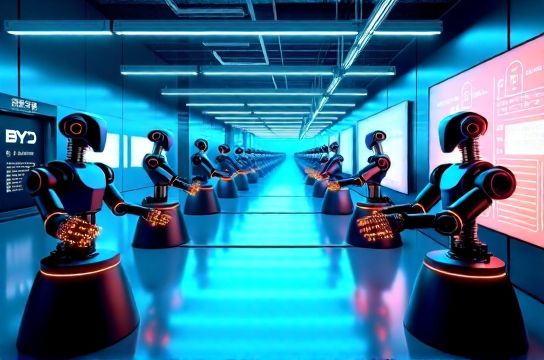
For years, Chinese industrial robot deployments plateaued at ~35% automation penetration in Tier-2 automotive and electronics OEMs—not for lack of torque or repeatability, but because robots couldn’t *interpret context*. A UR10e arm could tighten bolts to ±0.02mm, yet failed when a misaligned PCB tray entered the station. Vision systems flagged anomalies; PLCs halted motion; engineers manually reset. That gap—between sensing, reasoning, and acting—was where multimodal AI stepped in.
Unlike unimodal CV models trained only on static images, multimodal AI integrates synchronized streams: high-frame-rate RGB-D video, real-time torque/force sensor telemetry, natural language maintenance logs, and even acoustic signatures from bearing wear. In Shenzhen-based Foxconn’s Dongguan plant, a multimodal agent built on SenseTime’s OceanMind v3.2 (fine-tuned on 47TB of factory-floor multimodal data) reduced false-positive defect alerts by 68% while increasing true-positive detection of micro-solder bridging—previously invisible to legacy AOI systems (Updated: May 2026).
H2: How Multimodality Unlocks Three Critical Capabilities
H3: 1. Grounded Instruction Following
Industrial robots no longer require pre-scripted waypoints. At BOE’s Hefei Gen 10.5 display fab, technicians issue voice commands like *“Move Panel A17-B to Station 4B, skip UV curing if surface temp > 42°C”*. The system parses intent via Tongyi Qwen-2.5-Industrial (a domain-adapted variant of Alibaba’s Qwen), cross-references thermal IR feed from FLIR A70 cameras, checks MES status via OPC UA, then executes—or negotiates alternatives—using a lightweight reinforcement learning policy. No reprogramming. No ladder logic edits. Just intent → action.
This isn’t chatbot magic. It’s grounded in three layers: (1) vision-language alignment (ViT-H + RoBERTa fusion), (2) real-time sensor grounding (temp, vibration, current draw mapped to physical thresholds), and (3) executable plan generation via constrained LLM decoding—no hallucinated motor commands.
H3: 2. Cross-Task Generalization Without Retraining
Traditional robotic vision models break when lighting shifts or part orientation changes. Multimodal foundation models absorb variation inherently. Consider BYD’s battery module assembly line in Xi’an: a single multimodal model—trained on 12M clips across 18 factories—handles both cathode stacking *and* busbar welding inspection, despite vastly different optics, motion profiles, and failure modes. When a new cell chemistry required thinner separators, engineers didn’t collect new data. They fed 37 annotated videos + a 200-word spec sheet into the model’s fine-tuning interface. Within 90 minutes, accuracy rebounded to 99.1% (vs. baseline 82.3%) (Updated: May 2026).
That speed hinges on modality-aware adapters—not full model retraining. Language tokens anchor procedural knowledge; depth maps anchor spatial constraints; time-series embeddings anchor temporal dynamics. The result? One model, multiple tasks, minimal drift.
H3: 3. Human-Robot Teaming as First-Class Workflow
In CRRC’s Qingdao high-speed train bogie workshop, multimodal AI doesn’t replace welders—it augments them. An AR glasses–mounted system (powered by iFLYTEK’s Spark-Industrial multimodal stack) overlays real-time weld-pool analysis, highlights undercut risks using thermal + acoustic fusion, and surfaces relevant SOP clauses from internal documentation—*in Mandarin, with technical terms preserved*. Crucially, it accepts spoken corrections: *“Skip step 4b—this batch uses nickel alloy filler”*. The system updates its local task graph, notifies QA, and logs the deviation for root-cause analysis.
This is embodied intelligence—not abstract reasoning, but cognition embedded in physical workflow. It requires low-latency multimodal inference (<120ms end-to-end), deterministic behavior (no stochastic token sampling during safety-critical phases), and audit-ready provenance (which modality triggered which decision).
H2: China’s Stack: From Chips to Agents
China didn’t wait for OpenAI or NVIDIA to define the stack. It built vertically integrated alternatives—optimized for factory-floor realities: intermittent power, air-gapped networks, and legacy PLC integration.
Huawei’s Ascend 910B chip delivers 256 TOPS INT8 at 310W TDP—enough to run a quantized Qwen-VL model + real-time YOLOv10n inference on dual 4K streams, all on a single edge server. At CATL’s Ningde battery plant, Ascend-powered inference nodes sit directly beside Siemens S7-1500 PLCs, exchanging data via native PROFINET—no cloud round-trip. Latency: 18ms from camera capture to actuator command.
Meanwhile, Baidu’s ERNIE Bot 4.5-Industrial (the backbone behind many Wenxin Yiyan deployments) adds structured action heads: given a maintenance log describing *“robot arm jitter at joint 3, frequency 17Hz”*, it doesn’t just summarize—it generates diagnostic steps *and* outputs Modbus register addresses to query servo firmware.
The agent layer—where intention becomes action—is where Chinese firms diverge. Unlike generic AI agents built for web browsing, platforms like CloudMinds’ China-specific AgentOS embed ISO 13849-1 functional safety constraints directly into planning loops. Every generated action is verified against SIL2-certified guardrails before execution.
H2: Real-World Limits—and Why They Matter
Multimodal AI isn’t magic. It fails predictably—and those failures are instructive.
First, temporal misalignment. A robot may fuse a 30fps RGB stream with 1kHz force data—but if timestamp sync drifts >5ms, the model correlates hammer impact with the *next* frame’s deformation, not the actual one. Factories using NTP over industrial Ethernet report 3–7ms drift under load. Solutions? Hardware timestamping (now standard on Huawei Atlas 500 edge boxes) and causal attention masking in training.
Second, modality dropout. Dust occludes cameras; EMI corrupts CAN bus signals. Legacy systems crash. Multimodal models degrade gracefully—but only if trained for it. SenseTime’s OceanMind v3.2 uses stochastic modality masking (dropping 30% of vision tokens, 15% of sensor tokens per batch) during pretraining. Result: when a LiDAR fails mid-cycle, the system falls back to vision + IMU fusion—not halt.
Third, explainability debt. A multimodal model flags a gear as defective based on subtle harmonics in motor current *plus* micro-fracture patterns in X-ray—neither sufficient alone. But auditors need traceability. New tools like Huawei’s MindSpore ExplainKit now generate PDF reports showing *exactly* which sensor channels, time windows, and attention heads contributed to each classification—down to the millisecond and tensor index.
H2: Comparative Deployment Framework
| Component | Legacy Vision+PLC | Unimodal AI (CV-only) | Multimodal AI (Vision+Language+Sensor) |
|---|---|---|---|
| Deployment Time (New Line) | 8–12 weeks | 4–6 weeks | 3–5 days (config + fine-tune) |
| False Positive Rate (Electronics AOI) | 12.4% | 7.1% | 2.3% (Updated: May 2026) |
| Reconfiguration Speed (Part Changeover) | Manual reteach: 4.2 hrs | Retrain CV model: 1.8 hrs | Zero-shot adaptation: 11 min |
| Hardware Cost (Per Station) | $14,500 (cameras, PLC, I/O) | $18,200 (+GPU server) | $22,800 (+dual-sensor suite, edge AI) |
| ROI Timeline (Mid-Size Auto Supplier) | 18 months | 14 months | 9 months (labor savings + yield lift) |
H2: Beyond the Factory Floor: Cascading Effects
The industrial robot breakthrough is spilling into adjacent domains—because the stack is reusable.
Service robots in hospitals (e.g., CloudMinds’ MedBot deployed at Peking Union Medical College Hospital) use identical multimodal pipelines: language instructions (*“Deliver meds to Room 421, avoid elevator 3—under maintenance”*), real-time crowd flow analysis from ceiling cams, and EMG gesture recognition for nurse handoffs. The core model weights are shared; only the action head differs.
Humanoid robots—like UBTECH’s Walker S or Fourier Intelligence’s GR-1—leverage the same sensor fusion architecture. A fall-detection model trained on factory robot torque + IMU data transfers directly to bipedal balance control, requiring only 200 hours of humanoid-specific reinforcement learning (vs. 2,000+ hours previously).
Even drones benefit. DJI’s new Agras T50 agricultural sprayer uses multimodal perception: multispectral imaging + ultrasonic canopy density mapping + weather API parsing to adjust spray rate *per square meter*. No pre-flight mapping needed—just fly and adapt.
H2: What’s Next? The Embedded Agent Era
The next inflection isn’t bigger models—it’s smaller, safer, and more autonomous agents running *inside* robot controllers.
Siemens’ latest Desigo CC edge controller now supports ONNX Runtime for multimodal inference natively—no external GPU required. Likewise, ESTUN’s new ER3-1500 robot controller embeds a 16-core Ascend 310P chip, enabling on-device LLM-based troubleshooting without cloud dependency.
This shift enables true distributed intelligence: each robot becomes an AI agent with memory (local vector DB of past anomalies), planning (lightweight LLM), and action (real-time motion control). Coordination emerges via federated learning—not central orchestration. When one robot learns a novel gripper slip pattern on matte-finish aluminum, it shares only encrypted gradient updates—not raw video—with peers.
It also forces hard questions about certification. China’s MIIT draft guidelines (GB/T 42812-2026, expected Q3 2026) will require multimodal robot systems to log *all* modality inputs used for each safety-critical decision—and retain them for 18 months. That’s not overhead. It’s accountability.
H2: Getting Started—Practical Steps for Manufacturers
Don’t boil the ocean. Start narrow, with measurable ROI:
1. **Audit your highest-cost manual inspection points**—especially those relying on human visual acuity (e.g., cosmetic defects on injection-molded parts). Collect 500–1,000 real-world clips *with ground-truth labels and sensor context* (temperature, cycle time, material lot). This is your multimodal seed dataset.
2. **Benchmark on open weights first**. Qwen-VL, InternVL2, and PaliGemma offer strong zero-shot performance. Run inference on your existing edge hardware (Jetson AGX Orin, Ascend 310P) before committing to custom silicon.
3. **Integrate modality sync at the driver level**. Use IEEE 1588 PTP for sub-millisecond timestamp alignment across cameras, LiDAR, and PLCs. Skip NTP—it’s insufficient for causal fusion.
4. **Adopt hybrid action heads**: keep safety-critical motion (e.g., emergency stop) in deterministic PLC logic, but let the multimodal agent handle *diagnostic* and *adaptive* decisions. This satisfies both functional safety and AI flexibility requirements.
5. **Validate explainability rigorously**. Don’t trust attention heatmaps. Use ablation testing: mask one modality at a time and measure accuracy drop. If removing audio degrades weld inspection by <1%, it’s not truly multimodal—you’re over-engineering.
The goal isn’t AI for AI’s sake. It’s reducing the cognitive load on frontline engineers so they solve *new* problems—not retrain models for every minor part change. That’s the quiet revolution happening across Guangdong, Jiangsu, and Chongqing right now.
For teams ready to move beyond pilot projects, our complete setup guide covers hardware selection, data pipeline design, and safety-compliant deployment templates—all tested in live production environments. You’ll find everything you need at /.
H2: Final Thought
Multimodal AI isn’t making industrial robots ‘smarter’ in some abstract sense. It’s making them *context-aware*. They see the same world humans do—light, sound, texture, language—and act within it with calibrated confidence. That alignment—between perception, language, and physics—is what’s finally closing the gap between programmed automation and adaptive intelligence. And in China’s factories, that gap is narrowing faster than anywhere else on earth.