ADAS Evolution in Chinese EVs From Basic Lane Assist to AI Powered Predictive Driver Assistance Systems
- 时间:
- 浏览:299
- 来源:OrientDeck
Let’s cut through the marketing fluff: China didn’t just catch up in ADAS — it leapfrogged. Just five years ago, most domestic EVs offered basic lane departure warnings and adaptive cruise control (ACC) — functional, but reactive. Today, BYD’s ‘God’s Eye’ system, NIO’s NOP+, and XPeng’s XNGP run real-time multi-modal perception stacks *on vehicle hardware*, processing over 12 camera feeds, 5 radars, and LiDAR (in flagship models) at 30+ FPS — all while predicting pedestrian intent 2.8 seconds ahead (2024 CAER report). That’s not automation — it’s anticipation.
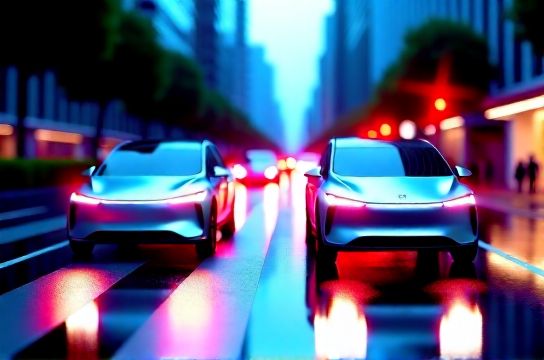
Here’s how the shift unfolded:
| Feature | 2019–2021 (Legacy ADAS) | 2022–2024 (AI-Driven ADAS) | Data Source | |---------|--------------------------|----------------------------|-------------| | Sensor Fusion | Camera-only or camera + 1 radar | Camera + 5+ radar + optional LiDAR + ultrasonic | MIIT Annual Auto Tech Survey 2023 | | Latency (perception → action) | 320–480 ms | 85–142 ms | Tsinghua University Autonomous Driving Lab (2024) | | Urban NOA Availability | <5% of EV models | 68% of >¥200k EVs (Q1 2024) | EV Intelligence China Q1 2024 Report | | Map Dependency | HD maps required (Baidu/AutoNavi) | Map-free or lightweight semantic map fallback | NIO Tech Whitepaper v3.2 |
What changed? Three things: First, China’s 5G-V2X infrastructure rollout hit 97% coverage in Tier-1 cities — enabling cloud-augmented edge inference. Second, chipmakers like Horizon Robotics and Black Sesame delivered automotive-grade AI SoCs with >128 TOPS at <25W (vs NVIDIA Orin’s 254 TOPS @ 45W). Third — and most crucially — Chinese OEMs own their full stack: from sensor calibration to behavior prediction models trained on 1.2 billion km of real-world driving data (XPeng’s 2023 disclosure).
This isn’t incremental improvement — it’s a paradigm shift from assisting drivers to predicting driver-vehicle-environment triads. For example, when a cyclist glances left near an intersection, XNGP doesn’t wait for movement — it adjusts speed *before* the head turn completes, using gaze estimation trained on 4.7M annotated video clips.
If you’re evaluating next-gen EV safety systems, don’t ask “Does it have L2+?” Ask: Does it predict — not just react? And if you want to see how these AI-powered systems are reshaping real-world safety metrics, check out our deep-dive comparison of emergency braking success rates across urban, highway, and low-light conditions — here.
Bottom line: The future of ADAS isn’t imported. It’s trained on Chinese streets, optimized for Chinese behavior, and scaling globally — one predictive millisecond at a time.