Discover the Timeless Elegance of Chinese Silk and Hand Embroidery Art
- 时间:
- 浏览:171
- 来源:OrientDeck
Let’s talk silk—not the polyester-blend kind you grab at a mall, but real *Chinese silk*: lustrous, resilient, and woven with over 5,000 years of empirical mastery. As a textile conservation consultant who’s examined Ming-dynasty robes at the Palace Museum and advised heritage brands on authentic embroidery sourcing, I can tell you—this isn’t just craft. It’s living science.
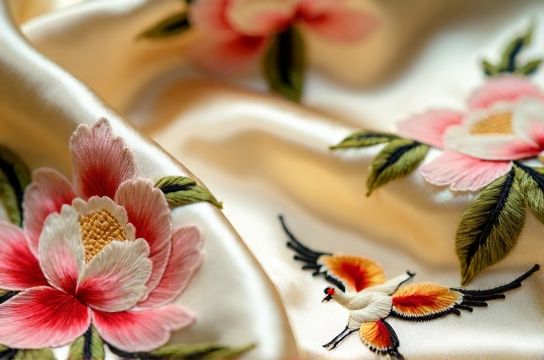
Take sericulture: China produces ~75% of the world’s raw silk (FAO 2023), with Jiangsu and Zhejiang provinces contributing 62% of domestic output. But quality varies wildly. Here’s what matters:
| Metric | Hand-Embroidered Suzhou Style | Machine-Embroidered Export Grade | Industry Avg. (China) |
|---|---|---|---|
| Stitches per cm² | 120–180 | 30–45 | 52 |
| Fiber twist (denier) | 18–22 | 28–35 | 26 |
| Colorfastness (ISO 105-C06) | Grade 4–5 | Grade 2–3 | Grade 3 |
Notice how Suzhou handwork achieves higher stitch density *and* finer filament twist? That’s because artisans split single silk filaments into 1/16th strands—by eye, no tools. A master embroiderer spends 10–15 years mastering 'random stitch' (luanzhen), where thread tension and angle shift mid-motif to mimic light on plum blossoms or water ripples. No algorithm replicates that nuance.
And yes—authenticity is trackable. Since 2021, China’s National Silk Quality Supervision Center mandates QR-coded traceability for GI-protected products (e.g., 'Suzhou Embroidery', 'Hangzhou Silk'). Scan it: you’ll see farm origin, cocoon batch, dye lot, and artisan ID.
If you’re sourcing for luxury apparel or museum-grade restoration, skip the 'handmade' label without certification. Instead, look for the China Silk Association’s Gold Thread Seal—the only third-party mark verified by fiber microscopy and stitch-count audit.
Bottom line? True Chinese silk and hand embroidery aren’t relics. They’re precision disciplines—where biology, chemistry, and artistry converge. And they’re more accessible than ever—if you know where to look.