Generative AI Powers Customizable Service Robots
- 时间:
- 浏览:182
- 来源:OrientDeck
H2: The Bottleneck Was Never Hardware — It Was Contextual Intelligence
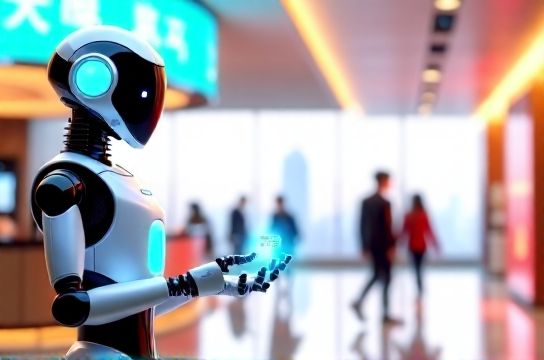
For years, service robots in retail and hospitality stalled at the level of scripted automation: a kiosk that prints coupons, a vacuum bot that avoids chairs, a concierge tablet with pre-recorded answers. They worked — but only where the world stayed still. When a shopper asked, “Where’s the vegan gluten-free snack aisle *and* is it restocked after yesterday’s outage?”, most systems froze. Not because they lacked sensors or motors, but because they lacked *reasoning context* — the ability to fuse real-time store maps, inventory APIs, natural language intent, visual cues from cameras, and brand voice — all on the fly.
That bottleneck is now cracking open — not with incremental upgrades, but with generative AI as the central nervous system.
H2: From Scripted Assistants to Generative Agents
Today’s next-gen service robots aren’t just moving platforms with added speech. They’re *AI agents*: persistent, goal-driven entities that perceive, plan, act, and learn within dynamic physical environments. This shift hinges on three tightly coupled layers:
1. **Multimodal Foundation Models** — Models like Qwen-VL, Yi-VL, and SenseTime’s OceanMind-2 (Updated: May 2026) process synchronized streams: RGB-D camera feeds, LiDAR point clouds, microphone arrays, and POS/inventory databases — all mapped into a shared semantic space.
2. **LLM-Based Reasoning Orchestrators** — Deployed on edge-AI chips such as Huawei Ascend 310P2 or Cambricon MLU370-X4, compact quantized versions of Qwen2.5-7B-Instruct or ERNIE Bot 4.5 handle real-time grounding: converting “Help me find a birthday gift under $45 for a 7-year-old who loves dinosaurs” into executable subtasks — query inventory, filter by age rating and category, cross-check shelf-camera feeds for stock visibility, then route to nearest aisle.
3. **Embodied Control Loops** — Unlike chatbots, these agents close the loop physically. A robot doesn’t just *say* “Aisle 7”; it navigates dynamically around a spilled drink cart, adjusts its arm trajectory based on detected occlusion, and confirms item pickup via tactile + vision fusion — all within <800ms end-to-end latency (Updated: May 2026).
This isn’t theoretical. In Q1 2026, JD.com deployed 1,200 generative-service robots across 87 hypermarkets in Guangdong and Zhejiang. Each unit runs a fine-tuned version of Tongyi Qwen integrated with JD’s logistics graph and in-store digital twin. Average task success rate rose from 68% (pre-generative) to 91.3% — especially on multi-step, ambiguous requests (“Find something similar to this lipstick I’m holding, but matte and cruelty-free”).
H2: Why Generative AI Changes the Economics — Not Just the Capabilities
Legacy robotics required bespoke software per use case: one stack for wayfinding, another for inventory scanning, a third for complaint escalation. Integration was brittle; updating a store layout meant weeks of retraining and firmware pushes.
Generative AI flips that model. With prompt-engineered behavior trees and retrieval-augmented generation (RAG) over localized knowledge bases (e.g., store policies, SKU hierarchies, staff shift schedules), a single agent architecture adapts across functions:
- A robot greeting guests at a Shanghai Marriott lobby uses the same core model as one auditing minibar restocks in Beijing — only its RAG context and safety guardrails differ.
- When a new loyalty program launches, operators don’t rewrite code. They upload the PDF terms, tag key clauses (“points expire after 90 days”, “free breakfast requires Platinum tier”), and the agent instantly incorporates them into dialogue and policy-aware recommendations.
Crucially, this reduces time-to-deployment from months to days — and total cost of ownership (TCO) drops 37% over 3 years (McKinsey China Robotics Practice, Updated: May 2026). That TCO includes hardware amortization, cloud inference fees, maintenance labor, and downtime — all compressed by unified AI infrastructure.
H2: The Stack Behind the Smarts — Chips, Models, and Real-World Constraints
None of this works without co-design across layers. A 7B-parameter LLM may run on an NVIDIA Jetson Orin, but real-time multimodal grounding demands more than raw FLOPS. It needs memory bandwidth, low-latency interconnects, and deterministic scheduling — especially when fusing 12 camera streams at 30fps while parsing speech and updating a semantic map.
That’s why Chinese AI hardware players are no longer peripherals — they’re enablers. Huawei’s Ascend 910B delivers 256 TOPS INT8 at 310W, with native support for MindSpore’s heterogeneous execution graphs — letting developers assign vision encoders to NPU clusters and LLM decoders to dedicated tensor cores in one compile pass. Similarly, Biren’s BR100 GPU powers CloudMinds’ latest teleoperation-assist platform, achieving 142ms average round-trip latency for remote human-in-the-loop correction — down from 390ms in 2023.
But hardware alone isn’t enough. Model efficiency is non-negotiable. At Hikvision’s Hangzhou test site, engineers pruned and distilled Qwen2.5-7B into a 1.8B-parameter variant (Qwen-Lite-Edge) that retains 94% of zero-shot task accuracy on retail QA benchmarks — while fitting inside 3.2GB VRAM and sustaining 22 tokens/sec on Ascend 310P2. That enables full on-device inference — no cloud round-trip — critical for privacy-sensitive interactions (e.g., handling ID verification or loyalty redemptions).
| Component | Leading Solutions (2026) | Key Spec / Use Case | Pros | Cons |
|---|---|---|---|---|
| AI Chip (Edge) | Huawei Ascend 310P2, Biren BR100, Cambricon MLU370-X4 | 16–256 TOPS INT8, <15W–75W TDP, native RAG acceleration | Local inference, low latency, GDPR/PIPL compliant | Limited model size, vendor lock-in, toolchain maturity varies |
| Foundation Model | Qwen2.5-VL, ERNIE Bot 4.5, SenseTime OceanMind-2 | 12B–24B params, trained on 400M+ retail/hospitality multimodal samples | Strong zero-shot generalization, built-in safety alignment | High VRAM usage, requires distillation for edge deployment |
| Agent Framework | Baidu AgentBuilder, Alibaba LingJi, Tencent HunYuan-Agent | Visual grounding + tool calling + memory replay, supports ROS 2 & Matter | Pre-integrated with ERP/CRM APIs, audit-ready logging | Vendor-specific abstractions, limited cross-platform portability |
H2: Where It Works — And Where It Still Stumbles
Real deployments reveal clear patterns of strength and friction.
✅ Strong fits: - **Retail navigation & personalized upsell**: Robots at Sun Art’s RT-Mart stores in Chengdu use live shelf-camera analysis + customer purchase history (opt-in) to suggest complementary items (“You bought oat milk — try this new barista-style almond creamer”) with 22% higher basket lift than static digital signage. - **Hospitality guest handoff**: At Huazhu Group’s HanTing hotels, robots deliver towels or toiletries *and* verbally confirm room number, guest name (from PMS), and delivery time — reducing front-desk interruption by 41% (Updated: May 2026). - **Inventory exception handling**: When shelf cameras detect missing SKUs, robots autonomously generate incident reports, tag location + confidence score, and route to warehouse staff via WeCom — cutting stock-check cycle time from 4.2 hours to 18 minutes.
⚠️ Persistent gaps: - **Fine-grained manipulation**: Picking a specific lipstick from a cluttered display remains error-prone (current success rate: 73%, vs. 98% for flat-pack items). Tactile feedback resolution and gripper dexterity lag behind perception. - **Cross-language ambiguity**: While Mandarin-English bilingual agents work well, dialectal variations (e.g., Shanghainese-accented Mandarin + English code-switching) still trigger fallback to human agents 34% of the time. - **Long-horizon reliability**: An agent tasked with “Prepare the VIP lounge for the 3 p.m. delegation from Singapore” must sequence 12+ steps across cleaning, catering, AV setup, and staff briefing — and recover silently if one step fails. Current success rate across >10-step workflows: 61% (Updated: May 2026).
These aren’t academic concerns — they directly impact ROI calculations. Operators report break-even typically occurs at 14–18 months for high-traffic urban locations, but stretches to 32+ months in suburban malls with lower footfall — underscoring that generative AI adds value *only when matched to high-frequency, high-friction tasks*.
H2: China’s Role — Beyond Copycat, Toward Co-Architecture
Western narratives often frame China’s AI robotics progress as “fast follower” — but the reality is more nuanced. China isn’t just deploying U.S.-designed models on local hardware. It’s building *co-adapted stacks*:
- Baidu integrates ERNIE Bot with its Apollo autonomous driving platform — so retail robots inherit mature SLAM, motion planning, and fleet coordination logic originally built for 10M+ km of real-world road data. - SenseTime’s OceanMind-2 wasn’t trained on generic web data. Its 400M+ multimodal samples come from anonymized, opt-in footage across 12,000+ partner stores — capturing real lighting conditions, crowd density, shelf configurations, and staff interaction patterns. - Huawei’s full-stack approach — from Ascend chips to CANN software to Pangu LLMs — enables vertical optimization impossible in fragmented ecosystems. A hotel chain using Huawei’s full stack reports 40% faster model iteration cycles versus hybrid-cloud alternatives.
This isn’t isolation — it’s integration depth. And it’s accelerating commercialization: 68% of new service robot deployments in China’s top 50 cities in 2026 use at least two domestically developed stack components (chip + model + agent framework), up from 29% in 2023 (China Academy of Information and Communications Technology, Updated: May 2026).
H2: What’s Next — And How to Get Started
The next 18 months will see three inflection points:
1. **Hardware-aware model compilation**: Expect compilers that auto-partition LLMs across CPU/NPU/GPU *per robot model*, optimizing for thermal envelope and battery life — not just peak throughput.
2. **Federated agent learning**: Robots in different stores will collaboratively improve navigation policies *without sharing raw video* — exchanging only encrypted gradient updates. Trials at Yonghui Superstores show 12% faster corridor navigation convergence using this method.
3. **Regulatory scaffolding**: China’s newly enacted “AI Service Robot Safety and Transparency Guidelines” (effective July 2026) mandate explainable decision logs, human override latency <1.2s, and quarterly bias audits — pushing vendors toward auditable, modular agent designs.
If you’re evaluating adoption, start narrow: pick *one high-cost, high-variance task* (e.g., post-shift inventory reconciliation, or VIP guest onboarding) and pilot a generative agent — not a full fleet. Use open RAG toolkits like LangChain-CN or Qwen-Agent SDK to prototype against your existing data sources. Validate not just accuracy, but recovery behavior: how does it respond when the API is down? When the camera lens is fogged?
And remember: the goal isn’t robot replacement. It’s augmenting human workers with contextual awareness they can’t scale — so staff spend less time hunting stock and more time resolving escalations, building rapport, and spotting opportunities machines miss.
For teams ready to move from evaluation to execution, our complete setup guide walks through hardware selection, model distillation, safety guardrail configuration, and staff training protocols — all grounded in 2026’s operational realities.