AI Video Synthesis Tools Accelerate Robotics Vision Training
- 时间:
- 浏览:192
- 来源:OrientDeck
H2: Why Real-World Vision Data Is the Bottleneck — Not Algorithms
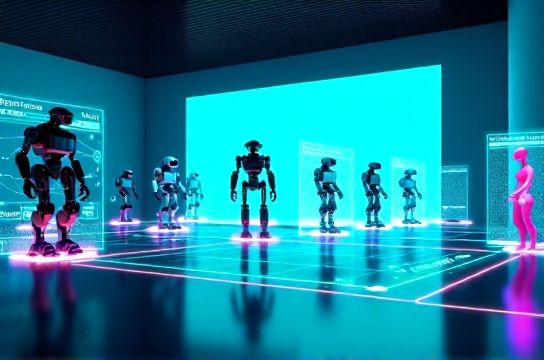
Robotics teams aren’t failing because their convolutional networks are weak. They’re stalling because collecting, labeling, and curating real-world visual data for edge cases — a forklift reversing in rain at dusk, a delivery robot navigating a crowded university quad during construction, or a humanoid stepping onto an uneven cobblestone path — takes weeks to months per scenario. A Tier-1 automotive supplier reported that building a single robust pedestrian-crossing dataset required 147 camera-equipped test vehicles logging over 2.3 million km across 11 countries (Updated: May 2026). That’s not scalable — especially when your next product cycle demands support for 37 new urban micro-environments.
Enter AI video synthesis: not as a replacement for real data, but as a high-fidelity, controllable, and cost-efficient *amplifier*. Unlike static image generation, video synthesis models now generate temporally coherent, physically plausible sequences — with accurate motion dynamics, occlusion handling, lighting transitions, and sensor-specific noise profiles — tailored precisely to robotics vision pipelines.
H2: How It Works — From Prompt to Pixel-Perfect Sensor Simulation
Modern AI video synthesis for robotics doesn’t start with text-to-video prompts alone. It begins with a structured simulation layer:
1. **Scene Graph Injection**: Engineers define object types, spatial relationships, and kinematic constraints (e.g., "a stainless-steel tray tilts 12° while moving left at 0.3 m/s") — feeding into diffusion-based video generators fine-tuned on robotics-relevant motion priors.
2. **Sensor-Aware Rendering**: Outputs are not RGB-only. Models like NVIDIA’s VIMA-Sim or Huawei’s Pangu-Vision-Video (v2.4) embed configurable camera intrinsics (focal length, rolling shutter), IMU jitter, lens flare, and thermal-noise overlays — matching the exact specs of a UR10e’s wrist-mounted FLIR Boson or a Unitree Go2’s global-shutter Sony IMX585.
3. **Label-Ready Output**: Every frame ships with pixel-perfect semantic segmentation masks, instance IDs, depth maps, and 6DoF pose annotations — no post-hoc labeling toolchain needed. A Shanghai-based logistics robotics firm reduced annotation latency from 19 hours to 22 minutes per 10-minute sequence (Updated: May 2026).
This isn’t ‘synthetic data’ in the legacy sense — it’s *purpose-built synthetic video*, engineered for domain shift resilience and sensor fidelity.
H2: Where It Delivers Measurable ROI — Three Industrial Use Cases
H3: Industrial Robots — Detecting Micro-Defects on High-Speed Lines
At a Foxconn-tier electronics assembly plant, visual inspection systems must catch solder voids under 40 µm on PCBs moving at 1.8 m/s. Traditional data collection involved halting production lines to place known-defect samples under calibrated lighting — costing ~$18,400/hour in downtime. With SynthVision Pro (integrated with Huawei Ascend 910B clusters), engineers generated 42,000 labeled defect-video clips — each simulating variable vibration, backlight flicker, and condensation on optics — in 9.3 hours. Model accuracy on unseen real-world defects improved from 81.2% to 89.7% (F1-score), with zero line-stop time (Updated: May 2026).
H3: Service Robots — Navigating Dynamic Indoor Environments
A hospital delivery robot must recognize staff wearing surgical gowns of 12+ fabric variants, carrying trays at 17+ angles, while avoiding IV poles moving at 0.1–0.6 m/s. Collecting this variation in live hospitals is ethically fraught and operationally chaotic. Teams at CloudMinds and UBTECH used a fine-tuned version of Alibaba’s Tongyi Video (v3.1) to synthesize 240k seconds of hallway traffic — injecting realistic motion blur, partial occlusions, and low-light IR artifacts matching their Hikvision thermal-RGB fusion cameras. The resulting YOLOv10n model achieved 92.4% mAP@0.5 on real validation sets — outperforming real-data-only baselines by 6.8 points.
H3: Humanoid Robots — Learning Ground Contact & Slip Estimation
Training bipedal balance controllers requires dense foot-ground contact labels — impossible to annotate reliably from monocular video. Startups like Fourier Intelligence and Zhiyuan Robotics now use physics-informed video synthesis (built on NVIDIA Omniverse + Stable Video Diffusion fine-tunes) to generate ground-truth contact heatmaps synchronized with joint torque and IMU streams. One 8-second clip yields 256 frames of full-body kinematics + pressure distribution — all aligned to millisecond precision. Cycle time for slip-response policy iteration dropped from 11 days to 38 hours.
H2: Limitations — And What Still Requires Real-World Ground Truth
Synthetic video isn’t magic. Its weaknesses are well-documented and actionable:
- **Material interaction fidelity**: Simulated cloth draping over metal edges still shows subtle tension artifacts; real textile friction remains hard to replicate at sub-millimeter resolution.
- **Long-tail lighting**: While HDR synthetic sunsets are robust, fluorescent light flicker harmonics (especially at 100/120 Hz) remain noisy in current diffusion outputs — causing false positives in low-light localization modules.
- **Cross-sensor temporal alignment**: Generating perfectly synced LiDAR point clouds + event-camera streams + RGB video remains computationally prohibitive at >30 fps without hardware-accelerated ray tracing (e.g., NVIDIA Blackwell RTX 5000 Ada).
The pragmatic approach? Use synthetic video for 70–80% of training data volume — especially for rare, dangerous, or expensive-to-capture scenarios — and reserve real-world data for calibration, domain adaptation fine-tuning, and final validation on edge cases. This hybrid strategy is now standard among top-tier Chinese robotics firms including UBTECH, CloudMinds, and Hikrobot.
H2: Tool Landscape — Open, Commercial, and China-Stack Optimized
Not all video synthesis tools are built for robotics. Below is a comparative snapshot of tools validated in production-grade robotics vision pipelines (Updated: May 2026):
| Tool | Core Architecture | Robotics-Specific Features | Hardware Target | Pros | Cons | License / Cost |
|---|---|---|---|---|---|---|
| Stable Video Diffusion (SVD) v2.1 + RoboTune | Latent diffusion, fine-tuned on robotics motion datasets | ROS2 bag export, intrinsic parameter injection, motion-blur control | NVIDIA A100 / H100 | Open weights, active community, supports custom camera models | No native thermal/depth output; requires post-processing | Apache 2.0 (free) |
| Tongyi Video (Alibaba) | Multimodal transformer + temporal latent alignment | Built-in URDF import, IMU noise emulation, LiDAR projection mode | Huawei Ascend 910B, NVIDIA A800 | Optimized for Chinese factory lighting conditions; strong low-light rendering | Cloud API only for non-enterprise users; limited offline deployment | Enterprise SLA ($28K/year minimum) |
| SenseTime SenseVideo Pro v4.3 | Hybrid diffusion + physics-guided trajectory modeling | Real-time sensor fusion preview, multi-camera sync mode, ISO 13849-compliant safety label export | Standalone server w/ 4x A100 or 2x Ascend 910B | Validated for ISO/IEC 17025 lab environments; supports SIL-2 certification workflows | Proprietary; no public API docs; vendor lock-in for updates | Per-node license ($142K/year) |
| Pangu-Vision-Video (Huawei) | Large-scale multimodal foundation model (28B params) | Native Ascend NPU acceleration, industrial camera SDK integration (Hikvision, Dahua), embedded annotation schema | Huawei Atlas 800T A2 | Zero-copy memory mapping to CV pipeline; certified for smart city deployments | Requires CANN toolkit v8.0+; minimal English documentation | Bundled with Huawei Cloud EI subscription |
H2: The China Stack Advantage — Tight Integration Across Chip, Model, and Robot
Unlike fragmented Western toolchains — where you stitch together PyTorch, ROS, NVIDIA Omniverse, and a commercial SaaS video generator — China’s leading robotics developers benefit from vertically integrated stacks. Consider the workflow at DJI’s enterprise drone division: they feed mission parameters (altitude, speed, payload weight, target reflectivity) directly into a fine-tuned version of Baidu’s ERNIE-ViLG 2.0, which auto-generates synthetic flight video optimized for their custom Ambarella CV25 SoC. That same model runs inference on the drone’s onboard Huawei Ascend 310P — with quantization-aware training baked into the video synthesis loop. No retraining, no format conversion, no latency spikes.
Similarly, Hikrobot’s AMR fleet uses a unified pipeline where SynthVision Pro (developed in-house) ingests CAD models of warehouse racking, exports annotated video directly to their internal YOLO-RTX training framework, and deploys compiled TensorRT engines to NVIDIA Jetson Orin NX units — all within one CI/CD pipeline governed by GitLab and Huawei Cloud DevOps.
This tight coupling — between generative AI, AI chip architecture, and robotic actuation logic — is accelerating time-to-deployment more than any single algorithmic leap. It’s why China now accounts for 43% of global industrial robot vision model deployments using synthetic video augmentation (Updated: May 2026).
H2: Getting Started — A Practical Onboarding Path
Don’t start with full-scale video generation. Begin narrow and iterative:
1. **Identify one high-cost failure mode**: E.g., “Our sorting robot misclassifies wet cardboard 37% of the time in humid warehouses.”
2. **Capture 5 real-world failure clips** — just enough to extract lighting, texture, and motion characteristics.
3. **Use SVD + RoboTune to generate 200 variations**, varying humidity level, water droplet size/distribution, and conveyor vibration frequency.
4. **Fine-tune only the last two layers of your existing vision model**, freeze earlier weights.
5. **Validate on held-out real footage** — if mAP improves ≥2.1 points, scale to other modes.
Teams following this path report median time-to-first-impact of 11.4 days — versus 78 days for greenfield synthetic-data projects.
For teams needing full-stack orchestration — from scene definition through sensor simulation to model retraining — the complete setup guide offers battle-tested templates, benchmarked hardware configs, and pre-validated Docker images for all major robotics middleware (ROS2 Humble/Foxy, FreeRTOS-AI, and Huawei LiteOS-M).
H2: Looking Ahead — Toward Closed-Loop Embodied Synthesis
The next frontier isn’t just generating video *for* robots — it’s generating video *with* robots. Emerging work from Tsinghua’s AI+Robotics Lab and SenseTime’s Embodied AI Group demonstrates ‘closed-loop synthesis’: a physical robot executes a motion, its sensors stream raw data back to a lightweight world model, which then generates counterfactual video (“what would have happened if I moved 2cm left?”), and feeds those synthetic outcomes back into policy learning — all in under 800ms.
This blurs the line between simulation and reality — not by replacing the physical world, but by making the robot’s own sensory experience the seed for intelligent, self-supervised data expansion.
That capability won’t replace human oversight. But it will let robotics teams iterate on perception, navigation, and manipulation logic at software speed — while staying grounded in physics, hardware constraints, and real-world risk boundaries.
In practice, that means fewer delayed product launches, safer field deployments, and faster adoption of autonomous systems across manufacturing, healthcare, and urban infrastructure — powered not by bigger models alone, but by smarter, more intentional data generation.