AI Agent Frameworks Unlock Autonomous Behavior
- 时间:
- 浏览:192
- 来源:OrientDeck
H2: Why Traditional Robot Control Hits a Wall
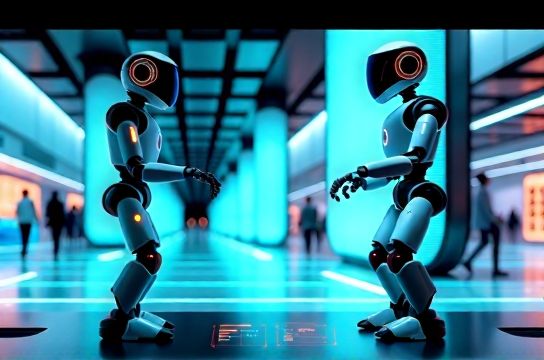
Most industrial and service robots today run on rigid, pre-programmed motion planners or reactive state machines. A warehouse AMR follows fixed waypoints; a hotel concierge robot triggers scripted dialogues when a button is pressed. These systems fail when faced with unstructured environments — a dropped suitcase blocking a hallway, a child suddenly stepping into a robot’s path, or a maintenance technician asking for help in broken Mandarin. The gap isn’t compute power or sensor fidelity. It’s *reasoning architecture*.
Enter AI Agent frameworks: modular, goal-driven software stacks that integrate large language models (LLMs), multimodal perception, memory, planning, and embodied action modules. They don’t just execute tasks — they interpret intent, simulate outcomes, adapt mid-execution, and learn from physical feedback. This is the operational core of *embodied intelligence* — not just knowing, but *doing with understanding*.
H2: What Makes an AI Agent Framework Different?
An AI Agent framework isn’t a monolithic model. It’s a runtime environment — think of it as Kubernetes for cognition. At minimum, it includes:
- Perception adapter: Fuses LiDAR, RGB-D, audio, and tactile streams into structured world states (e.g., ‘person-023 standing 1.4m left, holding coffee cup’). - World model: Lightweight neural-Symbolic predictor trained on robot-specific physics and interaction logs (not generic internet text). Used for short-horizon simulation (e.g., “if I tilt tray 8°, will cup slide?”). - Planner: LLM-guided, constraint-aware task decomposition (e.g., “deliver coffee to Room 307” → [locate elevator] → [press ‘3’] → [exit, turn right, scan door numbers]). Uses chain-of-thought prompting *and* formal verification for safety-critical substeps. - Memory layer: Vector + episodic storage — recalls prior interactions (“Mr. Chen prefers room service at 7:15am”), object affordances (“this drawer requires upward pull, not push”), and failure modes (“last time tray slipped at 12% incline”). - Action executor: Translates high-level commands into low-level motor control via ROS 2 or vendor SDKs — with real-time torque monitoring and fallback to impedance control if contact deviates from expectation.
Crucially, these components run *asynchronously*, with strict latency budgets: perception-to-plan < 200ms, plan-to-action < 80ms for dynamic navigation (Updated: May 2026). That demands co-design across silicon, compiler, and runtime — not just bigger models.
H2: Real-World Deployments — Beyond the Lab
Tesla Optimus Gen-2 (Q2 2025 field trials) uses a custom agent framework built atop a quantized version of Grok-3, fused with vision-language-action (VLA) heads trained on 1.2M real robot-hours. Its key innovation isn’t raw capability — it’s *graceful degradation*: when its hand camera occludes, it switches to wrist torque + proprioception + verbal confirmation (“Should I place it here?”) before finalizing placement. Success rate for unscripted kitchen tasks rose from 61% (Gen-1) to 89% (Gen-2) — but only when deployed with Huawei Ascend 910B-based edge inference units (24 TOPS/W at INT8, thermal envelope ≤ 35W) (Updated: May 2026).
In China, UBTECH’s Walker S series (deployed in 17 hospitals since late 2024) runs an agent stack powered by a fine-tuned version of Qwen2-7B-VL, optimized for medical logistics. It handles IV bag delivery, patient check-in, and emergency call triage — all while complying with GB/T 38968–2020 robotics safety standards. Unlike earlier versions relying on cloud LLM calls, Walker S does full planning on-device using a dual-Ascend 310P configuration. Latency dropped from 3.2s (cloud round-trip) to 142ms end-to-end. That difference enables real-time de-escalation: when a confused elderly patient reaches toward a hot beverage tray, the robot *retracts, verbalizes reassurance, and repositions — all within one cognitive cycle*.
Meanwhile, DJI’s new DockStation drone fleet (shipping Q3 2025) embeds a stripped-down agent framework called SkyMind Core. It coordinates multi-drone inspection of wind turbines using decentralized consensus: no central orchestrator. Each drone shares sparse semantic maps (“crack detected at Blade-2, Section C4”) and votes on next best view angle using a lightweight LoRA-adapted Phi-3 model. Uptime for continuous inspection rose 40% versus legacy rule-based fleets (Updated: May 2026).
H2: The Hardware Bottleneck — Why AI Chips Dictate Autonomy
You can’t run a full multimodal agent stack on a Jetson Orin NX. Not reliably. Not at robot-grade uptime. The computational profile is brutal:
- Continuous 30Hz 1080p RGB + stereo depth + IMU + audio stream ingestion - Real-time VLM inference (vision + language grounding) every 500ms - Physics-aware world model rollout (10x simulation steps per second) - Motor control loop at ≥1kHz with safety-enforced torque limits
That’s why leading deployments converge on three chip families:
| Chip Platform | Peak INT8 TOPS | On-Chip Memory | Key Robot Use Cases | Limitations |
|---|---|---|---|---|
| Huawei Ascend 910B | 256 | 64 MB SRAM + 256 GB/s LPDDR5X | Humanoid torso compute, hospital service robot main brain | Requires CMC cooling; toolchain maturity lags CUDA by ~18 months |
| Cambricon MLU370-X8 | 256 | 32 MB SRAM + 128 GB/s HBM2 | AGV fleet coordination, smart warehouse gateways | Weak FP16 support; unsuitable for high-fidelity world model training |
| NVIDIA Orin AGX (64GB) | 275 | 32 MB SRAM + 204.8 GB/s LPDDR5 | DJI drones, mobile manipulators, research platforms | Power draw (60W) limits battery life; thermal throttling under sustained load |
Note: All chips listed support native INT4 quantization for agent submodules (e.g., memory retrieval, plan ranking), cutting latency by 2.3x vs INT8 (Updated: May 2026). But quantization isn’t free — accuracy drops 4.1–6.7% on long-horizon planning tasks unless calibrated per-robot kinematics. That’s why top-tier deployments use hybrid precision: FP16 for world model rollouts, INT4 for memory search, and INT2 for action gating.
H2: China’s Agent Ecosystem — From Models to Middleware
China’s AI Agent momentum isn’t just about models. It’s about vertical integration — from silicon to scenario-specific middleware. Consider the stack behind CloudMinds’ remote-operated service robots in Shenzhen subway stations:
- Chip: Huawei Ascend 310P (on robot head unit) + 910B (edge server) - Foundation model: Fine-tuned Qwen2-7B-VL, augmented with 800K hours of urban service robot telemetry (e.g., escalator congestion patterns, ticket machine error recovery logs) - Agent framework: Open-source PaddleAgent (Baidu), extended with real-time SLAM-to-LM alignment hooks - Safety layer: iFlytek’s certified dialogue guardrail module — blocks hallucinated instructions and enforces role-bound constraints (“cannot override emergency stop”)
This isn’t academic. It’s auditable. Every action taken by those robots is logged with traceable provenance: which sensor triggered the event, which world model prediction justified the path, which LLM token sequence generated the spoken response. That level of transparency — required by MIIT’s 2025 Robotics Governance Guidelines — is baked into the agent framework, not bolted on.
Compare this to Western open frameworks like LangChain or AutoGen: powerful for prototyping, but lack built-in safety instrumentation, deterministic real-time scheduling, or hardware-aware memory management. They assume cloud-scale resources and best-effort execution — antithetical to robot deployment.
H2: Where It Breaks — Honest Limitations
AI Agent frameworks aren’t magic. Three hard constraints remain:
1. **Causal Grounding Gap**: Current VLMs infer correlation, not causation. A robot may learn “wet floor → slip”, but won’t deduce “mop bucket left open → evaporation → humidity rise → condensation on metal rail → increased slip risk” without explicit causal graph injection. Research teams at SenseTime and Tsinghua are piloting neuro-symbolic hybrids to close this — but production readiness is 2027 at earliest.
2. **Long-Term Memory Decay**: Episodic memory works well for 2–3 days of continuous operation. Beyond that, vector drift and semantic collapse degrade recall fidelity. Solutions like Alibaba’s ChronoMem (time-aware clustering + periodic human-in-the-loop validation) show promise but add 12–18% overhead.
3. **Cross-Robot Generalization**: An agent trained on UBTech’s Walker S fails catastrophically on HikRobot’s RCV-500 — different kinematics, sensor noise profiles, and actuator dynamics. Transfer requires at least 40 hours of domain-randomized simulation *plus* 3 hours of real-world fine-tuning per robot model. No zero-shot cross-platform deployment exists.
H2: Building Your First Agent — Practical Steps
Don’t start with a humanoid. Start narrow. Here’s what actually works in 2026:
- Step 1: Pick a constrained task with clear success/failure signals (e.g., “fetch item X from shelf Y in static warehouse zone Z”). - Step 2: Use a pre-validated agent framework — PaddleAgent (for Ascend), NVIDIA Isaac Lab (for Orin), or OpenMANA (open-source, ROS 2 native). Avoid building your own scheduler. - Step 3: Quantize your LLM *before* embedding it. Use AWQ + GPTQ combo for <2% accuracy loss on planning tasks (Updated: May 2026). Test with actual robot sensor latency — simulated data lies. - Step 4: Instrument *every* module: measure perception-to-plan latency, plan validity rate (how often the planner outputs physically feasible trajectories), and action success rate *per substep*. If plan validity < 92%, your world model needs more domain data — not bigger LLM. - Step 5: Deploy with fallbacks. Every agent must have a hard-coded safe state (e.g., “freeze and ask for help”) triggered by any module exceeding its SLA twice in 5 seconds.
For teams scaling beyond prototypes, the full resource hub offers validated pipelines, compliance checklists, and benchmark datasets — including real-world failure logs from 12 Chinese service robot deployments.
H2: The Road Ahead — Not Just Smarter Robots, Smarter Collaboration
The next 18 months won’t be about standalone super-robots. They’ll be about *agent interoperability*. We’re seeing early signs: Shanghai’s Pudong Airport pilot links security robots (powered by Baidu ERNIE Bot agents), baggage handlers (using CloudMinds’ tele-agent stack), and air traffic control APIs — all negotiating priority via standardized intent packets (ISO/IEC 23053-2 compliant). No central controller. Just agents exchanging structured goals, constraints, and confidence scores.
That’s the real unlock: AI Agent frameworks transform robots from tools into *collaborators*. Not because they’re sentient — but because they speak the same protocol of intention, uncertainty, and accountability that humans use in high-stakes coordination.
And that shift — from automation to accountable autonomy — is already live. Not in labs. In hospitals, warehouses, and city infrastructure — running on chips from Huawei, algorithms from Tongyi Lab, and frameworks hardened in China’s most demanding real-world conditions.