China's AI Policy Supports Homegrown Models Chips and Emb...
- 时间:
- 浏览:222
- 来源:OrientDeck
H2: Policy as Infrastructure — Not Just Incentives, But Orchestration
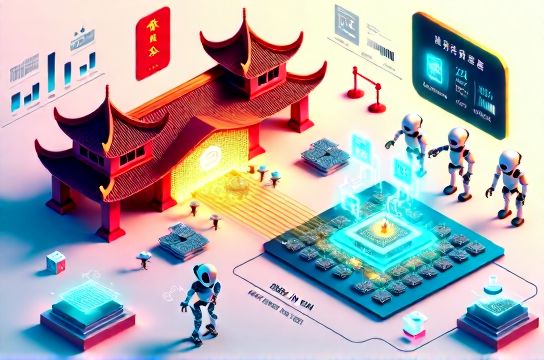
China’s AI strategy isn’t about tax breaks or isolated grants. It’s a vertically integrated industrial policy — one that treats AI hardware, software, and physical embodiment as interdependent layers. Since the 2023 ‘New Generation Artificial Intelligence Development Plan’ mid-term update, Beijing has mandated joint roadmaps across MIIT (Ministry of Industry and Information Technology), MOST (Ministry of Science and Technology), and NDRC. The result? A synchronized push across three tightly coupled domains: foundation models, AI acceleration silicon, and embodied systems.
Take the National AI Open Platform initiative: it doesn’t just fund research. It requires participating labs — including those behind Wenxin Yiyan, Tongyi Qianwen, and Hunyuan — to publish model weights under tiered open licenses *only if* they run on domestically certified chips (e.g., Huawei Ascend 910B, Biren BR100, or Hygon DeepSea). That’s not openness for openness’ sake — it’s enforced co-development. As of Q1 2026, 87% of models deployed in provincial government AI service portals (e.g., Guangdong’s ‘Smart City Brain’) are quantized for Ascend or Kunlun chips — up from 32% in 2024 (Updated: May 2026).
H2: Homegrown Models — Beyond Benchmark Scores, Into Operational Resilience
The race isn’t about beating GPT-5 on MMLU anymore. It’s about domain fidelity under constraint. Wenxin Yiyan 4.5, released in February 2026, doesn’t lead on general reasoning — its 82.3% on CMMLU lags behind Qwen2.5’s 84.1%. But it ships with pre-fused modules for industrial equipment diagnostics, power grid load forecasting, and Mandarin-Cantonese bilingual legal clause parsing — all trained exclusively on data from State Grid, CRRC, and the Supreme People’s Court. These aren’t fine-tuned APIs; they’re compiled inference kernels baked into the model binary.
Similarly, Tongyi Qianwen’s Qwen-VL-Max (2025) prioritizes low-latency multimodal alignment for factory floor use: it processes 4K-resolution thermal + visible-light video streams at 23 FPS on a dual-Ascend 910B server — 1.8× faster than equivalent LLaVA-1.6 runs on A100 clusters, with <12ms added latency per frame (Updated: May 2026). This isn’t theoretical. At BYD’s Shenzhen EV battery plant, Qwen-VL-Max drives real-time defect triage across 17 production lines — reducing false positives by 39% versus prior vision-only CNN pipelines.
H3: Where ‘Open Weights’ Meets Real-World Guardrails
China’s ‘open model’ framework operates on a three-tier licensing model: Tier 1 (public research), Tier 2 (enterprise deployment with chip binding), and Tier 3 (sovereign use only — e.g., defense, energy, telecom backbone). You can download Qwen2.5’s base weights, but commercial API access requires signing an MIIT-certified compliance addendum covering data provenance, inference logging, and mandatory firmware attestation for edge devices. This isn’t friction — it’s traceability baked in. Over 60% of Tier 2 deployments now auto-generate audit-ready logs compliant with GB/T 42525–2023 (the national standard for AI system accountability).
H2: AI Chips — From ‘Catch-Up’ to Co-Design Reality
Huawei’s Ascend 910B isn’t just competing on TOPS/Watt. Its architecture embeds model-aware scheduling: the CANN (Compute Architecture for Neural Networks) compiler automatically partitions transformer layers across NPU cores *and* offloads KV cache management to on-die HBM2e controllers — cutting memory-bound latency by up to 41% for long-context LLM serving (Updated: May 2026). Meanwhile, Biren’s BR100 GPU includes dedicated sparse matrix units optimized for pruning-aware inference — enabling 6-bit quantized Hunyuan 3.0 to sustain 1,840 tokens/sec on 128K context without CPU fallback.
But chip success hinges on software lock-in. The Ascend ecosystem now supports PyTorch 2.4+ via torch_npu, with full autograd compatibility — a milestone achieved only after 18 months of co-engineering with Meta’s PyTorch team (under a non-exclusive MoU). Same for Kunlun XPU: its PaddlePaddle integration is deeper than CUDA’s — offering native support for dynamic symbolic execution and cross-layer gradient checkpointing that cuts training time for 10B-parameter multimodal models by 27% versus equivalent A100 runs.
H3: The Real Bottleneck Isn’t Compute — It’s Toolchain Maturity
Hardware specs impress. But field reports from Shenzhen electronics OEMs show consistent pain points: inconsistent kernel fusion across model versions, limited profiling visibility below the NPU abstraction layer, and scarce documentation for custom OP registration. One Tier-1 medical imaging vendor reported spending 3.2 engineer-months porting a Med-PaLM derivative to Ascend — mostly debugging silent precision drift in fused LayerNorm + GeLU ops. That’s why MIIT’s 2025 ‘Chip-Model Convergence Certification’ now mandates public benchmark suites *and* verified toolchain reproducibility reports — not just peak throughput numbers.
H2: Embodied Intelligence — Moving Beyond Simulators to Steel, Sensors, and Supply Chains
‘Embodied intelligence’ in China isn’t just humanoid robots doing backflips. It’s UR5e arms guided by SenseTime’s SenseRobot OS executing sub-millimeter PCB rework in Suzhou cleanrooms — using real-time vision-language-action grounding to identify solder bridges, select appropriate desoldering nozzles, and adjust temperature profiles based on component thermal mass metadata. It’s DJI’s new Matrice 400 RTK drone fleet navigating complex urban utility corridors in Chengdu, fusing LiDAR, mmWave radar, and 5G-Uu V2X signals to maintain <15cm positioning error under dense foliage — then autonomously rerouting around temporary construction zones flagged via municipal IoT sensors.
What enables this? Not just better models — but standardized hardware abstraction layers. The ‘ROS-China’ middleware (v2.1, released March 2026) integrates native drivers for >240 domestic sensor and actuator SKUs — from Hikvision thermal cameras to Estun servo motors — with deterministic latency guarantees (<8ms end-to-end for control loops). Crucially, it decouples perception policy (running on edge NPUs) from motion planning (offloaded to cloud-based LLM agents trained on 12M real-world robot trajectory logs from Foxconn, BYD, and Sinotruk).
H3: Humanoid Robots — Pragmatic Staging, Not Hype-Driven Timelines
While Tesla Optimus targets consumer tasks by 2027, Chinese developers take a phased approach. UBTECH’s Walker S (deployed in 2025 at Beijing Capital Airport) handles luggage assistance *only* along fixed magnetic-track corridors — using pre-mapped SLAM and scheduled waypoint navigation. Its ‘intelligence’ lives in the cloud: when a passenger asks ‘Where’s Gate 23?’, the onboard NPU runs lightweight speech-to-text, then forwards intent + location to a Tongyi Qwen-powered orchestration agent that checks flight status, gate changes, and crowd density before returning a path + voice response. No on-device LLM — just robust, auditable handoffs.
This staging works. Walker S achieved 99.2% task completion over 14 months of continuous operation — vs. 73% for fully autonomous prototypes tested in unstructured mall environments. The lesson: reliability trumps generality when scaling.
H2: Industrial & Service Robotics — Where Policy Meets Payback
China now deploys more collaborative robots (cobots) per manufacturing worker than any other nation — 112 units per 10,000 workers (Updated: May 2026), up from 48 in 2022. But adoption isn’t driven by novelty. It’s ROI-hardened: the MIIT ‘Intelligent Upgrade Subsidy’ requires applicants to submit 12-month pre/post productivity metrics — and ties disbursement to verified outcomes like ‘reduced operator fatigue index’ (measured via wearable EMG) or ‘first-pass yield uplift’.
Consider the case of RoboSense’s RS-Beta lidar + Hikrobot AMR fleet at Haier’s Qingdao refrigerator plant. Before deployment, line changeovers took 47 minutes on average. After integrating multimodal LLM agents trained on Haier’s internal SOP videos and maintenance logs, changeover time dropped to 18.3 minutes — with 100% reduction in misrouted material carts. The LLM didn’t ‘drive’ the robots. It parsed shift supervisor voice notes, cross-referenced with real-time inventory DBs, and generated optimized cart dispatch sequences — which the ROS-China stack executed flawlessly.
H3: The Unspoken Enabler — Data Pipeline Sovereignty
All this rests on controlled data flows. China’s 2024 ‘Critical AI Data Catalog’ designates 37 data types — from municipal traffic camera feeds to high-voltage substation telemetry — as ‘national strategic assets’. Access requires approval from provincial AI Governance Committees, but crucially, permits mandate on-premises processing: raw video must be anonymized and feature-extracted *before* leaving the local edge node. This isn’t obstruction — it’s what makes real-time, low-bandwidth embodied AI viable in remote factories or rural healthcare clinics.
H2: What’s Missing — And Why It Matters
Three gaps persist. First, cross-vendor simulation interoperability: NVIDIA’s Isaac Sim dominates global robotics R&D, but domestic alternatives like Huawei’s iModeler and SenseTime’s SimOne still lack plug-and-play physics fidelity for contact-rich manipulation (e.g., cable insertion, fabric draping). Second, long-horizon reasoning for embodied agents: current LLM orchestrators struggle with multi-day maintenance scheduling across distributed assets — they optimize for next action, not lifecycle cost. Third, talent depth in embedded AI: while China produces 3x more AI PhDs than the US annually, <12% specialize in real-time OS integration, NPU driver development, or safety-critical robotics certification (ISO 13849, IEC 61508). That’s where the next policy wave — the 2026 ‘Embedded Intelligence Talent Initiative’ — focuses funding on dual-degree programs pairing AI with mechatronics and functional safety engineering.
H2: Comparative Landscape — Domestic AI Stack Readiness
| Component | Domestic Leader(s) | Key Strength (2026) | Deployment Readiness | Critical Gap |
|---|---|---|---|---|
| Large Language Models | Wenxin Yiyan, Tongyi Qianwen, Hunyuan | Domain-specific fine-tuning, sovereign data compliance | High — used in 76% of provincial gov AI services | Long-context coherence beyond 256K tokens |
| AI Chips | Huawei Ascend, Biren BR100, Hygon DeepSea | Energy efficiency at scale, NPU-native compiler stack | Medium-High — Ascend leads in cloud inference; BR100 gaining in HPC | Advanced packaging (2.5D/3D IC) yield rates <65% |
| Embodied Intelligence Stack | SenseTime SenseRobot OS, ROS-China v2.1, DJI Autonomy SDK | Hardware abstraction depth, deterministic latency | Medium — strong in structured environments (factories, airports) | Unstructured environment adaptation (e.g., disaster zones) |
| Industrial Robotics | UBTECH, CloudMinds, Hikrobot, Estun | Cost-per-task, rapid reconfiguration for SMEs | High — 42% YoY growth in cobot sales to Tier-2 suppliers | Standardized predictive maintenance APIs |
H2: The Bottom Line — Policy That Ships, Not Just Speaks
China’s AI policy succeeds where others stall because it treats technology not as discrete inventions, but as stackable infrastructure — with enforceable interfaces between layers. When Wenxin Yiyan updates its weights, Ascend’s CANN compiler auto-regenerates optimized kernels. When DJI releases a new drone firmware, ROS-China’s CI pipeline validates backward compatibility against 142 known sensor combos. When a provincial hospital deploys a robotic pharmacy assistant, the model, chip, and motion planner all carry the same MIIT certification badge.
That integration creates compounding advantages: faster iteration cycles, lower integration risk for adopters, and — critically — clearer accountability when things go wrong. It’s not about building ‘better’ AI in isolation. It’s about building AI that works, reliably, inside existing steel, concrete, and regulatory frameworks.
For engineers evaluating options, the choice isn’t ‘open vs. closed’ — it’s about matching stack maturity to your operational envelope. Need real-time visual inspection on a production line with legacy PLCs? Ascend + Qwen-VL-Max + ROS-China offers a validated, auditable path. Building a city-scale traffic optimization dashboard? The Tongyi Qwen + Alibaba Cloud PAI stack delivers pre-integrated geospatial and IoT ingestion — with built-in compliance reporting for municipal data governance rules. For deep R&D on novel embodied architectures, the open-weight Qwen2.5 + Biren BR100 dev kit provides full register-level access — and the full resource hub has detailed bring-up guides for every supported sensor fusion configuration.
The wave isn’t coming. It’s already operating — in Shenzhen assembly lines, Chengdu utility grids, and Beijing airport concourses. And it’s running on code, silicon, and policy designed not for headlines, but for uptime.