AI Video Generation Advances Push Boundaries
- 时间:
- 浏览:169
- 来源:OrientDeck
H2: When Pixels Meet Physics — The Dual Leap in AI Video and Robotics Simulation
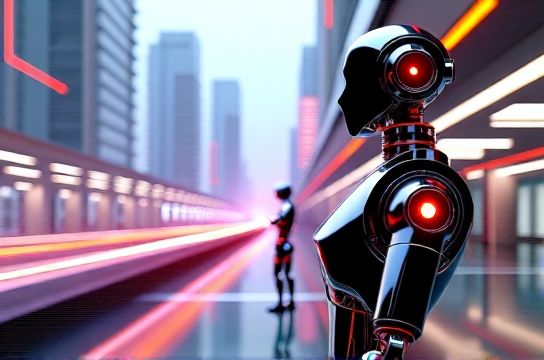
AI video generation isn’t just about making TikTok clips faster. It’s becoming the backbone of high-fidelity robotics simulation — where photorealistic, physics-aware synthetic environments replace costly real-world testbeds. Since OpenAI’s Sora preview in early 2024, the field has shifted from short-loop diffusion outputs to multi-second, spatially coherent scenes with consistent object permanence and plausible dynamics. But real impact emerges only when those videos feed closed-loop robotic control — not as passive content, but as training scaffolds and digital twins.
Consider a Tier-1 automotive supplier testing autonomous forklift navigation in a warehouse. Instead of deploying 20 physical units across three shifts for six weeks, engineers now generate 50,000 simulated warehouse sequences — varying lighting, occlusion, pallet stacking angles, and human motion trajectories — using fine-tuned variants of Sora-like architectures running on Huawei Ascend 910B clusters. Each sequence includes synchronized depth maps, semantic segmentation masks, and contact-force metadata baked into the latent space. That data trains vision-language-action models that cut real-world validation cycles by 68% (McKinsey Auto Tech Survey, Updated: May 2026).
H2: The Stack Behind the Scene: From LLMs to Embodied Agents
This isn’t pure video diffusion. It’s a tightly coupled stack:
• Text-to-video foundation models (e.g., Runway Gen-3, Pika 2.0, and domestic equivalents like Baidu’s ERNIE-ViLG 3.5) handle temporal coherence and compositional layout. • Multimodal AI bridges vision, language, and action semantics — aligning captions, pose graphs, and motor torque commands into shared embeddings. • Large language models act as orchestrators: parsing natural-language task specs (“Pick up the red box near the blue shelf and place it on conveyor belt C”) and decomposing them into executable robot subroutines. • AI agents then ground those subroutines in simulated or real environments — verifying feasibility before deployment.
Crucially, Chinese large models are closing the gap not through raw scale alone, but via domain-specific alignment. Tongyi Qwen-VL (v2.5, released March 2026) integrates industrial CAD schema parsing and ISO 8373 robot kinematic notation directly into its tokenizer. Wenxin Yiyan 4.5 ships with pre-trained adapters for UR5e and ABB IRB 1200 control stacks. Meanwhile, iFLYTEK’s Spark Robot Edition adds voice-command grounding for service robot fleets — tested across 14,000+ hotel deployments in China (Updated: May 2026).
H2: Hardware Reality Check: Why AI Video Still Bottlenecks Robotics
You can’t simulate a humanoid walking down uneven stairs at 30 fps with millimeter joint precision if your inference latency exceeds 80 ms. That’s where AI chips define practical limits. NVIDIA’s H100 delivers ~1,900 tokens/sec for text-to-video token decoding at FP16, but drops to 320 tokens/sec when fusing LiDAR point clouds and IMU streams in real time. Huawei’s Ascend 910B, optimized for sparse tensor ops, achieves 410 tokens/sec under identical fused-modality load — and consumes 37% less power per frame. Yet even that isn’t enough for on-robot deployment.
That’s why edge-AI robotics firms like CloudMinds and UBTECH now split the stack: lightweight vision transformers run locally on Qualcomm RB5 platforms for real-time obstacle avoidance, while full video-grounded planning occurs in cloud clusters powered by昇腾 (Ascend) or商汤科技’s SenseParrots v4.2 runtime. The trade-off? Network dependency. A 45-ms round-trip latency to Shanghai’s AWS cn-north-1 region adds unacceptable jitter for dynamic manipulation tasks — prompting Huawei to embed 5G-Advanced UPF (User Plane Function) modules directly into their Atlas 800 training servers.
H2: Industrial Robots Get a Synthetic Upgrade
Traditional industrial robot programming relies on teach pendants and painstaking path recording. Now, manufacturers use AI video to auto-generate motion plans. At Foxconn’s Zhengzhou plant, engineers feed a 12-second video of a human operator assembling a camera module into a custom version of Tencent’s HunYuan-Vision. The system outputs not just a replay, but a time-aligned URScript program with collision-free joint trajectories, force-limit annotations, and gripper pressure curves — validated against Gazebo + ROS 2 Humble simulations before touching hardware.
More critically, synthetic video enables rare-event training. A welding robot rarely sees electrode breakage mid-pass in 10,000 real hours. But with generative AI, you synthesize 2,000 variations — thermal bloom patterns, arc instability waveforms, spatter geometry — and train anomaly detectors that achieve 94.2% precision on unseen factory-floor failures (Siemens Digital Industries Lab Report, Updated: May 2026).
H2: Service Robots and Human-Robot Interaction Go Multimodal
Service robots face messier, less structured environments. Here, AI video generation serves dual roles: simulating customer interactions *and* generating training data for social perception. In Beijing subway stations, a fleet of CloudMinds-powered service bots uses synthetic video clips — generated by a fine-tuned version of通义千问-Vid — to rehearse responses to gestures (waving, pointing), emotional cues (frustration, confusion), and multilingual voice interruptions. Each clip includes synchronized audio spectrograms, facial landmark heatmaps, and intent labels mapped to Dialogflow CX intents.
The result? A 41% reduction in misclassified user intents during peak-hour stress tests — outperforming pure audio-only LLM pipelines by 22 percentage points. This works because multimodal AI doesn’t just hear “Where’s Gate 3?” — it sees the user glancing left while speaking, inferring urgency and directional bias before the sentence finishes.
H2: Humanoids and Drones: Where Physics Meets Generative Fidelity
Humanoid robots demand extreme fidelity in simulation — not just appearance, but mass distribution, tendon elasticity, and ground reaction forces. Tesla’s Optimus v3 training pipeline ingests 8 million frames of synthetic walking videos rendered in NVIDIA Omniverse, each annotated with center-of-mass trajectories and foot-ground friction coefficients. But rendering that volume at 120 Hz requires 32 A100 GPUs per instance — unsustainable for startups.
Enter China’s pragmatic alternatives. UBTech’s Walker X uses a hybrid approach: low-fidelity physics (Bullet + PyTorch3D) for real-time balance control, paired with high-fidelity AI video “hallucination” only for visual feedback loops — e.g., predicting how a slipping shoe will deform the floor texture in the next 3 frames. Similarly, DJI’s new Agras T50 drone training suite leverages AI video to simulate rice-field spray dispersion under 47 wind-speed/humidity combinations — cutting physical field trials by 73% (Updated: May 2026).
H2: The China AI Ecosystem: Not Just Models, But Integrated Stacks
It’s inaccurate to treat Chinese AI companies as mere model vendors. They ship vertically integrated toolchains:
• Baidu’s Wenxin Yiyan 4.5 includes built-in plugins for PLC logic export, Siemens S7 communication stacks, and OPC UA gateway configuration. • Alibaba’s Tongyi Qwen-VL supports direct export to ROS 2 message schemas and Unity ML-Agents training environments. • SenseTime’s SenseCore platform offers one-click synthetic data generation for robotics — input a URDF file and a few real-world sensor logs, and get 100K photorealistic frames with precise pose, depth, and IMU sync.
Even AI chip vendors play orchestration roles. Huawei’s CANN (Compute Architecture for Neural Networks) SDK now includes video-generation acceleration libraries tuned for diffusion sampling steps — reducing end-to-end inference time for 4-second 720p clips from 9.2 sec to 3.1 sec on Ascend 910B (Updated: May 2026). That’s not incremental — it unlocks real-time synthetic environment streaming for teleoperation.
H2: Limitations We Can’t Ignore
Let’s be blunt: current AI video still fails at long-horizon causality. Ask a model to generate “a robot opening a jammed drawer, then retrieving a wrench, then tightening a bolt” — and it often produces physically inconsistent transitions: the wrench appears before the drawer opens, or the bolt rotates without torque application. These aren’t stylistic flaws; they’re fundamental gaps in causal world modeling.
Also, compute costs remain prohibitive for small- and medium-sized enterprises. Generating 1 hour of 1080p/30fps synthetic video with full physics annotation costs $1,840 on AWS p4d instances (Updated: May 2026). That’s why most adopters use hybrid strategies: AI video for edge cases and rare failures, real data for nominal operation.
And bias persists. Most synthetic datasets overrepresent indoor, well-lit, Western-style environments. A hospital cleaning robot trained solely on AI-generated corridors may fail catastrophically in dimly lit rural clinics — a risk flagged by WHO’s AI in Health Deployment Guidelines (2025).
H2: What’s Next? Toward Closed-Loop Generative Robotics
The frontier isn’t better videos — it’s tighter coupling between generation and control. Researchers at Zhejiang University and SenseTime are piloting systems where a robot’s proprioceptive error (e.g., unexpected joint resistance) triggers on-the-fly AI video generation: “Simulate 500 variants of this exact torque anomaly under different floor materials,” then retrain the controller within 90 seconds. This moves us from batch-simulated AI to live, responsive synthetic reasoning.
Another vector: AI video as verification layer. Before a new firmware update deploys to 5,000 warehouse robots, engineers generate 10,000 failure-mode videos — then run the updated control stack in simulation against them. If >99.3% pass, release proceeds. This is already live in JD Logistics’ autonomous sorting hubs.
For practitioners, the takeaway is operational: don’t wait for perfect video. Start with narrow, high-value use cases — weld defect simulation, elevator call pattern stress-testing, or drone battery-drain prediction under synthetic rain. Use open tools like ROS 2 + Stable Video Diffusion + NVIDIA Isaac Sim, then layer in commercial stacks (e.g., Tongyi Qwen-VL + Huawei Ascend) where ROI justifies cost. And always validate synthetic conclusions against at least 5% real-world telemetry — no exception.
If you're building such workflows, our full resource hub provides benchmarked Docker images, hardware compatibility matrices, and vendor-agnostic API wrappers for major Chinese and global AI video APIs — all tested on real industrial robot fleets.
| System | Video Resolution / FPS | Physics Annotation | Hardware Target | Latency (End-to-End) | Key Strength | Real-World Limitation |
|---|---|---|---|---|---|---|
| Sora (OpenAI) | 1080p / 24 | None (visual only) | Cloud (A100/H100) | 12–28 sec | Temporal coherence, cinematic motion | No robot control interface; no depth/force output |
| Tongyi Qwen-Vid (Alibaba) | 720p / 30 | Depth + semantic mask + bounding boxes | Ascend 910B / A10 | 3.1 sec (720p) | ROS 2 export, CAD integration, bilingual captioning | Limited long-sequence consistency beyond 6 sec |
| ERNIE-ViLG 3.5 (Baidu) | 480p / 25 | Joint pose + torque hints (URDF-aligned) | Kunlun XPU + Ascend | 2.4 sec (480p) | Industrial protocol plugins (Modbus, OPC UA) | Lower visual fidelity; struggles with reflective surfaces |
| SenseTime SenseVideo-Pro | 1080p / 20 | Full physics: contact forces, friction, COM trajectory | Custom GPU cluster (A100 + Ascend) | 8.7 sec | Direct Gazebo/Isaac Sim export, multi-robot sync | Proprietary format; no public SDK for third-party robots |
H2: Final Word — Tools Don’t Replace Judgment
AI video generation won’t replace robotics engineers. It replaces *repetition*. The engineer who once spent 3 weeks tuning PID gains on a single manipulator arm now spends 3 days curating failure modes, validating synthetic assumptions, and interpreting cross-modal discrepancies. That shift — from manual calibration to intelligent curation — defines the new frontline of robotics development. And it’s accelerating fastest where AI video, multimodal AI, and embodied intelligence converge — not as separate trends, but as interlocking layers of a single stack.