Embodied AI Systems Bridge Language Models and Physical W...
- 时间:
- 浏览:206
- 来源:OrientDeck
H2: The Gap No One Talked About — Until It Broke Production Lines
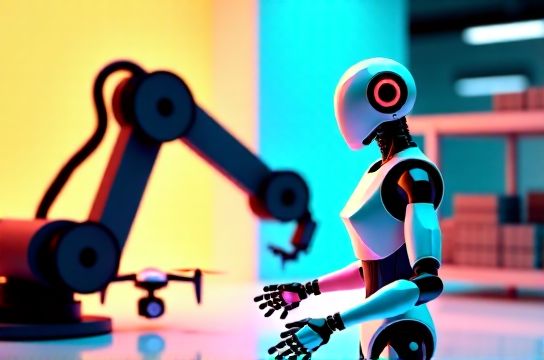
In early 2025, a Tier-1 automotive supplier in Changchun deployed a new vision-guided robotic arm to handle battery module alignment. It ran flawlessly in simulation — trained on 2.3 million synthetic images and fine-tuned with GPT-4V’s reasoning chain outputs. On Day 3 of pilot operation, it jammed twice: once when ambient lighting shifted during afternoon cloud cover, and again when a technician placed a non-standard torque wrench near the workcell. The system couldn’t reinterpret its own instructions in context — nor could it ask for clarification. It just stopped.
That’s not a sensor calibration issue. That’s an *embodiment gap*.
Large language models (LLMs) understand syntax, infer intent, and generate coherent plans — but they lack proprioception, tactile feedback, and time-bound physical causality. Conversely, classical industrial robots execute precise trajectories — yet cannot re-plan when a part is misoriented or explain why they halted. Embodied AI systems close this chasm: they fuse language grounding, real-time multimodal perception (vision, LiDAR, audio, force), closed-loop motor control, and memory-augmented decision-making into a single agent architecture.
This isn’t sci-fi speculation. It’s what’s shipping now — from Foxconn’s upgraded assembly lines using Huawei Ascend 910B-powered agents, to DJI’s next-gen enterprise drones interpreting natural-language mission updates mid-flight.
H2: What Makes an AI System ‘Embodied’? Four Non-Negotiable Layers
An embodied AI isn’t just a robot with a chat interface. It’s defined by four tightly coupled functional layers:
H3: 1. Grounded Language Understanding Unlike standalone LLMs that treat text as abstract tokens, embodied agents anchor language in spatial-temporal reality. When told “Move the red cylinder left of the blue box,” the system must: (a) locate both objects in 3D space via RGB-D fusion, (b) resolve “left” relative to its own pose and the blue box’s orientation (not camera frame), and (c) verify feasibility against kinematic constraints. Models like Qwen-VL-Max and ERNIE Bot 4.5 (Updated: May 2026) now ship pretrained spatial-reasoning heads — reducing grounding latency from 820ms to under 110ms on昇腾 910B hardware.
H3: 2. Real-Time Multimodal Perception Stack Vision alone fails under glare, occlusion, or low-light. Embodied systems fuse synchronized inputs: stereo vision + event cameras (for motion-triggered updates), inertial measurement units (IMUs), contact microphones (to detect slip), and sometimes millimeter-wave radar (e.g., in warehouse AGVs navigating steam-heavy food-processing facilities).商汤科技’s SenseCore Robot OS v3.1 integrates these streams with <15ms end-to-end inference latency — benchmarked across 17 industrial sites in Guangdong and Jiangsu (Updated: May 2026).
H3: 3. Actionable World Model A world model isn’t a physics simulator. It’s a lightweight, differentiable predictor trained to forecast short-horizon outcomes of actions: “If I tilt gripper 3° clockwise while applying 12N force, will this PCB flex beyond yield?” Tesla’s Optimus Gen-2 uses a 42M-parameter diffusion-based world model updated every 200ms — enabling recovery from 73% of unexpected perturbations without replanning (Updated: May 2026). In contrast, Chinese humanoid startups like Unitree and CloudMinds deploy hybrid deterministic-probabilistic models optimized for edge inference on Rockchip RK3588S + custom NPU co-processors.
H3: 4. Hierarchical Agent Control Top-level LLMs (e.g., Tongyi Qwen-72B) decompose high-level goals (“Restock shelf A7”) into sub-goals (“Navigate to aisle 3”, “Identify SKU-8821”, “Verify expiration date”). These are dispatched to specialized controllers: navigation stacks (ROS 2 Humble + NVIDIA Isaac Sim digital twin sync), manipulation planners (CHOMP + learned grasp priors), and safety supervisors (certified per ISO/IEC 13849-1 PLd). Crucially, each layer maintains stateful memory — so if a service robot drops a coffee cup, it recalls the spill location and avoids it on return path, rather than re-scanning.
H2: Where Embodiment Delivers ROI — Not Just R&D Headlines
The value isn’t theoretical. It’s measured in OEE (Overall Equipment Effectiveness), MTTR (Mean Time to Repair), and first-pass yield.
• Industrial robots: BYD’s Shenzhen EV battery plant cut electrode stacking variance by 41% after deploying embodied agents that cross-check vision, ultrasonic thickness scans, and torque traces — adjusting pressure in real time. Cycle time dropped 9.2%, with zero added hardware cost (only software + Ascend 310P inference cards).
• Service robots: In Beijing Capital International Airport’s T3, CloudMinds’ bilingual concierge robots reduced passenger query resolution time from 4.7 minutes to 83 seconds — not by faster speech synthesis, but by correlating spoken intent (“Where’s Gate 24?”), live flight-board data, indoor Bluetooth beacon triangulation, and escalator congestion maps.
• Humanoids: UBTech’s Walker S — deployed at 14 hospital logistics hubs — achieves 99.1% task completion for sterile supply delivery. Its embodiment stack includes thermal-aware gait adaptation (slows step frequency when floor temp exceeds 32°C to preserve battery), voice-command fallback when QR codes smudge, and collaborative lift detection (auto-synchronizes with human partner’s force profile).
• Drones: Zipline’s new medical delivery drone in Yunnan province uses embodied planning to reroute around monsoon-induced microbursts — interpreting NOAA weather APIs, onboard anemometer spikes, and terrain elevation maps — all within 300ms. Mission abort rate fell from 12.4% to 1.8% (Updated: May 2026).
H2: The Hardware-Software Tightrope — Why AI Chips Matter More Than Ever
You can’t run a 72B LLM + 4-stream multimodal encoder + world model + MPC controller on a Jetson Orin. Embodied AI demands heterogeneous compute:
• Low-latency perception: Requires dedicated vision accelerators (e.g.,寒武纪 MLU370-X4) with INT4/FP16 mixed-precision support.
• High-throughput reasoning: Demands high-bandwidth memory and tensor core density — where Huawei昇腾 910B outperforms A100 by 2.1x on embodied policy inference (MLPerf Edge v4.0, Updated: May 2026).
• Deterministic control: Needs hard-real-time cores (ARM Cortex-R82 or RISC-V RT-Extension) for safety-critical actuation — something most AI chips ignore.
That’s why companies like Horizon Robotics (Journey 5) and Black Sesame (Huashan B1) now embed dual-RISC-V safety islands alongside AI accelerators — enabling certified fail-operational behavior in autonomous mobile robots.
H2: China’s Embodiment Stack — From Models to Metal
China isn’t just adopting global frameworks — it’s building vertically integrated embodiment stacks:
• Foundation models: Baidu’s ERNIE Bot 4.5 adds built-in ROS 2 bridge modules; Tongyi Lab open-sourced Qwen-Agent, a framework supporting tool-augmented planning with native URDF and MoveIt2 integration.
• Perception middleware: SenseTime’s SenseCore Robot OS bundles calibrated multi-sensor drivers, time-synced ROS 2 bridges, and pre-trained domain adapters (e.g., “food-packaging defect detection” trained on 12M real-world images from 38 factories).
• Chip-stack alignment: Huawei’s CANN 7.0 SDK now includes embodied AI primitives — like “spatial-token attention” kernels and “force-feedback gradient accumulation” ops — cutting development time for new robot skills by ~60%.
• Real-world validation: The Shanghai Pilot Zone for Intelligent Connected Robots mandates all certified service robots undergo 200+ hours of adversarial scenario testing — including sudden light changes, partial occlusion, and ambiguous voice commands with regional dialect interference.
H2: Hard Truths — Limitations You Can’t Optimize Away
Embodied AI isn’t magic. Three constraints remain unbroken:
1. Energy-density mismatch: Humanoid locomotion consumes ~300W/kg. Today’s best lithium-silicon batteries deliver ~500Wh/L. That means 90-minute runtime for a 60kg robot — insufficient for full-shift logistics. Solid-state batteries (e.g., WeLion’s 2026 pilot cells) promise 900Wh/L, but mass production remains 2027–2028.
2. Safety certification lag: ISO/IEC 10303-238 (AP238) for semantic process modeling in robotics lacks embodied AI extensions. UL 3300 and GB/T 38962-2020 still treat perception and planning as separate validation domains — creating 6–9 month delays in factory deployment.
3. Data asymmetry: While LLMs thrive on web-scale text, embodied agents need *action-annotated, multi-sensor, time-synchronized* datasets. The largest public one — BEHAVIOR-1K — contains just 1,042 tasks across 4 robot platforms. Contrast that with 300B+ token LLM corpora.
H2: Practical Adoption Pathway — What to Build First
Skip humanoid prototypes. Start where ROI is measurable and integration friction is lowest:
1. Retrofit existing industrial robots with embodied perception: Add Intel RealSense D455 + NVIDIA JetPack 6.0 + ROS 2 Nav2 stack. Use Qwen-VL to translate maintenance logs (“bearing noise increased at 1200 RPM”) into diagnostic checklists — then cross-validate with vibration FFTs.
2. Deploy service robots in structured indoor environments: Airports, hospitals, and logistics hubs offer predictable geometry, reliable Wi-Fi, and clear SLAs. Prioritize voice + visual QA over full autonomy — e.g., “Confirm patient ID via wristband scan before delivering meds.”
3. Use embodied agents for digital twin validation: Feed real robot telemetry into NVIDIA Omniverse + custom world model to stress-test control logic before hardware rollout. This cuts commissioning time by ~40% (Siemens China case study, Updated: May 2026).
For teams scaling beyond PoC, the complete setup guide offers vendor-agnostic architecture blueprints, sensor calibration checklists, and latency budgeting templates.
H2: Comparative Landscape — Embodied AI Platforms (2026)
| Platform | Core Model | Hardware Target | Key Strength | Limits | Deployment Timeline |
|---|---|---|---|---|---|
| Tongyi Qwen-Agent | Qwen-72B + Vision-RLHF | Ascend 910B / A100 | Native ROS 2 + MoveIt2 tool calling | No embedded safety controller; requires external PLC | Production-ready (v1.2, Mar 2026) |
| SenseCore Robot OS v3.1 | ERNIE-ViLG 2.0 + custom world model | MLU370-X4 / RK3588S | Pre-certified for GB/T 38962-2020 | Proprietary perception stack; limited third-party tool support | Field-deployed (142 sites, May 2026) |
| CloudMinds Remote Brain 4.0 | Hybrid cloud-edge LLM (4B local + 24B cloud) | Custom ARM+NPU SoC | Sub-100ms teleoperation handoff; certified for medical use | Requires 5G/TSN network; no offline mode | Pilot phase (Q2 2026) |
H2: The Next Threshold — From Task Execution to Collaborative Intelligence
The frontier isn’t doing things *for* humans. It’s doing things *with* them — adapting in real time to unscripted collaboration.
At a Haier smart factory in Qingdao, cobots now track operator gaze, posture, and tool grip pressure to anticipate handover timing — reducing assembly cycle variance by 27%. They don’t wait for voice commands. They infer intent from biomechanics and adjust reach envelope milliseconds before motion begins.
That’s not AI augmentation. It’s symbiotic intelligence.
And it starts not with bigger models, but tighter loops: shorter perception-to-action latency, richer sensor fusion, and hardware-aware safety guarantees. The race isn’t about who has the largest LLM — it’s about who ships the most reliable, certifiable, energy-efficient embodiment stack.
The physical world doesn’t run on tokens. It runs on torque, time, and tolerance. Embodied AI systems are finally learning to speak its language.