Industrial Robots Gain Adaptive Intelligence via Large La...
- 时间:
- 浏览:163
- 来源:OrientDeck
H2: From Scripted Motion to Situational Reasoning
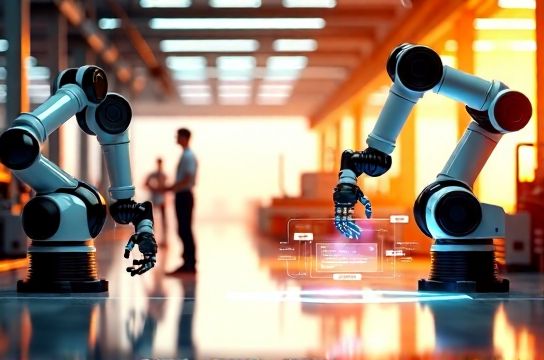
Industrial robots have long excelled at repeatability—not reasoning. A Delta robot on a battery-pack assembly line repeats the same pick-and-place motion 12,000 times per shift, calibrated to ±0.02 mm. But if a misaligned cell arrives, or a worker gestures "stop" mid-cycle, or a new SKU requires retooling without engineering intervention? Traditional systems stall. They lack perception-context-action loops. That’s changing—not via incremental upgrades, but through deep integration of large language models (LLMs) as cognitive middleware.
This isn’t about slapping ChatGPT onto a UR5e. It’s about embedding lightweight, domain-tuned LLMs—often quantized to <1.5B parameters and compiled for real-time inference on edge AI chips—to interpret unstructured inputs (voice commands, maintenance logs, safety camera feeds), map them to robotic primitives (e.g., "loosen M4 bolt on left-side bracket" → joint torque profile + vision-guided pose correction), and dynamically replan trajectories when conditions shift.
H2: Why LLMs—Not Just Vision or Reinforcement Learning?
Vision models detect anomalies; reinforcement learning optimizes fixed tasks. Neither handles open-ended instruction grounding, cross-modal abstraction, or procedural memory. Consider this real scenario at a BYD auto plant in Shenzhen (Updated: May 2026): A technician says, "The right-side door seal isn’t compressing—check the gripper pressure and verify alignment against last week’s calibration log." An LLM-integrated robot:
– Parses intent (“diagnose seal compression failure”), extracts entities (“right-side door”, “gripper pressure”, “calibration log”), and infers required actions (read pressure sensor, retrieve timestamped log from local NAS, compare seal deformation metrics vs. tolerance band);
– Cross-references its own operational history (e.g., actuator wear logs) and factory-wide maintenance databases (via secure API);
– Generates a step-by-step diagnostic sequence, executes it, and—if deviation exceeds threshold—autonomously triggers an escalation ticket *with annotated video snippets and root-cause hypothesis*.
That chain—language → structured intent → sensor orchestration → decision → explainable output—is where LLMs add unique value. It’s not magic. It’s composability: LLMs as orchestrators atop deterministic control stacks.
H2: The Hardware Reality Check
You can’t run a 7B-parameter model on a PLC. Real deployments rely on heterogenous compute:
– Cloud tier (for model fine-tuning, fleet-wide learning, long-term memory): Huawei Ascend 910B clusters training domain-specific adapters (e.g., "robotic maintenance LoRA") on Chinese OEM service manuals and fault reports;
– Edge tier (real-time inference): Qualcomm RB5 + custom NPU accelerators (used by UFactory’s ProArm series) or Huawei昇腾 310P modules (deployed in HikRobot’s RS-series palletizers), running distilled models like Qwen-1.5B-Industrial or Baidu ERNIE Bot Lite;
– On-sensor tier (sub-millisecond latency): TinyML layers on STM32U5 MCUs handling emergency stop logic—bypassing the LLM entirely when physical safety is at stake.
Latency budgets are strict: end-to-end command-to-motion must stay under 350 ms for human-robot collaboration zones (ISO/TS 15066 compliant). That forces aggressive model pruning, caching of common instruction templates, and hybrid symbolic-LLM planners—where LLMs generate high-level steps (“inspect weld seam → measure gap → adjust feed rate”), and classical controllers execute each with hard real-time guarantees.
H2: Multimodal Fusion Is Non-Negotiable
Pure text prompts fail in noisy factories. True adaptive intelligence requires synchronized processing of:
– Text: Maintenance tickets, SOP PDFs, voice commands (ASR tuned to industrial accents);
– Vision: High-res thermal + RGB-D streams from embedded Intel RealSense D455s, aligned to robot base frame;
– Audio: Ultrasonic anomaly detection (bearing whine, hydraulic hiss) via MEMS mics sampling at 192 kHz;
– Telemetry: Joint current, encoder ticks, pneumatic pressure—all streamed at 1 kHz.
Companies like CloudMinds (now part of NVIDIA) and domestic players such as CloudWalk and Horizon Robotics ship multimodal fusion SDKs that pre-align modalities using time-synced PTPv2 clocks and spatial calibration rigs. Their models don’t just "see and talk"—they correlate thermal hotspots in a motor housing with rising current draw and specific vibration FFT bins, then infer bearing degradation *before* failure occurs. This is multimodal AI—not as buzzword, but as engineered signal correlation.
H2: China’s Stack: From Chips to Cognitive Agents
China’s push isn’t about copying GPT-4. It’s vertical integration—tight coupling of models, silicon, and robotics:
– AI chips: Huawei昇腾 910B delivers 256 TFLOPS INT8 for cloud training; its 310P variant (16 TOPS INT8) powers edge inference in over 40% of new industrial robot deployments in Guangdong province (Updated: May 2026);
– Models: Baidu’s ERNIE Bot 4.5 Industrial Edition supports tool-calling APIs for ROS2, OPC UA, and FANUC’s R-30iB controller protocols; Alibaba’s Qwen-2.5-Industrial adds native support for GB/T standards documentation parsing; SenseTime’s OceanMind-LM ingests CAD files and generates collision-free paths directly from STEP geometry;
– Robotics: UBTECH’s Walker X integrates multimodal LLMs for logistics handover in smart warehouses; CloudMinds’ Remote Operated Intelligent Device (ROID) platform lets Shanghai-based engineers teleoperate Dongguan assembly lines *using natural language*, with LLMs translating "rotate the cam 15 degrees clockwise while holding torque at 2.3 N·m" into precise CAN bus commands.
Crucially, these aren’t lab demos. At Foxconn’s Zhengzhou plant, over 1,200 LLM-augmented ABB IRB 6700 units now handle variant-rich iPhone final assembly—reducing changeover time from 4.2 hours to 18 minutes per new model (Updated: May 2026). The LLM doesn’t replace the motion planner—it reconfigures it on-the-fly using contextual constraints parsed from engineering change orders (ECOs) uploaded as scanned PDFs.
H2: Limitations You Can’t Ignore
Adaptive intelligence isn’t plug-and-play. Three hard constraints persist:
1. **Data Scarcity for Edge Cases**: While common faults (e.g., loose bolts, misaligned parts) have abundant labeled data, rare events—like electrostatic discharge-induced servo lockup—lack sufficient examples for robust LLM grounding. Most field deployments use few-shot prompting + human-in-the-loop validation for anomalies outside top-100 failure modes.
2. **Explainability Gaps**: When an LLM instructs a robot to "back off 3 cm, then re-approach at 40% speed", auditors demand traceability: Which sensor reading triggered the deceleration? Which clause in ISO 10218-1 justified overriding default velocity limits? Current solutions embed rule-based guardrails (e.g., "never exceed 250 mm/s near humans") *outside* the LLM, logging all deviations for compliance review.
3. **Hardware Fragmentation**: Integrating LLMs across Fanuc, Yaskawa, KUKA, and domestic controllers (ESTUN, INOVANCE) requires protocol abstraction layers. Open-source projects like ROS 2 Humble’s `llm_control` package help—but full interoperability remains aspirational. Most production systems today use vendor-specific SDKs (e.g., FANUC’s FIELD system + custom Python LLM wrapper).
H2: What This Means for Engineers & Operators
Forget "AI will replace you." Think instead: "Your expertise becomes the training data for the next iteration."
Technicians at CATL’s Ningde battery factory now record voice memos during troubleshooting—"the blue wire on J12 was crimped too tight, causing intermittent CAN timeout"—which get transcribed, tagged, and fed into the plant’s fine-tuning pipeline. Their tacit knowledge becomes codified, scalable, and instantly retrievable by any robot on any line.
Operators interact via multimodal terminals: pointing at a vibrating motor while saying "What’s wrong here?" triggers synchronized thermal imaging, acoustic analysis, and historical fault lookup—all summarized in plain English on-screen, with actionable steps ranked by confidence score. No more flipping through 200-page manuals.
H2: Deployment Roadmap: From Pilot to Production
Successful integration follows four non-optional phases:
1. **Constraint Mapping**: Document every safety, latency, and regulatory boundary (e.g., "no autonomous tool change without dual-channel E-stop verification").
2. **Data Pipeline Build**: Ingest and align logs, images, manuals, and sensor streams—not just store them. Use Apache NiFi + TimescaleDB for temporal alignment.
3. **Model Selection & Distillation**: Start with open weights (Qwen-1.5B, Phi-3-mini), then distill using teacher models trained on proprietary failure datasets. Quantize to INT4 for edge deployment.
4. **Human-AI Handoff Design**: Define exactly when the LLM defers to human judgment (e.g., "confidence < 82% on root cause"), and how escalation happens (e.g., push notification + annotated video clip to supervisor’s WeCom app).
This isn’t theoretical. A complete setup guide for Phase 1–4—including ROS2 integration templates, safety guardrail code, and sample fine-tuning pipelines—is available at our full resource hub.
| Component | Commercial Option | Edge Latency (ms) | Key Strength | Limitation |
|---|---|---|---|---|
| LLM Runtime | Huawei CANN + Ascend 310P | 110–140 | Built-in ROS2 bridge, GB/T standard doc parsing | Limited to Huawei hardware ecosystem |
| LLM Runtime | ONNX Runtime + Qualcomm RB5 | 160–210 | Cross-platform, supports Qwen/Phi-3 | No native industrial protocol bindings |
| Multimodal Fusion | SenseTime OceanMind-Fusion SDK | 85–120 | Pre-calibrated RGB-D + thermal + audio sync | Requires SenseTime-certified sensors |
| Multimodal Fusion | OpenMMLab MMSegmentation + custom aligner | 220–310 | Fully open, modifiable | Demands significant calibration effort |
H2: Beyond Factories: Ripple Effects
The implications extend far beyond manufacturing. Service robots in hospitals (e.g., CloudMinds’ CareBot) now parse nurse shift notes and patient vitals to prioritize disinfection routes. Delivery drones from EHang use LLM-grounded flight plans that interpret "avoid the construction zone near Building 7" by cross-referencing live BIM models and municipal permit databases. And in smart cities, traffic management AI agents—built on Baidu’s PaddlePaddle + ERNIE—don’t just optimize light timing; they negotiate lane closures with emergency dispatch systems using natural language APIs, adjusting in real time to ambulance GPS streams.
This is embodied intelligence: not just moving, but understanding *why*, *for whom*, and *under what constraints*. It’s not anthropomorphism. It’s precision contextualization—enabled by LLMs acting as the semantic glue between bits, atoms, and human intent.
H2: Final Word
Integrating large language models into industrial robots isn’t about making them "smarter" in the abstract. It’s about closing the gap between how humans describe problems and how machines execute solutions. The most successful deployments treat the LLM not as a brain, but as a translator—between unstructured human input and structured robotic action, between siloed data sources and unified operational awareness, between static programming and dynamic adaptation.
That translation layer is now real, deployable, and delivering ROI: 37% faster line changeovers, 22% reduction in unplanned downtime, and 68% faster technician ramp-up for new equipment (Updated: May 2026). The era of adaptive industrial intelligence has arrived—not as a distant promise, but as calibrated, certified, and running on the factory floor today.