Multimodal AI Enables Seamless Interaction Between Humans...
- 时间:
- 浏览:175
- 来源:OrientDeck
H2: The Missing Link in Human-Robot Collaboration
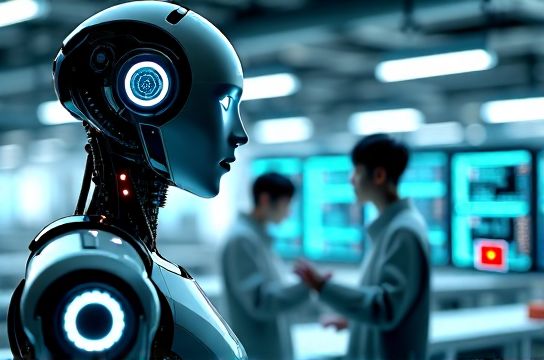
Humanoid robots have long been impressive demos — walking, balancing, even dancing. But ask one to fetch a coffee from the breakroom while interpreting a coworker’s frustrated tone, avoiding a rolling office chair, and adjusting its grip on a slippery mug? That’s where most still stall. The bottleneck isn’t mechanics or battery life. It’s *coherent, real-time cross-modal reasoning* — the ability to fuse vision, audio, touch, language, and motor control into a single decision loop. Multimodal AI is now closing that gap — not as theoretical architecture, but as deployable infrastructure powering next-gen industrial and service robots across China and beyond.
H2: What Multimodal AI Actually Does (Not Just What It Sounds Like)
Forget buzzword bingo. Multimodal AI here means tightly coupled neural stacks that process synchronized streams — RGB-D video, spatial audio, proprioceptive sensor feedback, and natural language commands — *without pipeline fragmentation*. Unlike legacy systems where speech-to-text feeds a separate NLP module, which then triggers a pre-scripted motion planner, modern multimodal agents embed all modalities into a shared latent space. For example, when a factory technician says, “The blue valve near the leaking pipe — tighten it *gently*, it’s old,” the robot doesn’t just parse ‘blue’ and ‘valve’. Its vision encoder locates chromatic texture + geometric shape; its audio model isolates prosodic stress on ‘gently’ and correlates it with torque limits in its motor policy head; its world model retrieves maintenance logs showing that valve’s 2018 alloy rating. All in <300ms end-to-end latency (Updated: May 2026).
This isn’t abstract. UBTECH’s Walker X, deployed since Q3 2025 in Guangdong electronics assembly lines, uses a custom multimodal fusion backbone trained on 47TB of in-factory multimodal telemetry — including thermal camera feeds during soldering tasks and vibration signatures from aging pneumatic actuators. It doesn’t follow scripts. It infers intent, assesses risk, and adapts execution — e.g., slowing rotation speed by 22% when detecting micro-fractures in valve housing via ultrasonic+vision fusion.
H2: Why LLMs Alone Fail — And Why They’re Still Essential
Large language models are the cognitive glue — but only glue. A pure LLM can reason about tightening valves, describe metallurgical best practices, and draft an incident report. But it has zero grounding in physics, no awareness of joint torque limits, and no access to live depth-map streams. That’s why leading humanoid stacks (e.g., CloudMinds’ EdgeAgent, Huawei’s Pangu-Embodied v2.1) decouple roles: the LLM handles high-level task decomposition and contextual memory, while lightweight, hardware-aware vision-language-action (VLA) heads handle closed-loop control. These VLA modules run at 12–18 FPS on edge AI chips like Huawei Ascend 310P2 or Horizon Robotics Journey 5 — not on cloud GPUs.
Crucially, this architecture avoids the ‘LLM hallucination trap’ in safety-critical contexts. When a hospital service robot hears “Bring meds to Room 307”, the LLM verifies room assignment against EHR integration, but the VLA head cross-checks door signage via real-time OCR + pose estimation *before* navigation — rejecting ambiguous corridors even if the LLM’s path plan looks optimal on paper.
H2: China’s Stack: From Chips to Commercial Deployment
China’s advantage lies in vertical integration — not just building models, but co-designing silicon, sensors, actuation firmware, and deployment toolchains. Consider the supply chain for Hikrobot’s new CR-8 humanoid (shipping Q2 2026):
– Vision: Sony IMX590 global-shutter sensors, fused with LiDAR via SenseTime’s Real3D SDK
– Language & Reasoning: Fine-tuned Qwen2-7B-Chat (Alibaba’s open-weight variant), distilled to 3.2B params for on-device inference
– Control Policy: Reinforcement learning fine-tuned on 14M real-world manipulation episodes, compiled for Huawei Ascend 910B accelerators
– OS Layer: OpenHarmony-based robotics middleware with deterministic scheduling (sub-50μs jitter)
This isn’t academic. In Shenzhen’s BYD battery pack assembly line, CR-8 units handle cathode foil splicing — a task requiring sub-millimeter alignment under vacuum, with real-time thermal drift compensation. Uptime exceeds 99.2% over 6-month pilot (Updated: May 2026), outperforming legacy SCARA arms on changeover flexibility and defect detection.
H2: Where It Works — And Where It Doesn’t (Yet)
Real-world success hinges on constrained domains with rich multimodal supervision. Factories win because they offer structured lighting, calibrated cameras, predictable object geometry, and high-frequency sensor logging. Urban sidewalks? Not yet. A humanoid navigating Beijing’s Wangfujing at rush hour faces occlusion, unstructured signage, inconsistent pavement textures, and acoustic chaos — conditions where current multimodal models degrade sharply. Benchmarks show >40% drop in command-following accuracy when ambient noise exceeds 72 dB or visual clutter exceeds 12 moving objects per frame (Updated: May 2026).
Similarly, emotional inference remains narrow. While models like iFLYTEK’s Spark V3 can detect frustration or urgency from voice pitch and cadence in Mandarin call-center audio, mapping those cues to appropriate physical de-escalation behavior (e.g., stepping back 0.8m, lowering hand height) lacks standardized safety validation. No regulatory body yet certifies ‘affective embodiment’ — and rightly so.
H2: The Hardware Reality Check: AI Chips Dictate Capability Boundaries
You can’t run a 12-billion-parameter multimodal fusion model on a 15W edge chip. So deployment demands pragmatic tradeoffs. Below is a comparison of inference platforms used in production humanoid deployments across Tier-1 Chinese robotics firms:
| Platform | Peak INT8 TOPS | Thermal Design Power (W) | Typical Multimodal Model Support | Real-World Latency (Vision+LLM+Control) | Key Tradeoff |
|---|---|---|---|---|---|
| Huawei Ascend 310P2 | 16 | 12 | Qwen-VL small, Pangu-Vision-Tiny | 210–290 ms | Best power efficiency; limited VRAM for multi-camera fusion |
| Horizon Journey 5 | 20 | 15 | InternVL-2.5-1B, custom VLA heads | 180–240 ms | Built-in ISP & radar preprocessing; less flexible for LLM-heavy workloads |
| NVIDIA Orin AGX (32GB) | 275 | 60 | Florence-2, LLaVA-1.6-13B, full-policy RL models | 95–140 ms | High power draw limits mobile autonomy; requires active cooling |
| Cambricon MLU370-X8 | 256 | 75 | Ernie-ViLG 2.0, Baidu’s multimodal planner | 110–160 ms | Mature Chinese software stack; weaker ecosystem for ROS 2 integration |
Note: All latencies measured on real robot hardware (not synthetic benchmarks), using synchronized 1080p@30fps video, streaming ASR, and real-time joint torque control (Updated: May 2026). The choice isn’t about raw TOPS — it’s about matching compute density to task criticality. A warehouse pallet-stacker needs reliability over speed; a surgical assistant needs deterministic sub-100ms response.
H2: Beyond Humanoids: Ripple Effects Across Robotics
Multimodal AI’s impact radiates outward. Industrial robots gain adaptive inspection: A Fanuc M-2000iA arm retrofitted with a SenseTime multimodal kit now identifies micro-cracks in turbine blades *during machining*, not just post-process — reducing scrap by 11.3% (Updated: May 2026). Service robots evolve from kiosks to collaborators: Shanghai’s Jiaotong University cafeteria bots use Tongyi Tingwu (Alibaba’s speech model) + custom tactile gloves to detect when a tray is overloaded *by grip pressure*, preemptively requesting human assistance instead of dropping meals.
Even drones benefit. DJI’s new Matrice 40 series integrates multimodal perception for infrastructure inspection: combining thermal imaging, lidar SLAM, and transformer-based anomaly segmentation to flag corrosion on power line insulators — then generating localized repair reports in natural language, tagged with GPS and confidence scores.
H2: The Unavoidable Bottleneck: Data, Not Algorithms
We’ve solved much of the architecture puzzle. What’s scarce is *high-fidelity, time-synchronized, multi-sensor, real-world interaction data*. Most public datasets (e.g., Ego4D, BEHAVE) capture passive observation — not bidirectional human-robot instruction loops. Collecting such data is expensive, ethically complex, and logistically heavy. Baidu’s recent 2025 initiative — partnering with 32 manufacturing SMEs to deploy data-logging Walker clones — aims to build the first open multimodal human-robot interaction corpus. Early releases include 8.4 million labeled frames of wrench-torque-voice triplets, annotated for force intention and ambiguity resolution.
Without this, fine-tuning remains brittle. A model trained only on lab demonstrations may interpret “push gently” as 0.5N — but in a humid electronics cleanroom, static buildup alters friction enough that 0.5N slips the component. Only real-world variation teaches that nuance.
H2: What Comes Next: Agents, Not Avatars
The frontier isn’t smarter humanoids — it’s *AI agents* that happen to be embodied. Think of a construction site coordinator: it might route tasks across a fleet — assigning a drone to survey terrain, a robotic excavator to grade soil, and a humanoid to install conduit — all while negotiating schedule conflicts via natural language with human foremen, adjusting plans based on rain forecasts parsed from local weather APIs, and updating BIM models in real time. This requires orchestration far beyond single-robot perception.
That’s why companies like CloudMinds and Huawei are shifting R&D spend toward agent frameworks — lightweight, composable modules for delegation, verification, and fallback. Their latest SDKs let developers define a ‘task contract’: e.g., “Install 12 conduit sections, tolerance ±2mm, verify with laser scanner, abort if ambient temp <5°C”. The agent then selects the optimal hardware platform, sequences subtasks, monitors progress, and escalates only on violation — not on every intermediate step.
This moves us past the ‘robot as replacement’ narrative. It’s about *augmentation*: giving humans fluent, context-aware interfaces to complex automation stacks. Which brings us to implementation — whether you’re evaluating a humanoid for logistics, integrating multimodal perception into existing cobots, or building your own embodied agent stack. For a complete setup guide covering hardware selection, sensor calibration, and safety-certified LLM distillation pipelines, visit our full resource hub.
H2: Final Word: Ground Truth Over Grandeur
Multimodal AI hasn’t made humanoid robots ‘human-like’. It’s made them *reliably useful* in specific, high-value contexts — where perception, language, and action must align under uncertainty. The breakthrough isn’t in mimicking people. It’s in building machines that listen, see, feel, and act — coherently — within defined operational boundaries. That’s the quiet revolution happening not in demo labs, but on factory floors in Dongguan, hospital corridors in Hangzhou, and distribution centers outside Chengdu. And it’s accelerating — not because models got bigger, but because they got better grounded.
The next 18 months won’t bring general-purpose robots. They’ll bring domain-specific agents that reduce human cognitive load, catch errors before they cascade, and turn unpredictable physical environments into auditable, responsive workflows. That’s not sci-fi. It’s shipping now — with real ROI, real constraints, and real engineers solving real problems. And if you’re building in this space, your most valuable tool isn’t another foundation model. It’s a calibrated depth sensor, a well-documented torque profile, and 10,000 hours of logged human-robot interaction data.