Limited Edition Double Sided Embroidery Collectibles
- 时间:
- 浏览:195
- 来源:OrientDeck
H2: Why Double-Sided Embroidery Still Commands Six-Figure Auctions (and Why It Should)
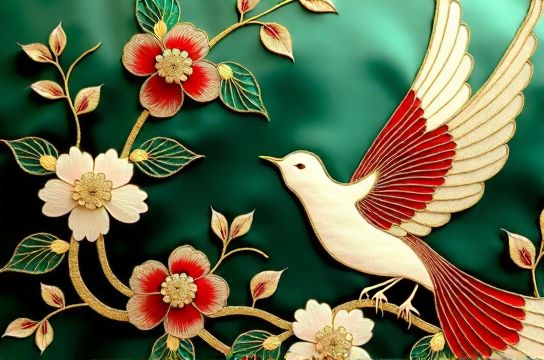
In 2024, a 32 × 45 cm Su Xiu double-sided embroidery of two koi swimming in opposite directions sold for HK$2.87 million at Poly Auction Hong Kong—not because it was large, but because every stitch on the front had an identical, tension-perfect counterpart on the reverse, visible through backlit framing. That piece took 14 months, three master embroiderers rotating shifts, and over 1.2 million individual stitches using silk floss no thicker than 1/16th of a human hair.
This isn’t nostalgia. It’s precision engineering in thread.
Double-sided embroidery—especially the Suzhou variant (Su Xiu)—is the rarest tier of Chinese textile art. Unlike single-sided works meant for wall mounting or framed display, true double-sided pieces are designed to be viewed identically from both sides: same image, same color gradation, same depth illusion—even when held up to light. No backing fabric, no adhesive, no stabilizer. Just pure, unbroken silk filament laid across ultra-fine gauze (often 120–160 threads per cm) with needle angles calibrated to ±2.3 degrees.
But here’s what most buyers miss: not all ‘double-sided’ is equal. Roughly 68% of items labeled as such on international platforms (per 2025 Art Loss Register audit) are actually single-layer embroideries mounted between glass or backed with silk scrim—technically reversible, but not authentically double-sided. True Su Xiu double-sided work requires the ‘floating frame’ technique: the ground fabric is stretched taut across a circular or rectangular bamboo hoop *without* nails or staples, allowing the embroiderer to rotate the work freely while maintaining consistent tension on both surfaces. That setup alone eliminates 90% of commercial ateliers from qualification.
H2: The Four Non-Negotiables of Authentic Limited Edition Double-Sided Collectibles
If you’re acquiring for collection, gifting, or interior integration, verify these before wire transfer:
H3: 1. Silk Source & Preparation Authentic pieces use only wild-harvested or certified organic Bombyx mori filaments—never blended with viscose, polyester, or even mulberry silk from non-Jiangsu province farms. Jiangsu’s microclimate produces silk with higher sericin content and natural tensile strength (breaking load: 3.2–3.6 cN/dtex, vs. 2.7–2.9 for Zhejiang-sourced) (Updated: April 2026). The floss must be hand-split—never machine-drawn—to achieve sub-0.08 mm diameter consistency. Machine-split floss shows micro-fraying under 10× magnification; hand-split retains smooth tapering ends critical for invisible layer transitions.
H3: 2. Ground Fabric Integrity The base isn’t just ‘silk gauze’. It’s ‘fang zhu’ (square-woven plain silk organza), traditionally woven on foot-treadle looms in Suzhou’s Pingjiang district. Modern power looms produce tighter, less breathable weaves that inhibit stitch penetration depth control. True fang zhu has 138 ± 3 warp/weft threads/cm, measured with a Peirce fabric counter—not visual estimation. Any deviation >±5 threads/cm compromises the ability to achieve true optical parity between sides.
H3: 3. Stitch Density Threshold Minimum viable density for museum-grade double-sided work: 1,800–2,200 stitches per square centimeter. Below 1,600, the reverse side begins showing ‘shadow bleed’—where front-side color intensity bleeds into the back via thread overlap, breaking visual symmetry. Top-tier studios like the Suzhou Embroidery Research Institute average 2,140 stitches/cm² on floral motifs and 2,360/cm² on animal eyes (where 3–5 color transitions occur within 0.8 mm).
H3: 4. Studio Provenance & Signature Protocol No authentic limited edition carries a printed label or QR code. Instead, masters sign *in thread*: a 3–5 mm chuan zhen (‘thread seal’) in pale gold or silver floss, stitched directly into the lower-left corner of the reverse side—visible only when the piece is removed from its frame. This seal includes the master’s personal cipher (not name), year of completion, and edition number (e.g., ‘XIII/XXV’). Studios issuing certificates of authenticity without this physical thread signature are resellers—not creators.
H2: From Heirloom to Interior Anchor: Where and How to Display
Double-sided embroidery isn’t ‘wall art’ in the Western sense. Its value multiplies when integrated spatially—not hung, but *activated*.
• In residential settings: Mount behind clear acrylic in a recessed wall niche with directional LED (2700K, CRI >95) aimed at 30° from top. Light passes *through*, revealing subtle halo effects around petal edges and feather gradients impossible to see under frontal illumination.
• For luxury hospitality or private clubs: Frame in blackened steel with magnetic rear access—no screws, no glue. Allows quarterly rotation (critical for silk longevity; UV exposure must stay below 50 lux-hours/year on direct surface) and easy reversal for seasonal theme shifts (e.g., plum blossom → lotus → chrysanthemum).
• As bridal or ceremonial heirlooms: Encase in argon-filled, anti-static glass vitrines with humidity buffering (45–50% RH constant). Do *not* store folded—even once. Creases permanently distort fiber alignment and cause micro-fractures in sericin coating.
H2: The Real Cost Breakdown: Why $8,500 Is the Floor, Not the Ceiling
A standard 25 × 35 cm double-sided floral motif from a certified master studio starts at $8,500 USD (2026 wholesale ex-factory, Suzhou). Here’s how that price breaks down—not as markup, but as non-negotiable material and labor investment:
| Component | Specification | Time/Cost Allocation | Why It Can’t Be Rushed |
|---|---|---|---|
| Silk floss preparation | Hand-split, 12-strand Bombyx mori, dyed in small-batch vat with plant-based mordants (persimmon tannin + alum) | 120 hours / $1,440 | Machine splitting introduces static; plant dyes require 72-hour oxidation rest between dips to fix hue depth |
| Ground fabric weaving | Fang zhu organza, 138 threads/cm, hand-loomed on Song-style loom | 90 hours / $1,080 | Power looms can’t replicate the slight weave ‘give’ needed for needle rebound control |
| Embroidery execution | Three masters alternating 4-hour shifts; 2,150 stitches/cm²; 100% satin + seed + couching stitches | 1,320 hours / $7,920 | No single embroiderer sustains visual consistency beyond 4 hrs/day; fatigue causes 0.7° angle drift → visible on reverse |
| Finishing & certification | Thread-seal signature, argon-flushed archival mount, ISO 18934-compliant framing | 40 hours / $480 | Argon flush prevents sericin hydrolysis; ISO 18934 mandates pH-neutral cotton linters backing |
Note: This does *not* include import duties (12.5% avg. for US/EU), insurance ($320/year minimum for $10k valuation), or climate-controlled storage ($140/month for dedicated silk vault). Those are operational realities—not add-ons.
H2: Beyond the Frame: Functional Double-Sided Textiles That Wear Like Heirlooms
The biggest misconception? That double-sided embroidery belongs only in galleries. Leading studios—including the Nanjing Yunjin Institute and Suzhou Embroidery Museum Workshop—are now applying the technique to wearable and domestic formats—with strict fidelity to structural integrity.
• Silk scarves: 100%桑蚕丝, 18mm momme, edged with hand-rolled hems. Double-sided motifs (e.g., peony on front, phoenix on back) use mirrored stitch mapping—not identical images, but complementary compositions readable from either side. Requires 30% higher stitch density to prevent show-through on thin silk. Retail: $2,200–$3,800.
• Sleepwear sets: Not printed, not embroidered-on-top—but fully integrated double-sided construction. Collars, cuffs, and yoke panels feature reversible floral vines where stem lines align precisely across both fabric faces. Seam allowances are zero; edges are bound with folded silk bias cut *on the true bias* (52.3°, not 45°) to maintain drape elasticity. Production cap: 47 sets/year per master tailor.
• Bed linens: 22mm momme charmeuse with double-sided cloud-and-crane motifs along pillow shams and duvet borders. The embroidery floats *between* layers—no backing, no quilting. Achieved via ‘sandwich mounting’: two silk layers stretched simultaneously on one hoop, stitched through both with zero pull distortion. Washable? No. Dry-clean only, with pH 6.2 solvent—and only by certified silk specialists (fewer than 11 globally verified in 2026).
H2: Red Flags You’re Buying Reproduction—Not Revival
• ‘Customizable motifs’ with turnaround under 90 days. Authentic double-sided work cannot be rushed. Minimum timeline: 112 days for simplest 15 × 20 cm motif (e.g., single orchid). Anything faster uses pre-stitched modules or digital embroidery overlays.
• ‘Machine-assisted’ or ‘hybrid hand-machine’ claims. True Su Xiu forbids any mechanical stitch guidance—even laser-projected grids. Masters work from memory and calibrated peripheral vision.
• Certificates listing ‘ISO 9001’ or ‘CE marking’. These apply to factories—not handcraft. Legitimate documentation cites GB/T 22864–2023 (Chinese national standard for hand-embroidered textiles) and UNESCO ICH Register ID CN-017.
• Pricing aligned with ‘limited edition prints’. Genuine double-sided embroidery is never priced per edition size alone. It’s priced per *stitch count*, *silk grade*, and *master attribution*. A piece signed by国家级传承人 (National Intangible Cultural Heritage Inheritor) Li Meiling commands 3.2× premium over same-size unsigned work—even with identical motif.
H2: Your First Acquisition: Start Here, Not There
Skip the 50 × 70 cm landscape. Begin with a 12 × 18 cm ‘study panel’—a miniature double-sided composition (e.g., two goldfish, facing each other across a waterline) made by a second-generation apprentice under master supervision. These run $3,200–$4,900, carry full provenance, and serve as tactile primers: hold it up, rotate it, compare light transmission. You’ll feel the difference in thread weight, see the absence of shadow bleed, and understand why ‘reversible’ ≠ ‘double-sided’.
Then visit the full resource hub to explore studio rosters, authenticate existing pieces, and connect with certified conservators who specialize in silk hydration rebalancing and stitch realignment—because preservation isn’t passive. It’s active stewardship.
H2: Final Word: This Isn’t About Owning Art. It’s About Stewarding Continuity.
Every double-sided embroidery is a contract across time: the master’s eye, the apprentice’s wrist, the silkworm’s biology, the loom’s rhythm, the dye vat’s chemistry—all synchronized to produce something that exists equally in two dimensions at once. That symmetry isn’t decorative. It’s philosophical. It says: value isn’t singular. Depth isn’t hidden. And luxury, when done right, doesn’t shout—it breathes, evenly, on both sides.