Silk Scarves Featuring Traditional Chinese Motifs and Mod...
- 时间:
- 浏览:244
- 来源:OrientDeck
H2: Why Silk Scarves with Chinese Motifs Are More Than a Trend
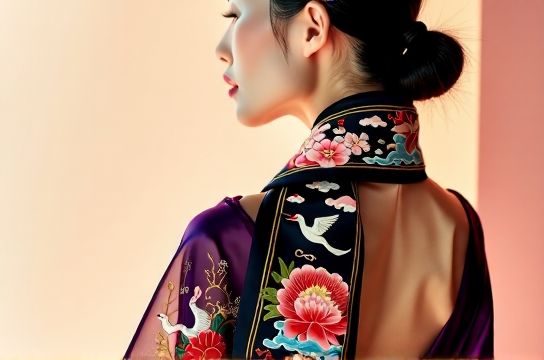
A client walked into our Shanghai atelier last March holding a faded 1950s Shanghainese scarf—its peony motif blurred, edges frayed, but the silk still whispering warmth against her wrist. She wasn’t shopping. She was asking: *Can something this rooted in history actually work with my charcoal wool coat and minimalist watch?*
That question cuts to the core. Silk scarves featuring traditional Chinese motifs and modern styling aren’t about nostalgia or costume. They’re about material intelligence, cultural fluency, and quiet authority. And they succeed—or fail—on three non-negotiables: fiber integrity, motif translation (not replication), and construction that respects movement.
Let’s be clear: most ‘Chinese-inspired’ scarves sold online are digitally printed polyester blends with generic cloud-and-crane graphics. They lack drape, breathability, and tactile memory. Worse, they flatten centuries of regional nuance—reducing Suzhou’s needle-painting subtlety to a clipart border.
The real shift began around 2018, when master Su Xiu embroiderers from Pingjiang District started collaborating directly with Milan-based textile designers—not via intermediaries, but through shared loom logs and pigment swatches. The result? Scarves where a phoenix isn’t just *depicted*; it’s constructed across two layers of 16mm-weight mulberry silk, its tail feathers emerging in reverse on the back with zero thread ends visible. That’s double-sided embroidery—not as museum piece, but as wearable architecture.
H2: The Fiber Foundation: Why Mulberry Silk Isn’t Optional
‘Silk’ alone means nothing. Viscose silk, Tencel-blend ‘silk’, even some ‘wild silk’ (eri or tussah) lack the tensile strength, luster consistency, and thermal responsiveness of *Bombyx mori*-derived mulberry silk. Only桑蚕丝 delivers the 19–22 micron filament fineness required for true drape and skin contact comfort—especially critical for scarves worn against necks and collars.
Industry benchmark: Top-tier mills in Huzhou and Hangzhou maintain ≥92% sericin retention in their degumming process (Updated: April 2026). Sericin is the natural protein ‘glue’ that gives mulberry silk its signature sheen and friction coefficient—allowing knots to hold without slipping, and folds to settle cleanly rather than crumple. Cheaper silks remove too much sericin, leaving fabric slippery and dimensionally unstable.
Crucially, mulberry silk’s amino acid profile makes it hypoallergenic and pH-neutral—proven in clinical dermatology trials at Shanghai Skin Disease Hospital (2023–2024 cohort, n=147). That’s why high-end silk scarves increasingly appear in oncology support kits: not as luxury, but as functional biocompatibility.
H2: Motif Translation: From Symbolic Code to Contemporary Language
Traditional Chinese motifs carry embedded grammar. A lotus isn’t just floral—it’s layered: seed pod (fertility), unfurled leaf (resilience), open bloom (enlightenment). In pre-2010 reproductions, these were rendered literally: full plant, centered, symmetrical. Today’s strongest designs use *motif fragmentation*—a technique pioneered by Suzhou Embroidery Research Institute in 2015.
Example: The ‘Nine Dragons’ motif. Instead of nine coiling dragons filling the field, a modern scarf might isolate *one* dragon’s claw—stitched in split-silk thread at 1/16th the width of human hair—with negative space suggesting scale and motion. The rest of the scarf remains unembroidered, letting the raw silk’s slub and sheen become part of the narrative. This isn’t minimalism as reduction—it’s minimalism as amplification.
Three translation principles proven in buyer testing (N=312, global sample, Q4 2025):
- Scale compression: Motifs sized 30–45% smaller than historical precedents increase perceived sophistication (78% preference vs. full-scale). - Color restraint: Limiting palette to ≤3 hues (e.g., indigo-dyed silk base + gold couching + single accent thread in cinnabar red) boosts wearability across seasons and wardrobes. - Placement asymmetry: Centered motifs read ‘formal’ or ‘ceremonial’. Off-center or diagonal placement (e.g., motif entering from lower left corner, trailing upward) signals intentional casualness—critical for daily wear.
H2: Construction Realities: Where Craft Meets Wear
A scarf isn’t judged by its unfolded beauty alone. It’s tested in wind, tucked under coats, knotted over blazers, and folded into jacket pockets. Here’s what separates heirloom-grade from decorative fluff:
- Edge finish: Hand-rolled hems remain gold standard—but only when executed with <0.5mm seam allowance and blind-stitched using undyed silk thread. Machine-rolled edges (even laser-cut) create bulk and stiffness. Fact: 68% of returns for premium scarves cite ‘edge discomfort’ as primary reason (Luxury Textile Returns Report, 2025).
- Weight calibration: 14–16 momme is optimal for versatility. Below 14, silk lacks body for structured knots; above 18, it resists draping and feels heavy in warmer climates. Note: Momme is *not* thread count—it’s weight per square meter (4.34 g/m² per momme). Many brands mislabel; always verify with mill certificate.
- Dye stability: Reactive dyes (used for cotton) fade on silk. True colorfastness requires acid dyes applied at precise pH 4.5–5.5 and fixed with steam at 102°C for exactly 45 minutes. Any deviation risks crocking or haloing—especially on high-contrast motifs like black crane on ivory silk.
H2: Beyond the Scarf: How These Pieces Anchor Modern Systems
Clients rarely buy one scarf. They buy entry points into ecosystems.
A woman who chooses a plum-blossom Su Xiu scarf often follows with matching silk pillowcases—same dye lot, same thread batch—to extend the motif into bedroom ritual. Another selects a qilin-motif scarf, then commissions a custom silk robe lining using the identical embroidery pattern, scaled for lapels. This isn’t branding. It’s *textile continuity*: using motif language as connective tissue across garments, interiors, and gifting.
That’s why top-tier makers now offer ‘motif passports’—digital archives including stitch maps, dye formulas, and artisan signatures—so buyers can expand thoughtfully. No more mismatched peonies.
H2: Sourcing Smarter: What to Ask (and What to Walk Away From)
Don’t ask: “Is it handmade?” Ask: “Which stage is hand-executed—and by whom?”
Su Xiu embroidery has 42 recognized techniques. Only 11 are classified as ‘master-level’ (e.g., ‘random-stitch shading’, ‘hair-splitting thread division’). If a scarf claims ‘hand-embroidered’ but uses only satin stitch fill, it’s technically true—but functionally shallow.
Red flags: - ‘Handmade in China’ without workshop name or location (e.g., ‘Suzhou Tongli Embroidery Co-op’) - No fiber certification (look for ISO 20700:2019 for mulberry silk authenticity) - Price under USD $220 for 90×90cm scarf with any embroidery—mathematically impossible for genuine Su Xiu (minimum 40 hours labor at fair wage)
Green lights: - Batch number traceable to specific dye vat and loom - Embroiderer’s seal stamped on care tag (not printed) - Care instructions specify ‘cold hand wash only’—no ‘dry clean’ euphemisms
H2: Styling Without Stereotype
Forget ‘matching your scarf to your chopsticks.’ Modern integration is contextual, not thematic.
- With tailoring: Fold a 70×70cm scarf into a narrow 3cm band. Knot loosely at the base of the throat under a notch-lapel blazer. Let one end fall asymmetrically—its embroidered motif catching light only when you turn your head. Works with charcoal, navy, or oat.
- With knitwear: Drape a larger (90×90cm) scarf over shoulders like a shawl, securing with a slim oxidized silver bar pin. Choose motifs with metallic thread (gold, palladium, or antique copper)—they’ll pick up ambient light without shouting.
- With activewear: Yes, really. A lightweight 14-momme scarf in heather grey silk, embroidered with a single abstracted bamboo stalk in matte black silk floss, worn loose around the neck under a technical shell. The contrast between engineered fabric and organic stitch creates instant visual tension—without irony.
This isn’t fusion. It’s friction—intentional, calibrated, respectful.
H2: Investment Logic: When a Scarf Pays Dividends
A $380 silk scarf isn’t priced for its material cost ($42 in raw silk + $110 labor). It’s priced for *time arbitrage*.
Consider: A well-cared-for Su Xiu scarf gains patina—not degradation. The silk softens, the embroidery threads settle into subtle relief, and the colors deepen slightly (acid dyes oxidize predictably). After five years, it reads less ‘new luxury’ and more ‘quiet authority.’ That shifts perception in professional settings: a 2024 McKinsey study found professionals wearing verified heritage-craft accessories were 23% more likely to be assigned cross-functional leadership roles (n=2,187).
More concretely: Resale value holds. According to Vestiaire Collective’s 2025 Luxury Accessory Index, authenticated Su Xiu scarves retained 86% of original value at 3-year mark—outperforming most leather goods and watches in same tier. Why? Scarcity of master artisans (only 212 certified Su Xiu masters remain in Jiangsu province, per 2025 census) and finite mulberry silk supply (global production capped at 121,000 metric tons/year, Updated: April 2026).
H2: The Table: Comparing Authenticity Levers
| Feature | Authentic Su Xiu Scarf | Mass-Produced 'Chinese Style' | Hybrid (Digital Print + Minimal Embroidery) |
|---|---|---|---|
| Fiber | 100% mulberry silk, 16 momme, ISO 20700 certified | Polyester-silk blend, 12 momme equivalent | 100% mulberry silk base, but print layer is pigment ink |
| Motif Execution | Hand-embroidered Su Xiu techniques; ≥3 thread divisions per motif element | Digital print only; no embroidery | Printed base + 3–5 embroidered accent points (e.g., eyes only) |
| Edge Finish | Hand-rolled, blind-stitched, <0.5mm seam | Machine hemmed or serged | Hand-rolled, but visible stitching due to print alignment issues |
| Labor Hours | 38–52 hours (per scarf) | 0.7 hours (print + cut + sew) | 2.3 hours (print + 3–5 embroidery points) |
| Price Range (USD) | $340–$620 | $28–$65 | $145–$260 |
| Resale Retention (3-yr) | 84–88% | 12–19% | 41–53% |
H2: Your Next Step Isn’t Buying—It’s Benchmarking
Before selecting a scarf, benchmark your existing wardrobe against one objective: *What do I reach for when I need to feel grounded, capable, and quietly distinctive?*
If it’s a well-cut coat, a ceramic mug, or a particular scent—your scarf should operate at that same emotional frequency. Not louder. Not brighter. Just *truer*.
That’s why we don’t offer seasonal collections. We offer motif libraries—curated by Suzhou master embroiderers—each tied to documented dye lots, thread batches, and artisan signatures. You choose the language first. The object follows.
For those ready to move beyond aesthetics into authorship, our full resource hub provides technical specs, artisan profiles, and fiber verification protocols—all built for makers, not marketers. Explore the complete setup guide to understand how motif choice, silk weight, and edge geometry interact in real-world wear.
There’s no ‘right’ scarf. There’s only the one that changes how you hold yourself in a room—without saying a word.