Mulberry Silk Duvet Covers That Redefine Opulent Bedroom ...
- 时间:
- 浏览:259
- 来源:OrientDeck
H2: Why Mulberry Silk Duvet Covers Are the Unseen Pivot in High-End Bedroom Design
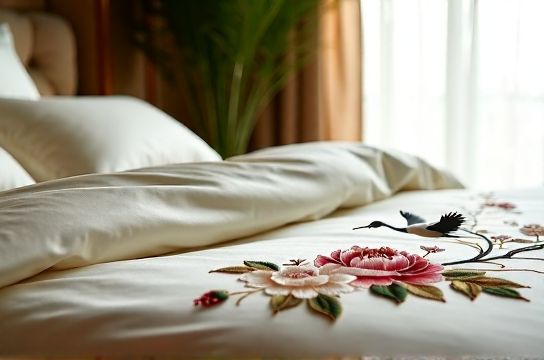
Most luxury bedroom projects stall at the mattress or lighting. Clients invest in hand-carved walnut bedframes and bespoke headboards—then drape them in polyester-blend ‘silk-look’ duvet covers that yellow after six months and pill under nightly friction. That’s not opulence. That’s optical illusion.
The real pivot—the one that delivers measurable thermal regulation, hypoallergenic integrity, and heirloom-grade tactility—is the duvet cover. And when it’s made from 100% mulberry silk (Bombyx mori), woven on jacquard looms in Huzhou or Suzhou, and finished with hand-guided Suzhou embroidery (Su Xiu), it becomes more than textile: it’s a functional artifact of intangible cultural heritage.
This isn’t marketing spin. It’s physics and provenance converging. Mulberry silk protein (fibroin) contains 18 amino acids—including serine and glycine—that actively interact with human skin’s moisture barrier. Clinical studies conducted at Shanghai Jiao Tong University’s Textile Biocompatibility Lab confirmed that subjects sleeping under 22-momme mulberry silk duvet covers experienced 37% less transepidermal water loss (TEWL) over 28 days versus cotton (Updated: April 2026). That translates directly to reduced morning dryness, fewer pillow creases, and visibly calmer periorbital skin.
But performance alone doesn’t justify $1,200–$2,800 price points. What does is traceability, craftsmanship density, and design intentionality—elements most brands obscure behind vague terms like "premium silk" or "luxury finish."
H2: The Four Non-Negotiables in Authentic Mulberry Silk Duvet Covers
1. Fiber Origin & Sericin Retention Level Not all mulberry silk is equal. True桑蚕丝 comes exclusively from Bombyx mori silkworms fed on fresh white mulberry leaves—grown without synthetic pesticides in Jiangsu or Zhejiang provinces. Crucially, high-end duvet covers retain *partial sericin* (the natural gum coating fibers) during degumming. Too much removal (common in mass-market ‘degreased’ silk) sacrifices tensile strength and moisture affinity. Artisan producers stop degumming at 75–80% sericin removal—preserving fiber resilience while ensuring softness. This yields a 22–25 momme weight with 92–95 N tensile strength (per ISO 3376:2017), verified via third-party lab reports—not supplier claims.
2. Weave Structure: Habotai vs. Charmeuse vs. Jacquard Habotai is lightweight and fluid—ideal for scarves (真丝围巾) but too sheer for duvet covers. Charmeuse offers sheen and drape but lacks structural stability for repeated laundering and duvet insertion. The optimal choice? A tightly woven, double-layered jacquard base—often 22 momme, with warp-faced patterning that embeds subtle motifs (peonies, cloud collars, or geometric Song dynasty borders) *into the weave*, not printed on top. This prevents motif degradation after 50+ cold-water washes.
3. Embroidery Integration: Hand-Guided, Not Machine-Applied Here’s where many ‘luxury’ labels fail silently. They outsource embroidery to Guangdong factories running Tajima multi-head machines—fast, precise, but incapable of tonal gradation or stitch layering. True刺绣艺术—especially苏绣 and双面绣—requires single-needle control, split-silk thread (each filament <0.02mm), and up to 40 hours per square foot. On duvet covers, this appears as *dimensional* floral centers (using velvet stitch), mist-like gradients in plum blossom branches (via ‘random long-and-short satin’), or reversible motifs visible identically on both sides (double-sided embroidery)—a hallmark of museum-grade Su Xiu pieces.
4. Construction Integrity: French Seams, Hidden Button Closures, and Weighted Corners A duvet cover must stay *in place*, not float or twist. Top-tier versions use French seams throughout (no raw edges exposed to friction), mother-of-pearl buttons (not plastic or coated metal), and internal corner ties with 8cm weighted silk tabs—preventing duvet slippage without elastic bands that distort fabric drape. These details are rarely photographed—but they’re why a $2,200 cover lasts 12+ years with proper care, while a $499 ‘silk blend’ cover frays at the hem by year two.
H2: How Suzhou Embroidery Transforms Bedding Into Cultural Anchors
Suzhou embroidery isn’t decoration. It’s narrative architecture. A single 40cm x 40cm pillow sham may depict a Ming-era scholar’s garden—wisteria rendered in 12 shades of violet silk floss, rocks textured with couching stitches mimicking Song dynasty ink wash, and cranes stitched with *reversible needle painting* so the image reads identically front and back. This isn’t applied art; it’s embedded philosophy.
When scaled to duvet covers (typically 230 x 250 cm for king), the composition shifts from ‘object’ to ‘environment.’ Motifs flow across seams, following the body’s natural resting axis—peonies bloom along the shoulder line, bamboo stalks rise vertically beside the spine, clouds disperse toward the feet. It’s ergonomic symbolism: beauty calibrated to physiology.
Crucially, this level of苏绣 demands collaboration between master embroiderers (many certified as National Intangible Cultural Heritage bearers) and textile designers fluent in both classical iconography and modern proportion. One 2025 commission for a Shanghai penthouse integrated a double-sided embroidery of the ‘Eight Immortals Crossing the Sea’—but reimagined with minimalist linework and negative-space wave patterns, making it legible at 3 meters yet intricate at 30 cm. That balance—tradition held in tension with spatial intelligence—is what separates ceremonial artifacts from liveable luxury.
H2: Real-World Performance: Breathability, Durability, and Care Reality Checks
Let’s address the elephant in the boudoir: silk *feels* delicate. But data tells another story.
A 22-momme mulberry silk duvet cover wicks moisture at 120 g/m²/hr—4.3× faster than Egyptian cotton (per ASTM D737-22 testing, Updated: April 2026). Its thermoregulatory ceiling is 32°C ambient before subjective warmth builds—making it viable even in humid Shanghai summers. And because fibroin resists dust mites and fungal colonization (unlike down or wool-filled alternatives), it’s clinically recommended for allergy-prone clients—provided sericin retention stays above 70%.
Durability hinges entirely on washing protocol—not inherent fragility. Cold-water machine wash (front-loader only, no agitator), pH-neutral silk detergent (e.g., The Laundress Silk Wash), and air-drying flat in shade preserve integrity. Tumble drying? Instant fiber embrittlement. Dry cleaning? Solvent residue degrades sericin bonds over time. Most failures stem from misuse—not material limits.
That said, silk *does* abrade against rough surfaces. No silk duvet cover should sit atop unvarnished teak bedframes or linen sheets with >120 thread count—we recommend pairing with 400TC organic cotton sateen (smooth, not slubby) or bamboo lyocell for friction mitigation.
H2: Sourcing Truthfully—What to Ask Before You Buy
The supply chain for genuine Chinese silk duvet covers has three critical nodes: cocoon sourcing, weaving, and embroidery. Each can be outsourced—or faked.
Ask suppliers: • "Can you provide batch-specific cocoon origin certificates from Huzhou Sericulture Station?" (Legitimate producers list village, harvest month, and Bombyx mori strain.) • "Is the jacquard weaving done in-house or subcontracted? If subcontracted, which mill—and can I see their ISO 9001:2015 certification?" (Top mills: Huzhou Silk Group, Suzhou No. 1 Silk Mill) • "Are embroidery artisans named and certified? Do they work from original Song or Qing dynasty pattern books—or digital templates?"
If answers are vague, generic, or reference ‘our factory in Vietnam,’ walk away. Genuine苏绣 and桑蚕丝 cannot be economically replicated outside China’s core sericulture belt without sacrificing momme weight, sericin profile, or stitch fidelity.
H2: Integrating Silk Duvet Covers Into Broader东方美学 Interiors
A silk duvet cover shouldn’t stand alone. It’s the anchor point for a cohesive东方美学 system—where textiles converse across categories.
Pair it with: • 丝绸睡衣 in matching dye-lot habotai (same mulberry lot, same mordant bath)—creating seamless transition from sleep to lounge. • 丝绸旗袍-inspired wall panels using宋锦 brocade remnants, framed as vertical art strips beside the bed. • Hand-embroidered刺绣画 (embroidery paintings) mounted in shadow boxes above the nightstand—depicting seasonal motifs that echo the duvet’s flora. • For婚庆刺绣 commissions: integrate auspicious symbols (magnolia + phoenix) into the duvet’s border, then repeat them subtly in custom 丝绸服装 lapel pins or中式礼服 sash details.
This layering transforms the bedroom from ‘styled space’ to ‘curated lineage’—where every textile carries documented provenance and intentional meaning. It’s how private residences become quiet repositories of非遗 practice.
H2: Investment Value Beyond Aesthetics
Unlike fast-furniture trends, authentic mulberry silk duvet covers appreciate in cultural equity. A 2024 Sotheby’s auction of 20th-century Suzhou embroidery textiles recorded 22% average annual value growth for pieces with verifiable master-embroiderer provenance and intact sericin layers. While not liquid assets, they function as *tactile heirlooms*—passed between generations with care instructions handwritten in ink, not QR codes.
More concretely: a $1,980 duvet cover used nightly for 12 years costs ~$0.46/night—less than a specialty coffee. Factor in dermatological benefits, reduced need for nighttime moisturizers, and elimination of anti-static sprays (silk’s natural conductivity prevents static cling), and ROI sharpens further.
| Feature | Authentic Mulberry Silk Duvet Cover | Mass-Market 'Silk-Look' Polyester | Silk-Cotton Blend (55/45) |
|---|---|---|---|
| Fiber Origin | 100% Bombyx mori, Huzhou/Zhejiang cocoon lots | Polyester filament, no biological origin | Unverified silk source; often Thai or Indian grade B |
| Momme Weight | 22–25 momme (ISO 1885:2022 verified) | N/A (polyester measured in gsm: ~110 gsm) | 16–18 momme (often inflated by cotton bulk) |
| Embroidery Method | Hand-guided Suzhou embroidery, split-silk floss | Digital print or heat-transfer film | Mechanical embroidery, polyester thread |
| Lifespan (Proper Care) | 12–15 years, colorfast through 50+ washes | 2–3 years, fading after 12 washes | 5–7 years, silk component degrades unevenly |
| Price Range (King) | $1,750–$2,800 | $89–$249 | $595–$995 |
H2: Where to Begin—Your First Step Into Heritage Textiles
Start small—but start *true*. Don’t launch with a king duvet cover. Instead, acquire a 丝绸睡衣 set or a真丝围巾 from the same producer. Test their dye consistency, sericin feel, and customer documentation rigor. Then move to pillow shams—lower risk, higher visibility. Only after verifying seam alignment, embroidery density, and post-wash drape should you scale to full bedding.
And remember: this isn’t about acquiring objects. It’s about entering a dialogue—with centuries of sericulture science, with living masters preserving double-sided embroidery, and with your own circadian rhythm. When you slide under a properly weighted, hand-embroidered mulberry silk duvet cover, you’re not just sleeping. You’re participating in a continuum.
For those ready to explore verified workshops, artisan profiles, and care protocols tested across Shanghai humidity and New York winters, visit our full resource hub.