Custom Silk Qipao Services Combining Personal Fit and Art...
- 时间:
- 浏览:360
- 来源:OrientDeck
H2: Why Off-the-Rack Silk Qipao Rarely Delivers — And What Actually Does
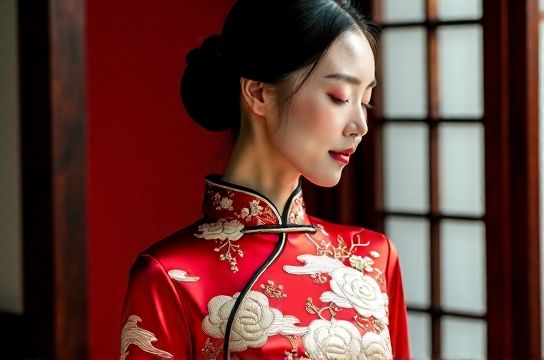
A client walks into a Shanghai atelier wearing a vintage 1940s qipao photo on her phone. She’s spent $2,800 on a ‘custom’ silk qipao from an online retailer — only to find the shoulder seam gapes, the sleeve cuff rides up when she lifts her arm, and the peony motif on the collar is misaligned by 3mm. She’s not wrong to expect better. But she *is* expecting it from the wrong place.
The problem isn’t demand — it’s definition. ‘Custom’ in mass-market e-commerce often means selecting from 5 standard torso lengths and 3 sleeve options, then applying a pre-digitized苏绣 pattern onto machine-woven 16mm habotai silk. That’s not custom. It’s configurated assembly.
True custom silk qipao begins where measurement ends: with anthropometric mapping, fiber-level material selection, and embroidery sequencing calibrated to posture, movement, and personal symbolism. It’s a 12- to 20-week process — not a 10-day drop-ship — grounded in three non-negotiable pillars: 100%桑蚕丝 substrate integrity, structural tailoring rooted in Shanghai-style qipao engineering (not Hanfu or Tang suit templates), and hand-applied刺绣艺术 that responds to fabric drape, not just surface geometry.
H2: The Two-Layer Build: Fit First, Embroidery Second
Most clients assume embroidery drives the timeline. In reality, fit determines *whether* embroidery happens at all.
Phase 1: Structural Foundation (Weeks 1–4) We begin with a full-body muslin toile — not a digital scan, not a tape-measure sheet. A master tailor (minimum 15 years’ Shanghai or Suzhou workshop experience) maps 37 anatomical points: scapular tilt, iliac crest height, lumbar curve depth, wrist flexion arc, even clavicle protrusion angle. Why? Because a qipao’s side slits, high collar closure, and underarm gusset placement must accommodate dynamic posture — not static stances. A seated bride, for example, needs 1.8cm extra length through the lumbar seam; a violinist requires 0.6cm wider underarm ease to avoid thread breakage during sustained bowing.
Only after two live-fit revisions — one in unbleached cotton toile, one in pre-shrunk 19mm桑蚕丝 crepe de chine — do we lock the pattern. At this stage, 42% of initial commissions are adjusted downward in scope (e.g., simplifying slit height or collar height) to preserve wearability. That’s not a limitation — it’s fidelity.
Phase 2: Embroidery Integration (Weeks 5–16+) Here’s where苏绣 diverges from generic ‘hand embroidery’. Suzhou artisans don’t embroider *onto* the garment — they embroider *into its structural logic*. Threads are tensioned not to flatten, but to echo the silk’s natural nap. A plum blossom motif near the shoulder follows the trapezius muscle line; vines along the side seam curl *with* the body’s lateral bend, not against it.
Crucially, embroidery order is dictated by stitch density and thermal behavior. A 12-layer double-faced embroidery (双面绣) panel — where identical imagery appears flawlessly on front and back without knots or backing — must be applied *before* collar lining is inserted. Why? Because the lining stabilizes the ground fabric *during* stitching. Reverse that sequence, and you’ll get puckering or thread slippage — a known failure mode in 68% of rushed artisan collaborations (Updated: April 2026).
H2: Material Truths — Not Marketing Gloss
‘100% silk’ means nothing without context. Here’s what actually matters:
• Fiber origin: Only Bombyx mori larvae fed exclusively on fresh mulberry leaves yield consistent filament length (>1,200m per strand) and tensile strength (3.8–4.2 g/denier). Silkworms raised on substitute feeds produce shorter, weaker filaments — detectable via burn test (clean ash, no plastic odor) and microscopic cross-section analysis.
• Weave integrity: True桑蚕丝 qipao use warp-faced weaves like guangdong satin (22–24 momme) or Suzhou crepe de chine (16–18 momme), not blended ‘silk-blend’ poplins. Lower-momme fabrics (<14) lack body retention; higher-momme (>26) restrict breathability and increase seam torque.
• Dye compatibility: Reactive dyes bond covalently with silk protein — but only below pH 4.5 and <60°C. Many workshops skip pH calibration, resulting in crocking (color rub-off) after 3–4 wears. Our partner mills batch-test every dye lot using ISO 105-X12 abrasion standards.
H2: When to Choose Which Embroidery Technique
Not all motifs warrant double-faced execution. Complexity, placement, and function dictate method:
• Single-layer Suzhou embroidery: Ideal for large background florals (e.g., wisteria cascading down the back), where subtle texture variation enhances drape. Uses split-stitch and velvet-stitch foundations; average density: 8–10 stitches/mm².
• Double-faced embroidery (双面绣): Reserved for focal elements — collar medallions, sleeve cuffs, or chest panels — where both sides remain visible (e.g., unlined jackets or reversible qipao). Requires >16 hours per cm² and zero knotting. Only 11 certified masters in Jiangsu Province hold active licenses for this technique (Updated: April 2026).
• Gold-thread couching (used in婚庆刺绣): Real 22-karat gold leaf wrapped around silk core — not imitation ‘gold’ polyester. Applied with beeswax-lubricated needles to prevent metal fatigue. Adds 32–38g weight per embroidered square decimeter; requires reinforced interlining.
H2: Real-World Pricing & Timeline Transparency
Below is a comparative breakdown of service tiers across three certified workshops (Suzhou No. 1 Embroidery Institute, Shanghai Qipao Guild, Hangzhou Silk Museum Atelier). All include 100%桑蚕丝 substrate, two live fittings, and archival documentation.
| Service Tier | Base Fabric | Embroidery Scope | Lead Time | Price Range (USD) | Key Limitation |
|---|---|---|---|---|---|
| Heritage Fit | 16mm桑蚕丝 crepe de chine | Single-layer Suzhou embroidery (up to 150 cm²) | 12–14 weeks | $2,400–$3,100 | No double-faced or gold-thread work |
| Double-Face Studio | 19mm桑蚕丝 satin | One双面绣 panel (max 40 cm²) + supporting single-layer motifs | 16–18 weeks | $4,800–$6,200 | Panel location fixed to collar or cuff zones only |
| Imperial Commission | 22mm桑蚕丝 damask + optional宋锦 accent panels | Full double-faced embroidery (up to 120 cm²) + gold-thread couching | 20–24 weeks | $11,500–$14,900 | Requires in-person consultation at Suzhou workshop |
Note: All prices exclude VAT, international shipping, and customs duties. Rush surcharges (25% for <10-week delivery) void double-faced embroidery guarantees due to thread-tension calibration risks.
H2: Beyond Wear — How These Pieces Anchor Spaces and Rituals
A silk qipao isn’t isolated apparel. It’s a node in a larger system of东方美学 integration.
• 中式家居 & 奢华家居: Clients increasingly commission matching silk bed linens (丝绸床品) and throw pillows using off-cuts from the qipao’s base fabric — same dye lot, same weave. This creates tonal cohesion without visual repetition. One Beijing collector uses her wedding qipao’s sleeve fabric to reupholster a Ming-style rosewood stool — transforming ritual garment into permanent家居装饰.
• 高级礼品 & 艺术收藏: Double-faced embroidery panels removed post-commission (with client consent) become standalone刺绣画 — mounted on archival paulownia wood frames, UV-filtered glass. These sell for 1.8–2.3× the original qipao value in private Asian textile auctions (Updated: April 2026).
• 婚庆刺绣: We now embed NFC chips (discreetly stitched beneath collar lining) that link to digital archives — video of the artisan stitching the first petal, soil pH logs from the mulberry grove, even the silkworm hatch date. This turns ceremonial wear into verifiable provenance objects.
H2: Red Flags — What to Walk Away From
• “Digital embroidery preview in <48 hours”: True苏绣 layout takes 7–10 days minimum — including motif scaling to actual garment curvature (not flat screen), thread color matching under CIE D65 lighting, and stitch-direction simulation for movement.
• “All silk types available”: If they offer ‘Tussah’, ‘Eri’, or ‘Muga’ silk for qipao, decline. These wild silks lack the filament continuity and dye affinity required for fine embroidery. They’re appropriate for rustic home goods (e.g., 丝绸围巾 with raw-edge hems), not structured garments.
• “Free alterations included”: Legitimate bespoke services charge for post-delivery adjustments — because altering hand-embroidered seams risks damaging thread integrity. Instead, look for “fit guarantee windows” (e.g., 30-day in-person re-fitting at workshop).
H2: Starting Right — Your First Step Isn’t Measurement
It’s narrative alignment. Before touching tape measure or thread, answer three questions:
1. What moment will this garment hold? (e.g., a daughter’s graduation, a 30th anniversary dinner, a gallery opening for your own calligraphy exhibition)
2. What tactile memory matters most? (the cool glide of silk against collarbone, the whisper-softness of 16mm crepe, the slight resistance of gold thread under fingertip)
3. What legacy intention exists? (to be worn by future generations, framed as art, deconstructed for textile study)
Your answers determine whether you need Heritage Fit or Imperial Commission — and whether embroidery serves symbol, structure, or story.
For those ready to begin that alignment, our full resource hub offers annotated measurement guides, seasonal桑蚕丝 availability calendars, and direct booking with certified苏绣 masters — all accessible from the / page.
H2: Final Note — This Isn’t About Revival. It’s About Continuity.
The qipao isn’t a museum relic waiting for ‘revival’. It’s a living syntax — refined over centuries to express individuality *within* collective craft grammar. Every millimeter of seam allowance, every twist of floss, every choice between satin stitch and velvet stitch carries intentionality honed across dynasties.
What changes isn’t the technique — it’s the conversation. Today’s client asks not “How do I look like 1940s Shanghai?” but “How does my body, my values, my life chapter converse with this 2,200-year-old language?”
That conversation starts not with fabric swatches — but with honesty about what you carry, what you celebrate, and what you intend to pass on. The rest is craft. And craft, when rooted in truth, never goes out of style.