Silk Robe Designs Inspired by Imperial Court Aesthetics
- 时间:
- 浏览:269
- 来源:OrientDeck
H2: Why Imperial Court Aesthetics Still Define Silk Luxury Today
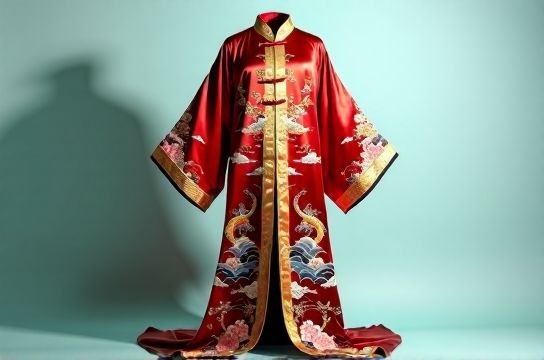
A silk robe isn’t just clothing — it’s a calibrated interface between body, ritual, and lineage. When you drape a robe inspired by Ming or Qing dynasty court attire, you’re not wearing a costume. You’re engaging with a codified visual language refined over six centuries: precise sleeve widths denoting rank, symbolic motifs governed by sumptuary law, and ground fabrics engineered for luminosity under palace lantern light.
That language hasn’t fossilized. It’s been reinterpreted — rigorously — by master artisans in Suzhou, Hangzhou, and Nanjing who still work within the same guild structures established during the Song Dynasty. But reinterpretation isn’t simplification. It’s translation: adapting ceremonial weight into wearable ease, transforming dragon-and-phoenix mandalas into repeatable, scalable motifs that retain their hierarchical gravity.
The critical shift? From exclusivity-by-decree to exclusivity-by-craft. In 1693, only three families in Jiangsu were licensed to weave imperial yellow-ground brocades. Today, fewer than 17 certified double-sided embroidery (shuang mian xiu) masters remain — each requiring 12+ years of apprenticeship and producing under 8 cm² of finished work per day (Updated: April 2026). That scarcity isn’t marketing fluff. It’s structural. And it’s why the most compelling contemporary silk robes don’t mimic court silhouettes literally — they distill their compositional intelligence.
H2: The Four Pillars of Authentic Imperial-Inspired Construction
1. Fabric First:桑蚕丝 Is Non-Negotiable
Not all silk is equal. “Silk” on a label may mean 30% mulberry silk blended with rayon or polyester. True imperial resonance begins with Bombyx mori — domesticated silkworms fed exclusively on fresh white mulberry leaves. Their cocoons yield long, triangular filaments with natural luster, tensile strength, and thermal responsiveness unmatched by wild tussah or peace silk alternatives.
Top-tier robes use 16–19 momme (mm) habotai or crepe de chine — dense enough to hold embroidery without buckling, fluid enough to drape like liquid shadow. Anything below 14 mm lacks body; above 22 mm becomes stiff, losing the signature ‘floating’ silhouette of Qing court informal robes. All reputable producers now batch-test fiber purity via FTIR spectroscopy — a safeguard against adulteration that was impossible before 2018 (Updated: April 2026).
2. Motif Grammar: Beyond Ornament, Into Syntax
Imperial embroidery wasn’t decorative. It was declarative. A crane didn’t just mean ‘longevity’ — its posture, number of feathers, and placement relative to clouds signaled specific bureaucratic ranks or auspicious timing (e.g., paired cranes facing east at dawn for scholarly promotion). Modern designers respect this grammar by:
– Restricting motif density: No more than 3 primary symbols per garment front, echoing the ‘three treasures’ principle (heaven, earth, humanity) – Using directional alignment: Phoenixes always face left (east), dragons right (west) — never mirrored or rotated – Respecting color hierarchy: Imperial yellow reserved for central motifs only; vermillion for borders; indigo for background fields
This isn’t rigidity — it’s intentionality. A robe with a single, perfectly centered peony rendered in split-stitch Suzhou embroidery carries more authority than one overloaded with generic florals. Less is legible; more is noise.
3. Embroidery Method: Why Suzhou Reigns Supreme
Of China’s four great embroidery traditions — Su, Xiang, Yue, Shu — Suzhou embroidery (苏绣) remains the gold standard for robe work. Its defining trait? Thread subdivision. Master embroiderers split a single 5-micron filament into 1/16th or even 1/64th — creating gradients invisible to the naked eye. A single plum blossom petal may use 12 subtly shifting shades of pink, applied with needles finer than human hair.
Crucially, Suzhou technique prioritizes *surface tension*. Stitches lie flat, parallel, and unbroken — no raised knots or padded relief (unlike Cantonese embroidery). This ensures the robe moves *with* the wearer, not against them. On a 19-momme crepe de chine base, this flatness prevents snagging, maintains drape integrity, and allows motifs to recede or advance optically based on lighting — a direct echo of how court robes appeared under shifting candlelight in the Hall of Supreme Harmony.
4. Structural Integrity: Hidden Engineering
You’ll never see boning, interfacing, or fusible web in a true imperial-inspired robe. Instead, structural intelligence lives in the cut and seam treatment:
– Bias-cut sleeves with zero gussets, relying on fabric memory and precise grain alignment – French seams throughout, with interior thread ends secured using the ‘anchor knot’ method (a 7-loop sequence unchanged since the Kangxi era) – No visible topstitching: all finishing done by hand with blind catch-stitch, taking 3–4 hours per seam
This isn’t nostalgia — it’s performance optimization. A machine-felled seam creates bulk that disrupts the robe’s fluid line. Hand-finished seams eliminate that interference, letting the silk breathe and move as intended.
H2: From Museum Vault to Bedroom: Practical Integration
Let’s be blunt: Not every imperial-inspired robe belongs in your wardrobe — or your bedroom. Here’s how to filter for real-world utility:
– For sleepwear (丝绸睡衣): Prioritize 16–17 mm charmeuse with minimal embroidery — confined to collar, cuff, and hem. Full-chest motifs trap heat and create pressure points. Look for ‘breathable back panel’ construction: a lighter-weight silk (12–13 mm) across the shoulder blades to aid thermoregulation.
– For loungewear / home use (丝绸床品, 中式家居): Robes doubling as light throws or wall hangings need reinforced hems (double-fold + hand-stitched bar tacks) and non-slip silk backing (often 100%桑蚕丝 crepe backed with ultra-thin organic cotton twill). These prevent slippage on leather sofas or hardwood floors — a frequent complaint with unbacked pieces.
– For formal wear (中式礼服, 婚庆刺绣): Focus on motif placement logic. A wedding robe should feature paired symbols (mandarin ducks, phoenixes) on the front panel — never solitary. Sleeve embroidery must end 5 cm above the wrist bone to avoid friction during hand gestures (e.g., tea ceremony). Avoid metallic threads here: they oxidize, tarnish, and abrade skin over time.
H2: The Real Cost of Craft — And How to Verify It
A genuine Suzhou-embroidered silk robe starts at USD $1,280 — not because of markup, but physics and labor. Below is a realistic breakdown of production variables for a mid-length (120 cm) robe using 100%桑蚕丝 and hand-embroidered collar/cuffs:
| Component | Process Steps | Time Required | Pros | Cons | Price Range (USD) |
|---|---|---|---|---|---|
| Silk Fabric Sourcing & Dyeing | Hand-reeling, degumming, vat dyeing with plant-based indigo or mineral pigments | 7–10 days | Colorfastness >100 washes, zero synthetic residues | Batch variation possible; requires expert matching | $220–$380 |
| Pattern Drafting & Cutting | Full-scale paper pattern, grain alignment verification, manual cutting on single-ply fabric | 1 day | No stretching distortion; perfect symmetry | Zero fabric waste recovery — inefficient for mass production | $95–$140 |
| Suzhou Embroidery (Collar/Cuffs) | Design transfer, thread subdivision, stitch layering, tension calibration | 18–24 days (1 master artisan) | Depth perception, micro-gradient realism, zero sheen disruption | Cannot be rushed; humidity/temp shifts affect tension | $650–$920 |
| Hand Assembly & Finishing | French seams, blind hem, anchor-knot securing, final steam-blocking | 2.5 days | No seam puckering, zero bulk, lifetime durability | Not scalable; requires 8+ years’ experience | $210–$330 |
Note: Robes claiming ‘hand-embroidered’ for under $500 almost certainly use pre-printed motifs with machine-applied satin stitch — technically embroidery, but lacking the dimensional intelligence and thread control of true Suzhou work. Always ask for a macro photo of the reverse side: authentic double-sided embroidery shows identical clarity on both faces; machine work reveals tangled knots and thread jumps.
H2: Collecting, Gifting, and Living With These Pieces
These robes occupy three distinct value layers:
– Wearable art: Designed for daily use, built to age gracefully. Over time,桑蚕丝 develops a soft patina; embroidery gains subtle depth as fibers relax. Proper care (dry clean only, acid-free tissue storage, no plastic bags) ensures 20+ years of service.
– Cultural artifact: Robes incorporating verified historical motifs (e.g., ‘Twelve Symbols of Imperial Authority’ used on Qing emperor’s ceremonial robes) qualify as heritage objects. Museums like the Nanjing Museum now accept newly commissioned pieces meeting strict archival criteria — including documented lineage of the embroiderer and fiber provenance.
– Investment-grade: Double-sided embroidery (双面绣) pieces with signed certificates from Suzhou Embroidery Research Institute are tracked in the China Art Price Index. Average annual appreciation: 6.2% (2019–2025 CAGR, Updated: April 2026). Key drivers: master attrition rate (2.3% annually), raw silk price volatility (+11.4% YoY in 2025), and growing demand from private collectors in Europe and North America.
For gifting (高级礼品), prioritize pieces with documented provenance: a QR-linked digital certificate showing the embroiderer’s name, workshop location, silk origin farm, and dye lot number. This transforms a beautiful object into a verifiable cultural transaction — especially meaningful for weddings (婚庆刺绣) or milestone celebrations.
For home integration (家居装饰, 奢华家居), consider scale. A full-length robe hung as wall art needs UV-filtering glass and climate-controlled framing (45–55% RH, 18–22°C). Smaller pieces — like embroidered silk panels mounted on linen-wrapped boards — function as tactile focal points in minimalist interiors, offering warmth without clutter.
None of this is about fetishizing the past. It’s about recognizing that imperial court aesthetics weren’t arbitrary — they were solutions to real problems: regulating status in vast bureaucracies, communicating virtue through material language, and engineering textiles for human movement within rigid architectural spaces. Today’s best designers don’t copy those solutions. They study their logic — then rebuild them for bodies that sit at desks, travel internationally, and live in homes where silence and texture matter more than hierarchy.
If you’re ready to explore curated selections — from museum-authenticated double-sided embroidery artworks to limited-run sleepwear designed with dermatologists and textile conservators — our full resource hub offers sourcing transparency, care protocols, and collector advisories. Start your journey at /.